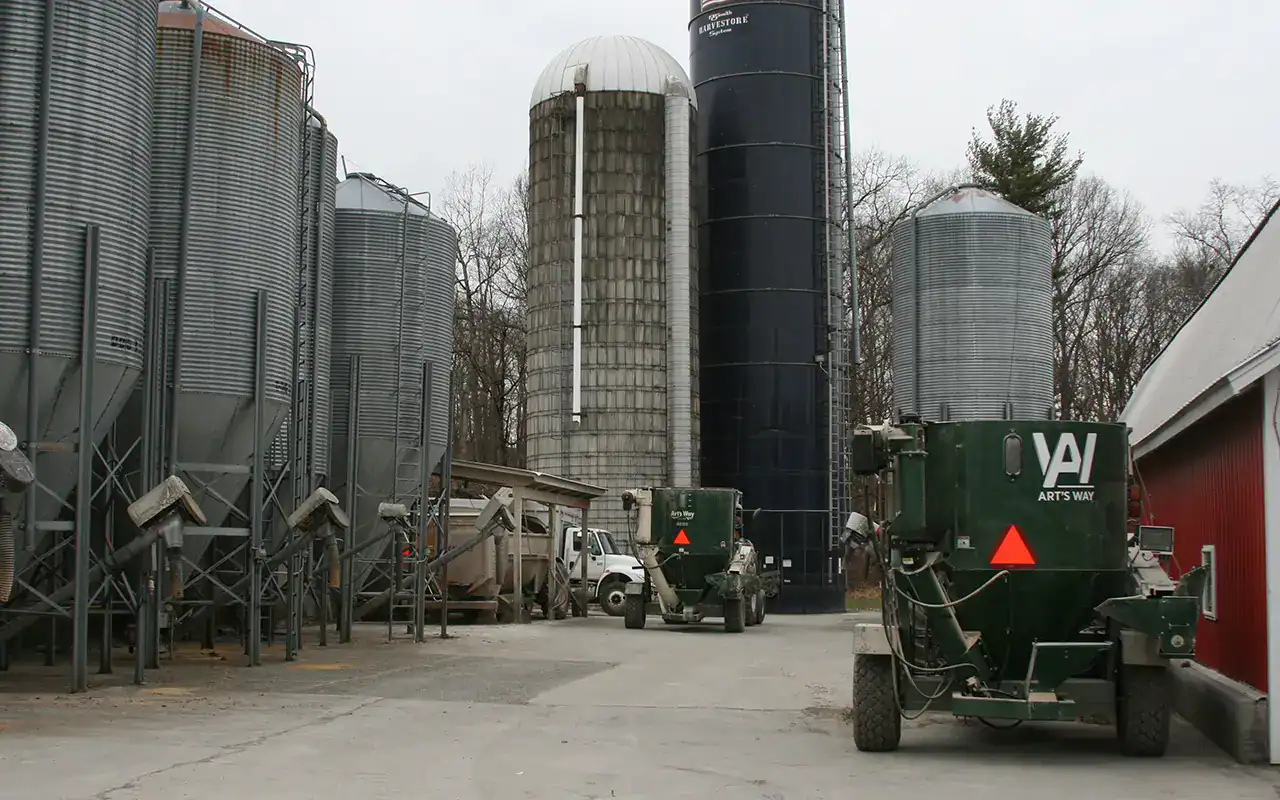
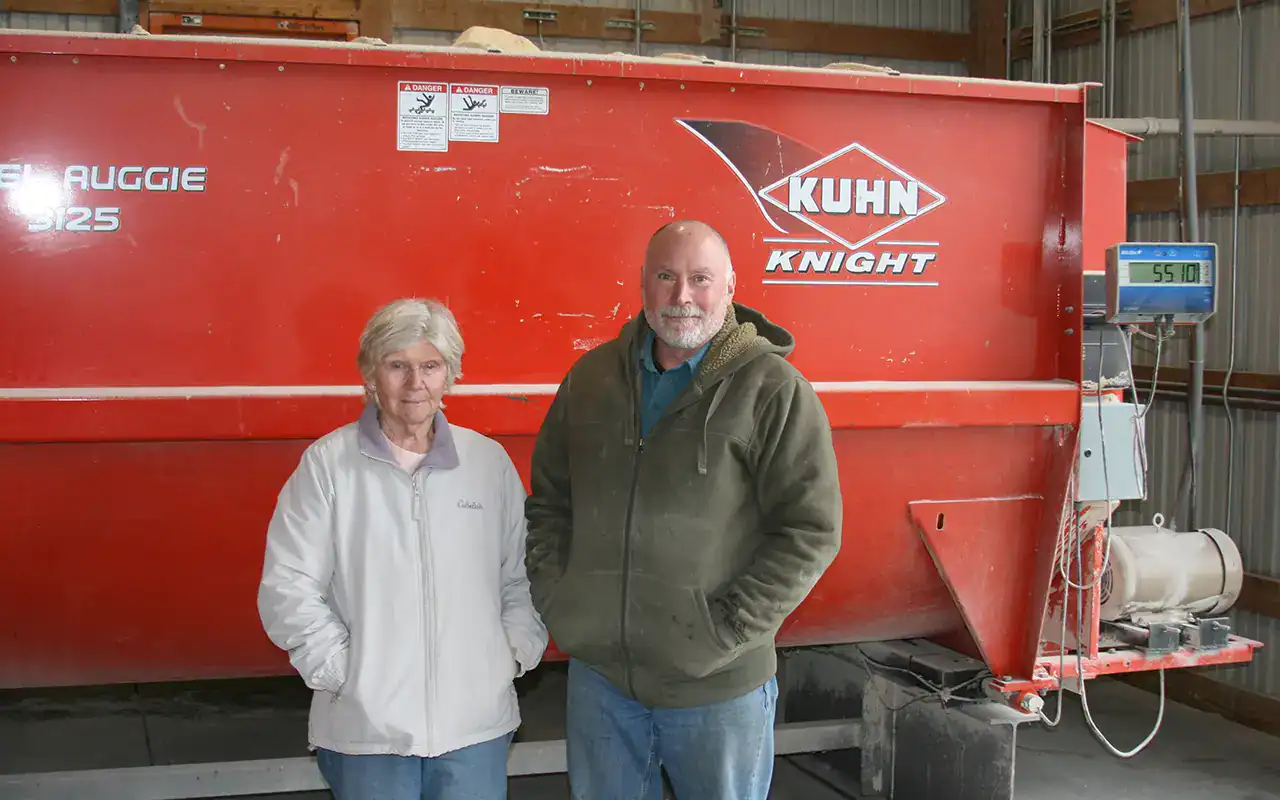
Upon my first visit to the Bruno Farms Custom Feeds operation in Ghent, NY, it didn’t take long for the realization to dawn that this was a science project gone full bloom. As it turns out, creating solid nutritional support for animals is also a bit of an art.
In the beginning…
From 1960 to “the night we sold our cows in November 1994,” said Lois Bruno, she and her husband, Vince, operated an 85-head dairy farm, initially in East Chatham prior to moving to Ghent in 1966. Once the cows were out of the picture, however, the couple “really had no idea what to do next.”
But there was a bridge to the Brunos’ future growing right outside the front door in their fields. “For the previous ten years we had grown a lot of high-moisture corn for the cows, and we would sell what we grew beyond what we needed for our own use to Blue Seal as a cash crop,” said Steve, Lois and Vincent’s son. “When the cows went, we said let’s see if we can sell corn directly to consumers instead of selling to a manufacturer. We can grind corn and sell it directly to other farms, which became, ‘Can you make this?’ or ‘Can you make that?’”
Time out. High-moisture corn?
Explained Steve, “If I store corn now it has to be below fifteen percent moisture, or it’ll split. But if you put wet corn in wetter in a sealed environment, you get anaerobic fermentation, making basically chunky-style bourbon. What you’re left with is of higher protein and better flavor.”
“What we found when we very first started,” said Lois, “was we grew a lot of corn for the cows. And then we found out, okay, Vince went out to plant corn and somebody called for feed, but you couldn’t do two things at one time. One or the other had to go and the grain business was picking up, so as it picked up, the planting went down.”
The conundrum: grow or buy?
At one time, the Brunos grew 500-600 acres of corn, and “in essence it would take the entire month of May” to get it planted, Steve added. “That doesn’t leave you time to make feed and deliver feed, too. We had to make a decision. If what you’re making money with is grinding and delivering feed, you can’t tell them, wait ‘til next month. The other reality was, weather is fickle, and you can do everything right and plant all the corn, but if it’s can be too wet or too dry, the yield stinks. Many years it was cheaper to buy corn than to grow it.”
Another advantage to purchasing the corn, he noted, is that you can call a supplier and place an order, knowing exactly what it is going to cost. “I can spend all the money on planting crops, but you don’t really know what it’s going to cost you for the corn until you see what you actually get as a yield at the end of the year. Everything’s a crapshoot. This year, for instance, we’re watching the price of fertilizer go through the roof.”
Be the best at what you do
Let’s pause for a word on the patriarch of this operation, Vincent Bruno, poached from his obituary following his January 10, 2021 death: “Vincent lived his life with the motto ‘if you are going to do something – be the best at it.’ His dairy farm was perennially ranked one of the top in the state, and at one point his cows produced the third-highest herd average in the nation. The farm was converted to Bruno Farms Custom Feeds in 1995; his son Stephen and grandchildren worked by his side. Vincent always greeted friends and customers alike with quick wit, a hearty laugh, and a twinkle in his eye. Vincent was blessed to wake up every day to work at something he loved.”
What they produce and sell
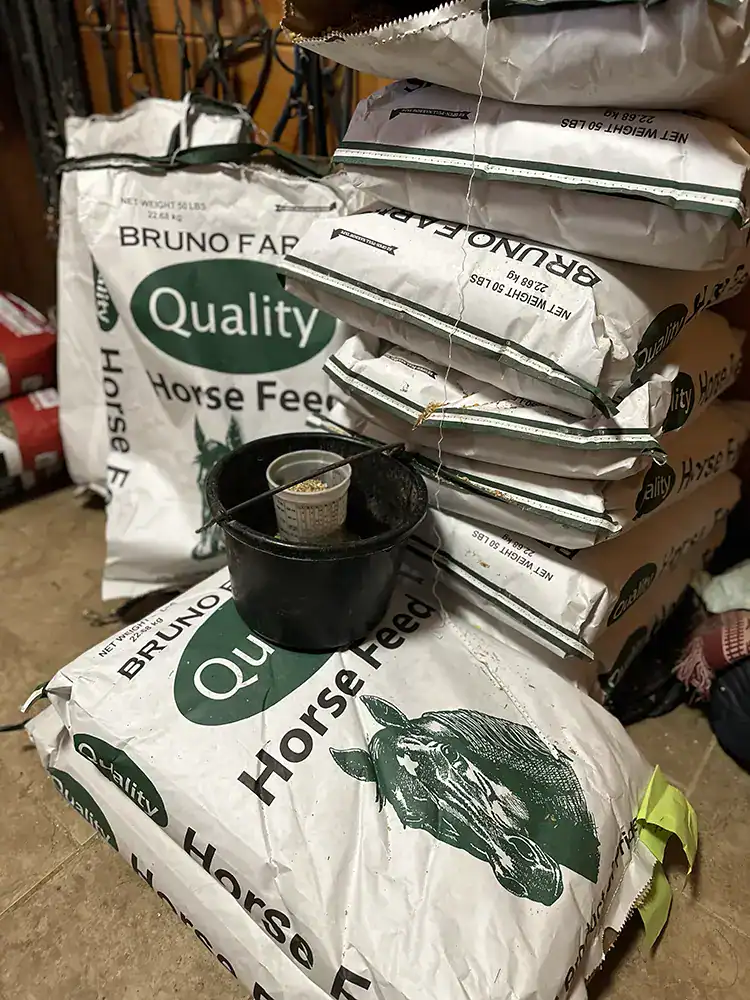
Steve emphasized that these days, Bruno Farms Custom Feeds “only grows corn. What we manufacture is pretty much a full line of standard agricultural feeds.” That would include whole or cracked corn, corn meal, whole oats, whole soybean meal, calf feeds, beef feeds, layer mash, broiler mash, chick starter, turkey feed, scratch feed, and more. What they do not manufacture is pet feed.
Over the course of time, said Steve, the list has “changed and developed. You make some products that sell really well for a while and then go out of favor. Markets change, things change, then you get to the point where you don’t sell enough to warrant making it.”
Bruno Farms Custom Feeds delivers much of what it makes, but “we also deliver custom mixes,” said Lois. In fact, Steve added, “anything we deliver bulk is made to order, a custom blend. We don’t have any complete feeds sitting around.”
When the COVID-19 pandemic insinuated its way into our lives in March 2020, and “everybody thought they couldn’t go to the grocery store,” Lois said, “everybody figured they better have a chicken. Then we sold more layer mash than anything.” But even now, Bruno Custom Feeds continues to sell “around eight tons of layer mash in a week.”
A cow isn't a pig; a pig isn't a chicken; a chicken isn't a horse.
“To do this job, you have to be knowledgeable in everything,” said Steve, a graduate of the Culinary Institute of America. “I don’t have a degree in nutrition, but I had to take a bunch of nutrition classes. You have to be constantly aware of it – I get people all the time asking for ‘one feed that’ll feed everything.’ But a cow isn’t a pig, a pig isn’t a chicken, and a chicken isn’t a horse. They don’t eat the same. They don’t have the same dietary needs. You’ve got a bird; a horse, which is a genetic anomaly because their gut is too small for the size of the animal, so they need loads of fiber; you’ve got a pig, which is an entirely different thing; and then you have a cow or a sheep, which has four stomachs. How do you think you can give one feed to four animals?”
You are what you eat
“You are what you eat, and that’s just as true for the animal,” Steve said. “An example. Every single year, people buy piglets, and they think, ‘I’m just going to feed it table scraps and garbage, leftover cake, extras from my garden,’ and they go to the butcher. Because there wasn’t a lot of protein, there’s not a lot of meat but there’s a lot of fat. Every year, I get customers coming and saying they raised a pig last year, but it was really pretty lousy and if they’re going to do it again, they plan to come buy from me this time.”
“You have to be aware there are some significant incompatibilities, as in, with horses you put extra copper in their diets, but copper is extremely bad for sheep, so you can’t make sheep feed after you make horse feed and instead make a couple batches of something else before making sheep feed. There are some medicated feeds we make that contain an ingredient that is extremely toxic to horses. Again, if I make any of these, I have to make several batches of something else first to make sure there’s no residue left because I don’t want to get somebody’s horses sick.”
Food safety
When the Food Safety Modernization Act was signed into law in 2011, with its goal of ensuring the safety of the United States’ food supply by shifting the focus to preventing its contamination, the law applied to human food as well as to animal food, up to and including pets. Steve would subsequently attend a weeklong session at Cornell to become certified.
“Then,” said Lois, “someone came to inspect us. We’d never had that before. I was nervous, but we passed with flying colors. The guy documented everything. He couldn’t get over how clean it was.”
Because of FMSA, Steve noted that they now keep records of every single load of feed they make: “If it goes in a truck, it’s which truck, what day, whether it was medicated, where it went, what it was. Every single bag of feed is recorded with the date, what time of day we bagged it, whether it was medicated.”
FMSA, according to both Steve and Lois, has been useful. When a question might arise over a certain feed, said Steve, “I can look back in my records and say, this is what I made before it and what I made after it. The other thing is, we’re meticulous about mycotoxins. We send a sample of every single load to Cornell to get tested. That protects the customers, and it protects me.”
It’s no longer cows, and now it’s grain, but the groundwork laid by Vincent Bruno 60-plus years ago has lived on into the next generation, transformed into a first-class business that benefits agricultural animals all around us. •
Bruno Farms Custom Feeds is located at 217 Gilligan Rd. in Hudson, NY. Call (518) 828-5807 or find them on Facebook.