This Month’s Featured Article
Soul Class
As of this writing, stock futures in the Far East are skittish. Nvidia, SpaceX, and eagerly-anticipated IPOs from Anthropic and Open AI have sparked a bull market like we haven’t seen since the late 1990s, but suddenly, unexpectedly, last night, they stumbled. Although analysts are not warning of market vulnerabilities like we saw 30 years ago, “unnerving” is the word of the day on Wall Street.
On the heels of Artificial Intelligence-laden graduation speeches that audiences met with full-throated boos, this moment lends some financial gravitas to the emotional backlash against AI. In its purest version, the question is, “What should the future of work be?” While the 21st century represented a shift toward a knowledge economy and the diminishment (both in estimation and in proliferation) of the trades, thanks to large language models, the 22nd century may witness the end of many knowledge-based jobs and a return to site-based work that can only be performed by skillful human hands.
Hands-on at Housy
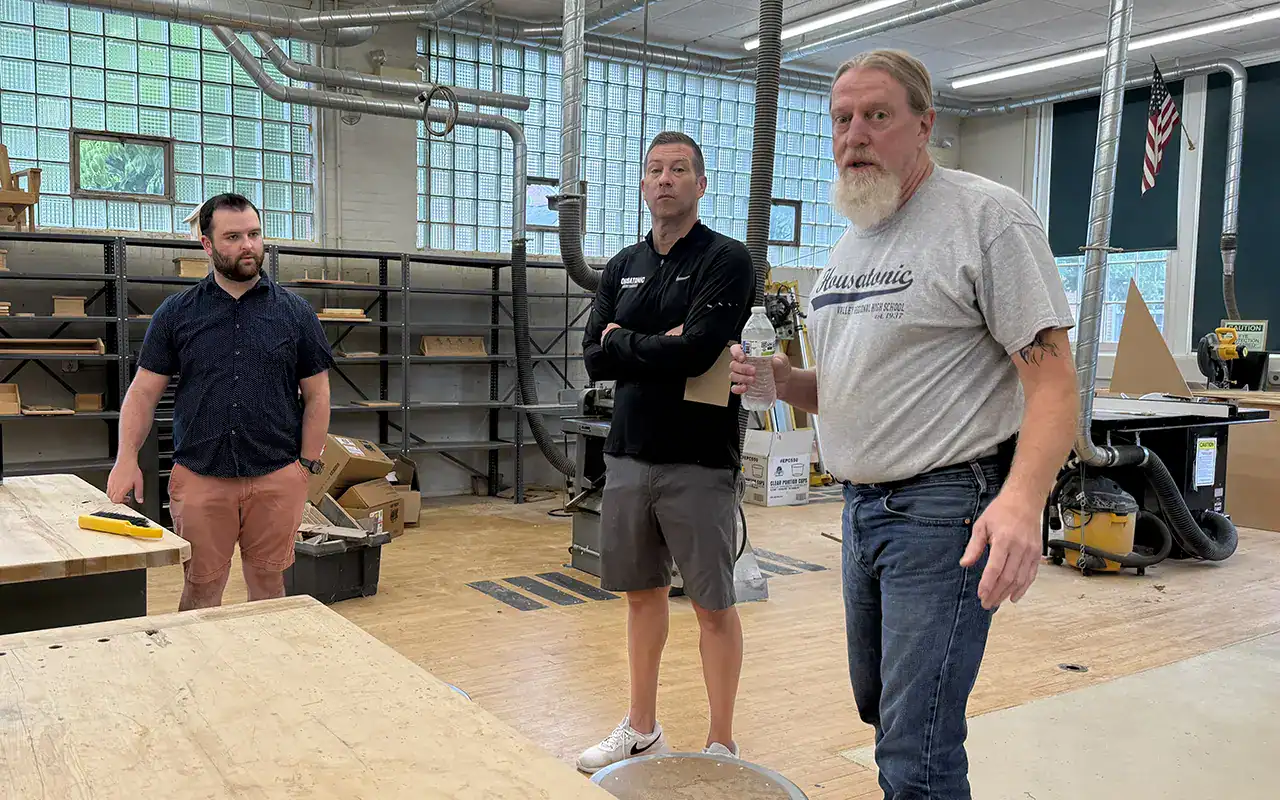
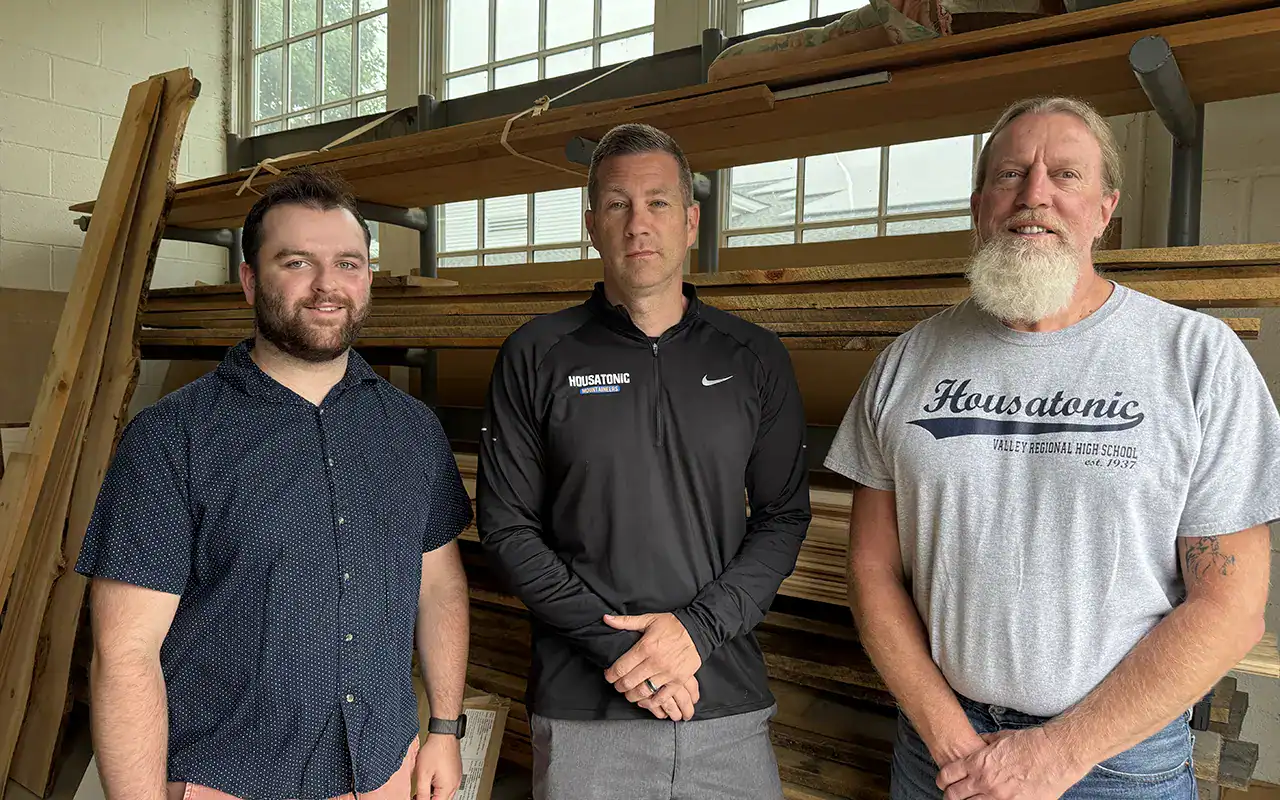
At Housatonic Valley Regional High School, preparation in those skills is expanding, thanks to the hiring of two new technical education teachers. Donald Crossman, formerly of The Gilbert School, and Luke Vermilyea, formerly of Griswold High School, will inherit the program from long-time woodshop teacher, Paul Padua, who, for an astounding forty-seven years, guided students from the basics of shop safety through self-designed woodworking projects.
Over the years, the school has had as many as three tech ed teachers who led courses in subjects including black and white photography, graphics production, and metals.
Crossman and Vermilyea will bring their experience in computer-aided design, additive (think 3D printing) and subtractive (think CNC tooling and plasma cutting) manufacturing, robotics, and other contemporary production processes to HVRHS this fall. While their classes for the coming year will consist of the existing woods, metals, and graphics curricula, they are beginning to retool for the future as the school undertakes a curriculum-writing process across the building. Their revised courses will complement the farm-to-table and ceramics classes in other departments, both of which have been immensely popular in their first few years of existence, largely due to their hands-on, product-based learning model. With fundraising help from local group, All Falls Village, the school is updating machinery that will provide students with training in fundamental shop practices as well as contemporary operations.
Career pathways
This shift aligns with a renewed push from state officials to promote school-to-career pathways. While HVRHS has always featured agriculture, food, and natural resource instruction through its agriscience program, Connecticut has identified eleven other “career clusters” that align with the state’s industry and occupation forecasts. The tech ed program most closely aligns with the state’s architecture and construction, manufacturing, and STEM priorities, all of which are further subdivided into “career pathways” such as “design/pre-construction” and “manufacturing production.” These pathways involve advanced courses that are certified through the state’s university system and credentials that can be earned by students as industry-recognized certifications in areas like OSHA-10 or Autodesk (CAD software).
Although these efforts are intended to provide a pipeline from schools to workplaces, there is no shortage of arguments for the involvement of meaningful, hands-on learning in the education of all students.
Stochastic work
Matthew Crawford, author of Shopcraft as Soulcraft, left a position as the executive director of a science and public policy think tank to open a motorcycle repair shop, where he regularly found himself involved with more authentic problem solving than he did in some purely academic settings. Crawford and others describe this as stochastic work, involving nearly inevitable failures for which algorithms cannot account. There is no anticipating when a screw head will snap off in an old carburetor, and only a veteran woodworker will best know how to incorporate a leftover piece of chinkapin oak in an upcoming restoration project. Experienced hands will sense how much pressure is too much on a belt sander or what five Newton-meters feels like when tightening a hose clamp. And in the field, when tools and replacement parts may be limited, creative problem-solvers often improvise as well as Broadway actors to get a job done.
Nordic countries have recognized the value of stochastic work for over a century. The Swedish word, slöjd, which translates as “crafts,” “handicraft,” or “handiwork,” refers to a part of the school curriculum that is compulsory in Finland, Sweden, Denmark, and Norway. So whether you are headed to university or a trade, everyone has an appreciation for both hand-making as a trade and as a way of thinking. A key proponent of the movement, Otto Salomon, put it best: “Slöyd, properly taught, will be found to supply an educational value not furnished by the subjects usually taught in schools, and in that sense, we regard its introduction as necessary.”
What learning ought to be
But what, exactly, is that educational value? In the poetic language of George Ricks’ 1892 preface to S. Barter’s Woodwork: The English Sloyd, “Manual training is a development of the manual and visual activities of the child, having for its purpose to quicken and develop the mental powers of observation, attention, and accuracy; to cultivate the moral faculties of order and neatness, perseverance, and self-reliance; to awaken and train the artistic faculties and direct the child’s instincts towards the beautiful and true; to satisfy and cultivate the child’s instinct for activity and excite pleasure in the acquisition of skill; to provide opportunity for the development and practice of the inventive and constructive faculties; and to afford scope for the imagination.” I’d suggest rereading that passage if you have the time; I can’t imagine a more sublime depiction of what learning ought to be.
Flow state
While the reader might object to the use of a quotation from over 130 years ago in an article about contemporary education, this writer would suggest that: a) what goes around in education definitely comes around, and b) recent research and practice are not so divorced from Ricks’ lofty description. His words perfectly describe a “flow state” that is experienced by artists and athletes when they are fully engrossed in their passions.
Renowned Hungarian psychologist Mihaly Csikszentmihályi studied the phenomenon in the 1990s, and research into brain-based learning has linked it to the central role of emotions in intellectual activities. Csikszentmihályi’s seminal work, Flow: The Psychology of Optimal Experience, outlines the characteristics of flow state, which include “concentration on the task at hand,” “loss of self-consciousness,” “transformation of time,” and “immediate and unambiguous feedback.” This last trait is unique to stochastic activities in schools, where the materials themselves and their resulting products can provide a tangible assessment of a student’s success. If your birdhouse didn’t come out right, you were the cause of it, and you can probably trace it back to something you need to learn or practice.
“Work orientation”
Later on in his life, Csikszentmihályi connected flow to autotelic personalities, or people who perform acts for their own intrinsic value and, as a result, find happiness. He coined the term “work orientation” that is characterized by “achievement, endurance, cognitive structure, order, play, and low impulsivity,” and some studies have shown that it is a better predictor of academic success than experience alone. In other words, a person’s ability to find meaning and immerse themselves in work is the key to both academic and personal fulfillment.
A few years ago, a gifted math student at Housatonic took her first shop class in grade 11 and discovered that she also had a talent for welding. The same traits that helped her to focus on advanced calculus problems served her well as she strived to lay down a perfect bead, and while she headed off to explore engineering as a vocation, she took with her a knowledge of the practical challenges that a welder would face on a daily basis. Should she end up designing engineering solutions that need to be executed by a welder, I can imagine her “talking the talk” with that tradesperson, and knowing just what the finished product should look like. More importantly, however, she will bring a level of mutual appreciation and respect to her work that will bridge the divisions that typically characterize relationships between blue-collar and white-collar workers. Shopcraft as soulcraft, indeed. •