This Month’s Featured Article
La Petite Reine: Experiencing the Tour De France
I don’t speak Italian, but I know a few words. Manubrio, for instance, is another word for “handlebar.” Selle means “saddles.” Maglia – as in la maglia rosa – is a jersey, specifically the pink jersey that is awarded to the leader of the Tour of Italy. That tour, really a bike race, is more well known to Italians as the Giro d’Italia or simply, “The Giro,” to true tifosi. You’ve probably noticed a theme.
My French is somewhat better, thanks to scores of French cognates in our language and a degree in English that made me read a lot. But more relevantly, I have spent years – decades – immersed in all things French while following Le Tour, first on borrowed VHS tapes and now online and streaming. It is the soundtrack to my summer mornings, the cœur d’été, and I mourn its ending like a dropped ice cream cone. I am a confessed tifoso.
A different kind of fan
That Italian term for “fan” also applies to football (soccer) and Formula One, but my first exposure to it was in videos of mountaintop finishes in the Tour. Much more than a “fan,” a tifoso has the kind of rabid hysteria that is symptomized by body paint, costumes, and fan clubs. The word describes, for example, Didi Senft, the 74-year-old German who has dressed in a devil’s outfit to prod suffering cyclists with his pitchfork since 1993.
It explains “The Dutch Corner” on turn 7 of the 21 switchbacks on the climb up Alpe d’Huez, where hundreds of Dutch fans cover themselves in both beer and orange body paint to spur on any and all Dutch contestants, regardless of their chances of winning.
It is the reason for the kind of Speedo-sporting, Viking-hat-wearing, flag-as-cape couture that no one bats an eye at when the wearer sprints up a hill alongside a climbing cyclist – un grimpeur – exhorting him at the top of his lungs, the tifoso turning red-faced and foaming at the lips.
A lifelong dream come true
It’s also the justification for saving my vacation days and several paychecks to be able to see it all in person.
Thirty years ago, my relationship with cycling began with a trip from San Francisco to Washington, DC, and it has evolved to incorporate all kinds of bikes and bike riding, though none of it in Europe. As legendary television commentator Phil Liggett waxes poetic over helicopter shots of such mellifluous-sounding destinations as the Col de Croix de Fer or the Col du Galibier, I have dreamt of soaring down miles-long descents between the sentinels of the Alps. I also realized that the window of opportunity to be able to climb to the tops of those descents was closing. This would be the summer.
Not knowing exactly how to connect all of these cols (the French word for a mountain pass), I signed on with touring group, Sportive Breaks, to follow the last week of the tour, which, this year, would feature some of the most epic and masochistic climbing stages in it history: two back-to-back days on the Mecca of cycling, the Alpe d’Huez, including a penultimate stage with three hors categorie (beyond categorization) climbs.
The tifosi tribe
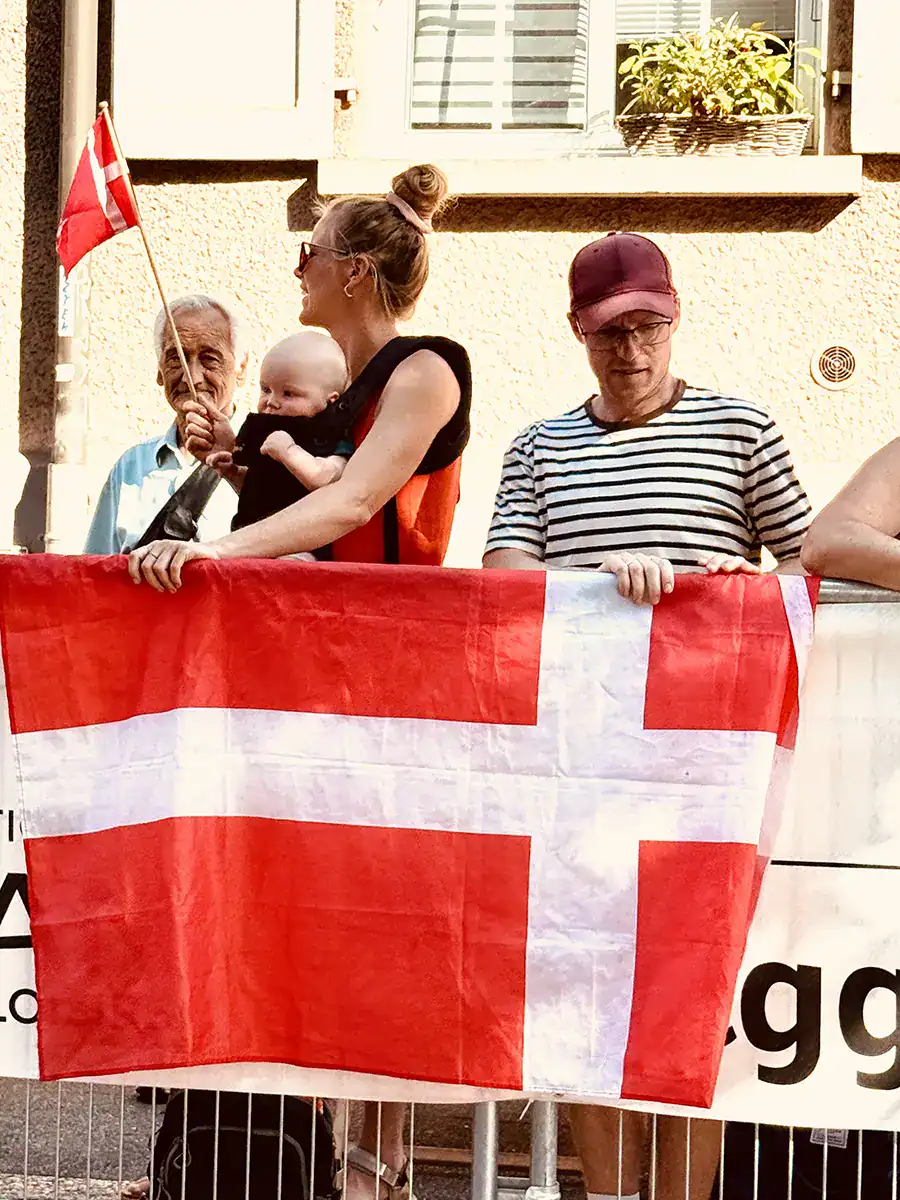
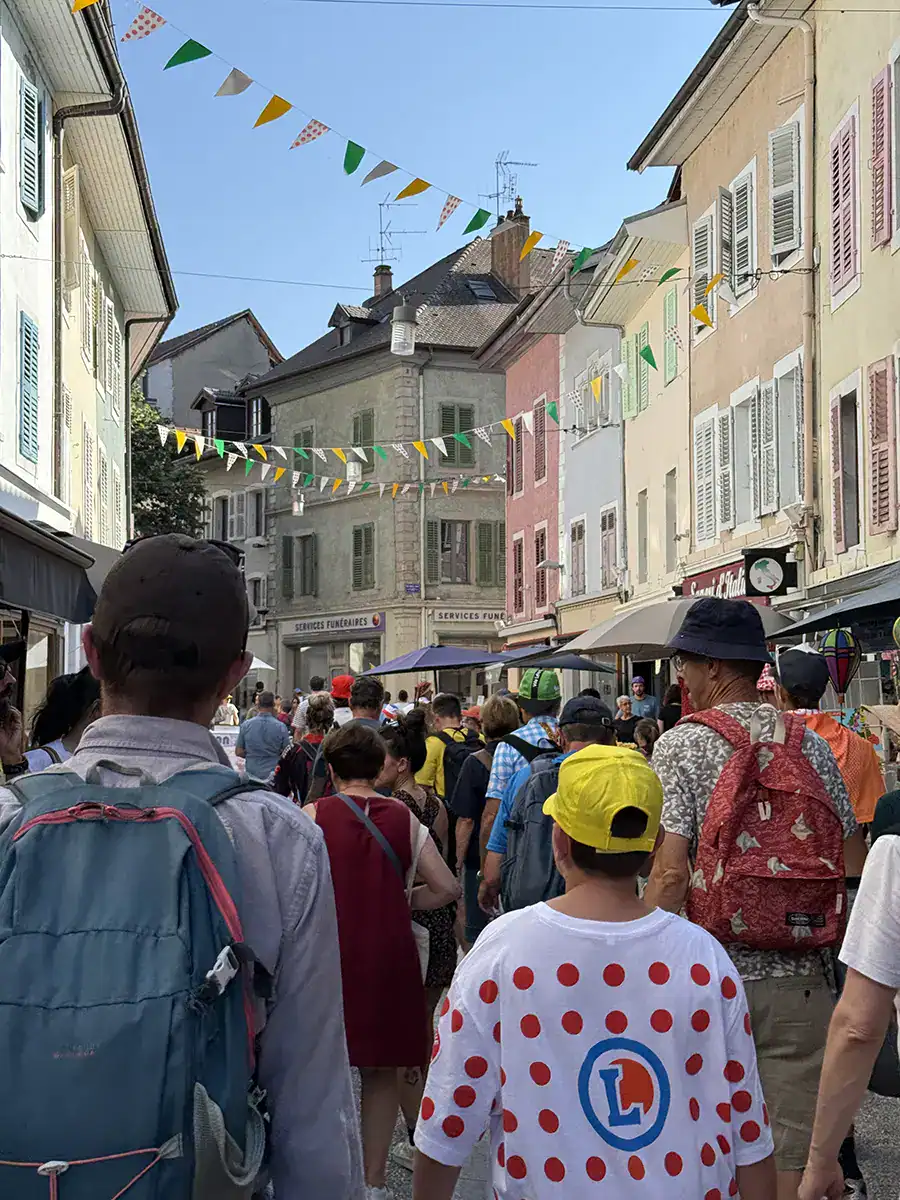
There is something – je ne se qua – about the Tour that attracts fans of all stripes. While my tribe is tifosi, the mass of humanity that comprises the 10-15 million roadside spectators must, of necessity, represent everyone from the impatient seven-year-old to the septuagenarian couple that encamps by a stream, as they do every year. It is the Germans swilling beer in the sun on an unremarkable section of road and the Columbians who will futilely cheer on Egan Bernal, the 2019 winner who is now past his prime. It is the mother and son from California who joined my cycling tour, just for the spectacle of it.
A traveling circus
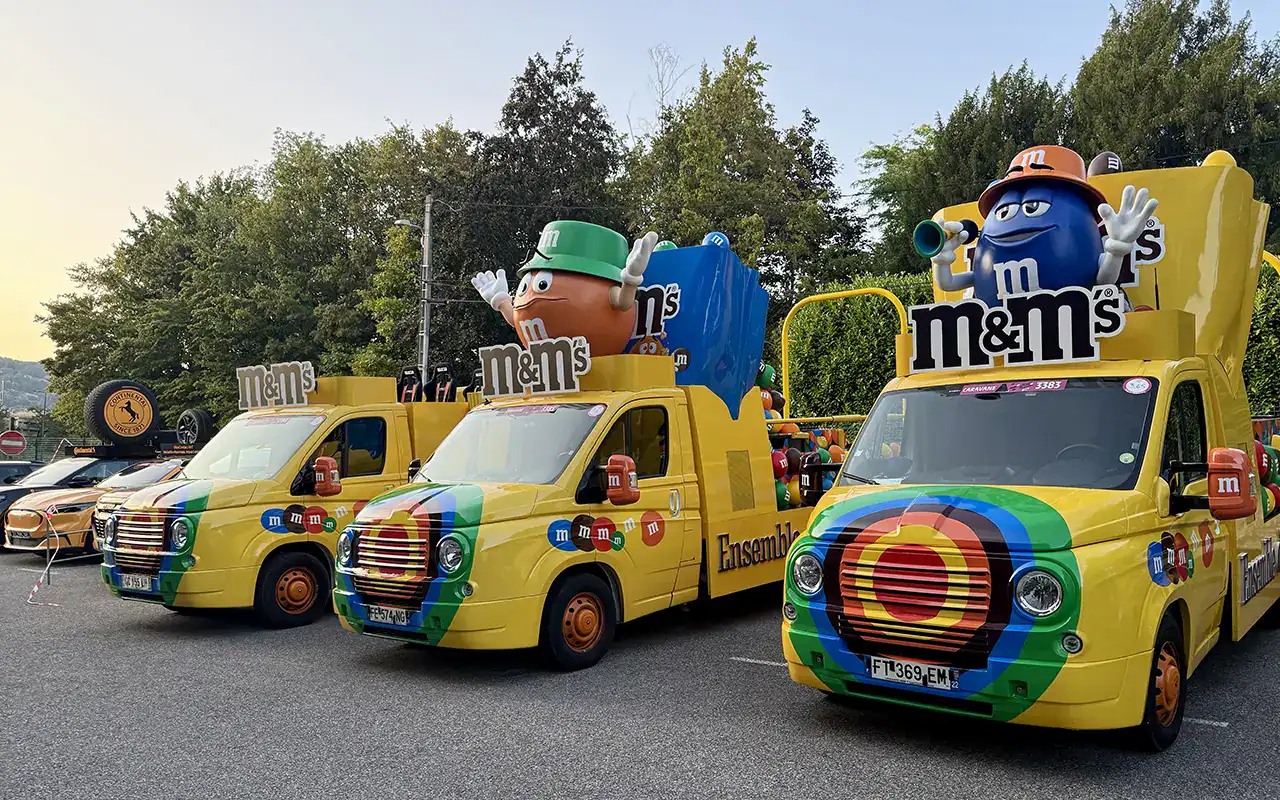
And a spectacle it is. The six-year-old (or the six-year-old in anyone) will be tantalized by the caravan that comes before the race itself. It is a traveling circus that serves to pump up the crowd with chants and sing-alongs to ABBA and Queen while jettisoning countless gratis detritus to promote the Tour’s sponsors: bucket hats, wristbands, neck gaiters, cans of Orangina, bags of M&Ms, branded shopping bags, and so forth. It is 20 minutes of hype that precedes another 20 minutes of VIP cars, police motorcycles, and the helicopters that signal the approach of the riders.
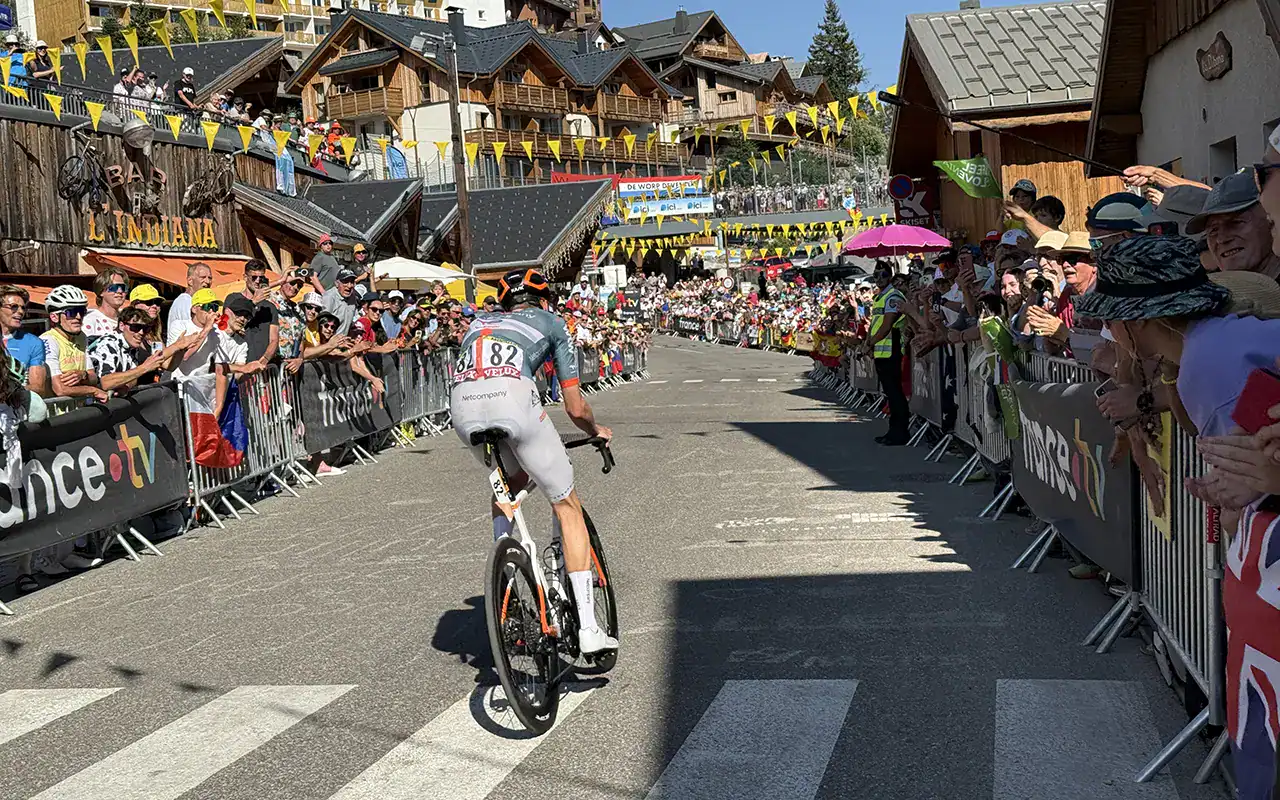
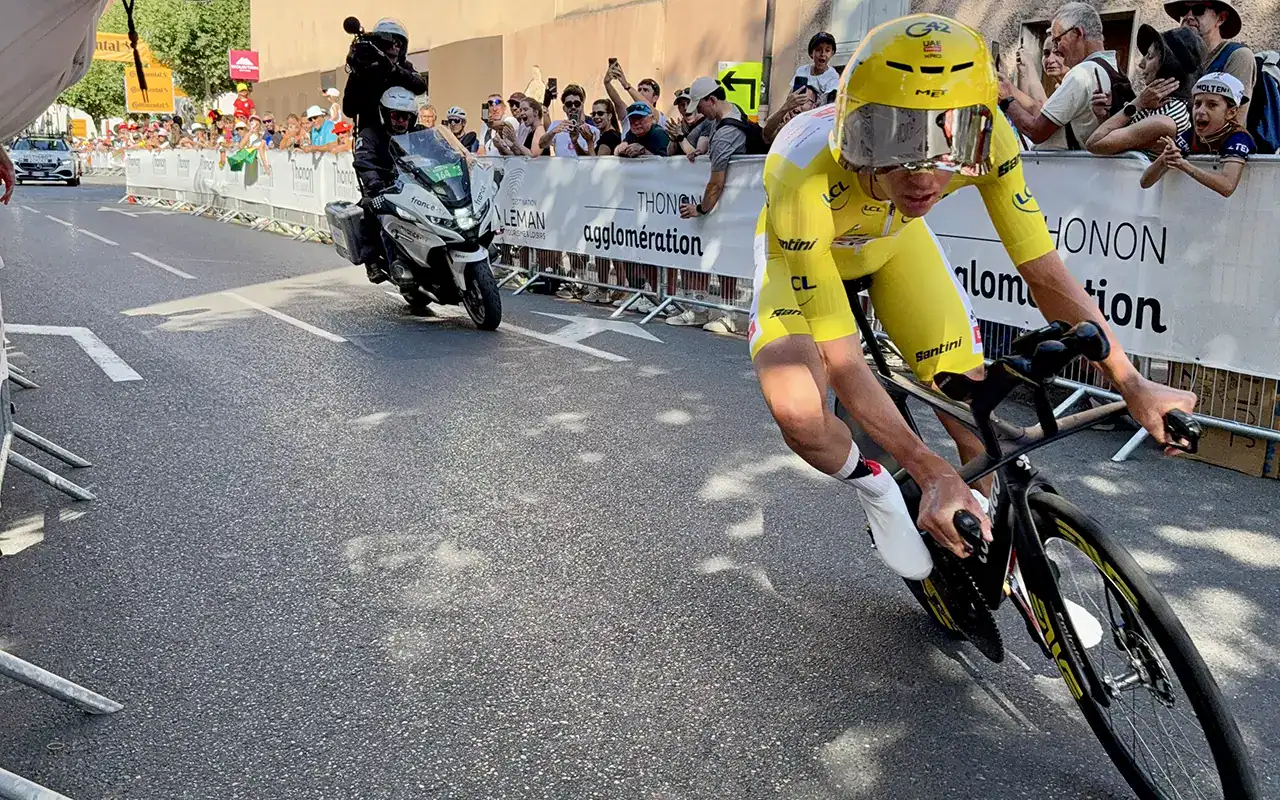
For this, one needs to be prepared. The race director’s red Land Rover will zip past (yellow plates, mind you), then a motorcycle with flashing lights, and finally the racers themselves. Depending on the stage and your location, this can last anywhere from three seconds to possibly ten minutes, but the leaders will always be gone in the blink of an eye. I watched portions of five stages in person, and if I added up the time directly viewing the peloton in its entirety, it might be five minutes. In other words, if you’re going to watch a bike race, you’re going for the wrong reason. The likelihood that the action will take place where you happen to be standing is slim to none.
The bar analysis
I learned this on the penultimate stage when thunderstorms threatened to strand me on Alpe d’Huez overnight and I opted instead to watch the action with dozens of fans at a bar in Vaujany, where we cheered on American Sepp Kuss by the edges of our seats, enjoying helicopter footage, close-up moto coverage, and replays of the two unfortunate crashes that cost him the stage. You will get none of this in person unless you position yourself near an outdoor screen, which are few and far between.
What you will get among the tifosi at any French bar is second-to-second assessments of the race through tour tracker apps, conjectures about who will win, recollections of race events from the past, and spirited encouragement of whichever rider is the favorite of that particular crowd. If you are a devoted fan of bike racing, this is where your tribe congregates.
Feeling like part of The Tour
There and on a bike. For five days, I rode portions of stages or rides near them that were open to the public. Reader, they were breathtaking. The moderate climb up the Col d’Ornon rewarded me with the stuff (my) dreams are made of: fast, twisting descents with 100-foot drops to the side and the majesty of the Massif Central in the distance. Another descent off the Col du Chat wound through vineyards and arched around sweeping bends. I have no photos of any of these because they required all of my faculties to navigate, and I was having too much fun to stop.
Alpe d’Huez was another story. It was the only hors categorie climb that I would undertake, and our guide skillfully coached us up for the experience the night before.
“The first 3 kilometers are the hardest,” he explained in a British accent. “If you get past those, it drops down a little below 8 percent gradient in the middle. There’s a kicker around 12 kilometers that goes up to 11.5 percent, but then it levels out around the finish.”
I suppose all that was true, and maybe I felt a slight difference, but this entire climb is incomparable to anything in our area with the possible exception of Mount Greylock, which I had climbed the weekend prior to leaving. It amounts to a little under an hour and a half of suffering, packed into 21 hairpin turns over 14 kilometers at an average gradient of 8 percent. Climbing it gave me a sense of the athleticism required just to finish the hardest of individual climbs. Of course, this was the last of three such climbs on one stage. There are 21 of them.
La petite reine
Once finished, I was content to be more of a spectator, blending in with the crowd at the bottom of the Col de la Croix de Fer the next day to just be one of the tifosi. There is a saying among the French when it comes to bicycles; especially in July, they are called la petite reine or “the little queen.” Traffic stops for her. Roads get rerouted. For three weeks, all eyes turn to her majesty, Le Tour. In small French villages, bike lanes have their own stop lights, and in Lyon and Paris, one can rent a bike at nearly any street corner and get around faster than in most other conveyances. Bikes are respected, appreciated, and incorporated into French life in ways that will probably never happen in most parts of the United States. And for three weeks in July, the French host a worldwide party in their honor that you have to see to believe. •