This Month’s Featured Article
Jane Strong, Co-Founder of The Equus Effect, on the non-profits upcoming annual event and why horses are beneficial for mental health
Due to the nature of their work, military veterans and first responders are significantly more likely to experience higher rates of behavioral health conditions. It was the awareness of this reality that inspired Jane Strong and David Sonatore to found the Sharon-based nonprofit The Equus Effect in 2012.
I caught up with Jane to learn more about the inspiration for The Equus Effect, how horses provide therapeutic support for veterans and first responders, and about this year’s annual event, “Honoring the Year of the Horse,” which will be held on October 3, 2026.
What inspired you to follow this path into the equine field?
I had been a competitive rider when I was much younger but left it all behind when I was 15. I thought that was the end of my story as an equestrian. I couldn’t imagine doing anything but competing, so it came as a real surprise to find another way to engage with horses.
What was your inspiration to begin The Equus Effect?
My inspiration returned in 2002, when I got back on a horse for the first time through a friend who had access to trails in Bedford, NY. My mind was telling me all sorts of things about being rusty, but my body told another story. It said two things: “You already know this,” and, “It’s going to be good for others too.” I was baffled by that second message, but it made me curious to learn more about how to work with horses for the benefit of others.
After about a year, my exploration led me to a book called The Tao of Equus by Linda Kohanov, who runs a school in Tucson called Eponaquest. I soon learned that this was exactly how I could have horses back in my life and actually share the goodness they can bring to the lives of others. Her work centers around ground-based activities and uses practices that help us touch into the many ways our five senses and intuition can tell us about setting healthy boundaries, building authentic relationships, and finding emotional congruence. We forget that. Most of us have lost touch with using non-verbal cues that can tell us a lot about how to respond to the world around us.
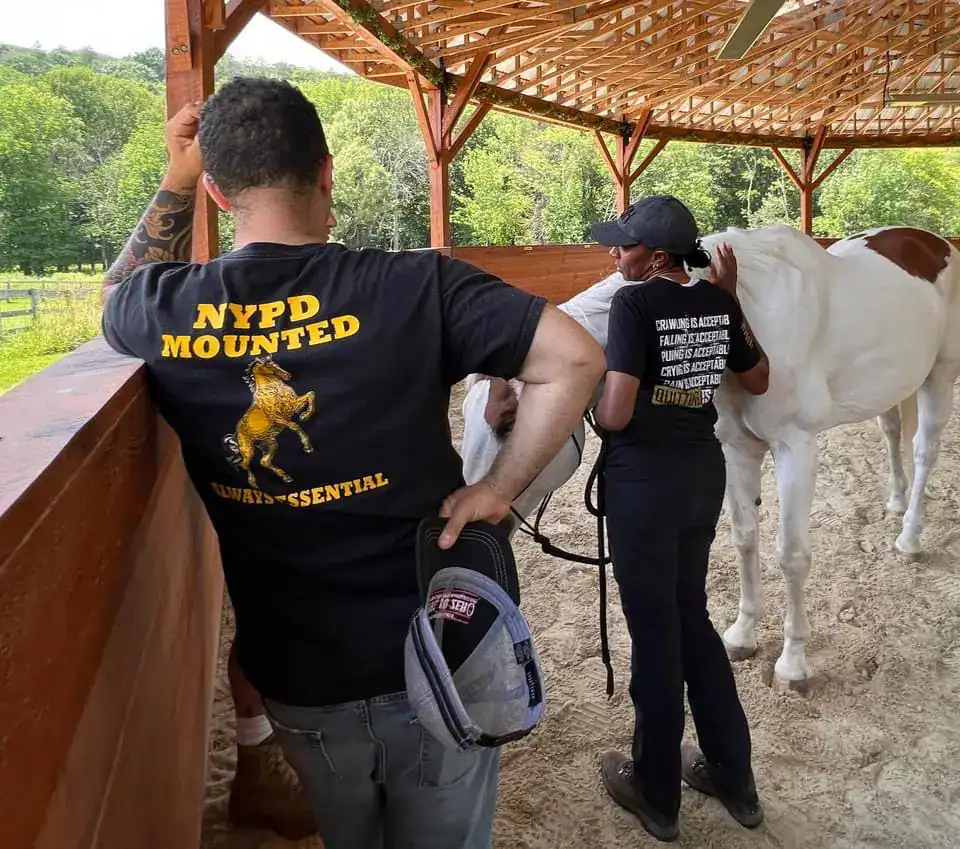
At The Equus Effect, my business partner David Sonatore and I offer practices that show participants how to settle down and use emotions as information, which turns out to be incredibly useful for veterans and first responders. Along with the experiential learning with our horses, we show folks how to respond appropriately to things that scare us or make us sad, feel vulnerable, angry, or frustrated. Horses are excellent at modeling how to take appropriate actions when something upsets us and also how to “go back to grazing” when a situation is over. Veterans and first responders tend to be a bit more inclined to feel threatened than most of us civilians because the stakes are higher for them. As prey animals who are hunted by large predators, horses know that if they make a mistake, they could be someone’s dinner.
What guided the decision to gear The Equus Effect toward veterans and first responders specifically?
In 2008, David and I saw that veterans were taking their lives at the rate of 22 a day. We knew right away that the horses could help. They, like military folks, know that things can change in a moment and can have lightning fast reactions that can save their own and others’ lives. Unlike horses however, when we humans have been through situations that feel dangerous to us either physically and emotionally, we tend to second guess our choices and often feel upset with ourselves over what we did or didn’t do. We knew the horses could help veterans and first responders recognize what they were feeling, what various emotions really mean, and how to let past experiences go. We knew they could help create new neural pathways that could lead to healthier, more productive lives – and we were right. To that end, in 2012 we became a non-profit organization that relies entirely on contributions from generous donors. Now, we’re finding this same approach with the horses works for lots of different kinds of people, but we started out with the types of men and women who were brave, stoic, and resistant to traditional types of mental health treatment. The VA did a research study on our work and found that we do indeed help people regulate their emotions, improve relationships, and feel more grounded and clear about moving forward in life.
What services and programs does The Equus Effect offer?
We offer a 16-hour curriculum that takes place over four four-hour sessions, two weekend days, or sometimes, a longer retreat-style program that takes place over three or four days. We are a multi-component program that includes hands-on work with the horses, an engaging discussion using movie clips to illustrate seven difficult emotions and how to handle them, and some tools and practices to take home. We believe that this way of learning engages the body, the heart, and the mind, all of which are essential to real change.
What is the focus of this year’s event?
2026 is the Year of the Horse, and we plan to celebrate our equine partners by demonstrating the ways in which we’ve written history together throughout our 6,000 year relationship. Until about 120 years ago when cars came along, horses were essential for transportation, agriculture, war, and of course, the pony express. They’ve always helped us “get there faster” with the kind of grace and strength that is unique to them – and before cars, unimaginable to us.
We have some fabulous, talented horses this year who are going to show us what they can do and then, we’re going to show guests how we work to take people to another level of self awareness and authenticity.
What do you hope attendees take away from this event?
Since our first event in 2015, we’ve always tried to entertain and educate, and I think this year is going to be particularly enlightening. I doubt many folks know how the various breeds, sports, and even some of the jobs horses have today came about. They’ll see some real talent out there, and I hope will be intrigued by the horses’ performances.
What do you love most about working with horses?
I guess what I like most is that they’re big, beautiful, social, and honest. They act how they feel and that’s a rare quality these days. I love being outside and watching people learn about how they come across to others, what kinds of old stories the horses help them leave behind, and how quickly people find they can get attuned to the horses’ energy and movements. Participants tell us that they are amazed at how much better they can listen, collaborate, and stay grounded in the face of life’s challenges.
What is most rewarding about working and educating within the equine industry?
I don’t really like to think of it as an industry, although I suppose one might look at it that way. To me, it’s about learning to connect and collaborate with another sentient being who relies entirely on their senses to tell them what is real and what isn’t. We can do the same. I think we just forgot how to take that part of ourselves seriously. It’s a privilege and an honor to learn about finesse instead of force, and I hope more people will come to realize just how much we can learn about ourselves through them.
What’s on the horizon for The Equus Effect?
In the short term, we’re planning to do more work with military and first responder families. We know that living with someone who is trained to put themselves in harm’s way comes at a price, and we want to help families make bridges instead of barriers.
There are about 210,000 911 calls per year in Dutchess County alone. That means folks are going out to calls where they don’t really know exactly what they’re going to meet, but they know it’s probably the worst day of someone else’s life. We also know that many veterans become first responders because of their military training. It makes for people who are ready for anything, but whose nervous systems are often spent. We want to offer these brave men and women some tools to help them as well as their families restore and renew their energy.
We’re also starting some programs for young people and others who are struggling with the distractions and demands at home, work, and school. I think we’ll just keep offering more and more programs – even some for equestrians who would like to have a better connection with their horses. We’d really like to be seen as a resource for the community on many levels. The applications are endless. •
The Equus Effect’s 12th Annual Event will take place on October 3, 2026 from 5-7pm at Highlands Hudson Valley at Keane Stud in Amenia, NY. For more information about the event, the non-profit and its mission, or its upcoming workshops, visit The Equus Effect website: theequuseffect.org.