
Main Street Business
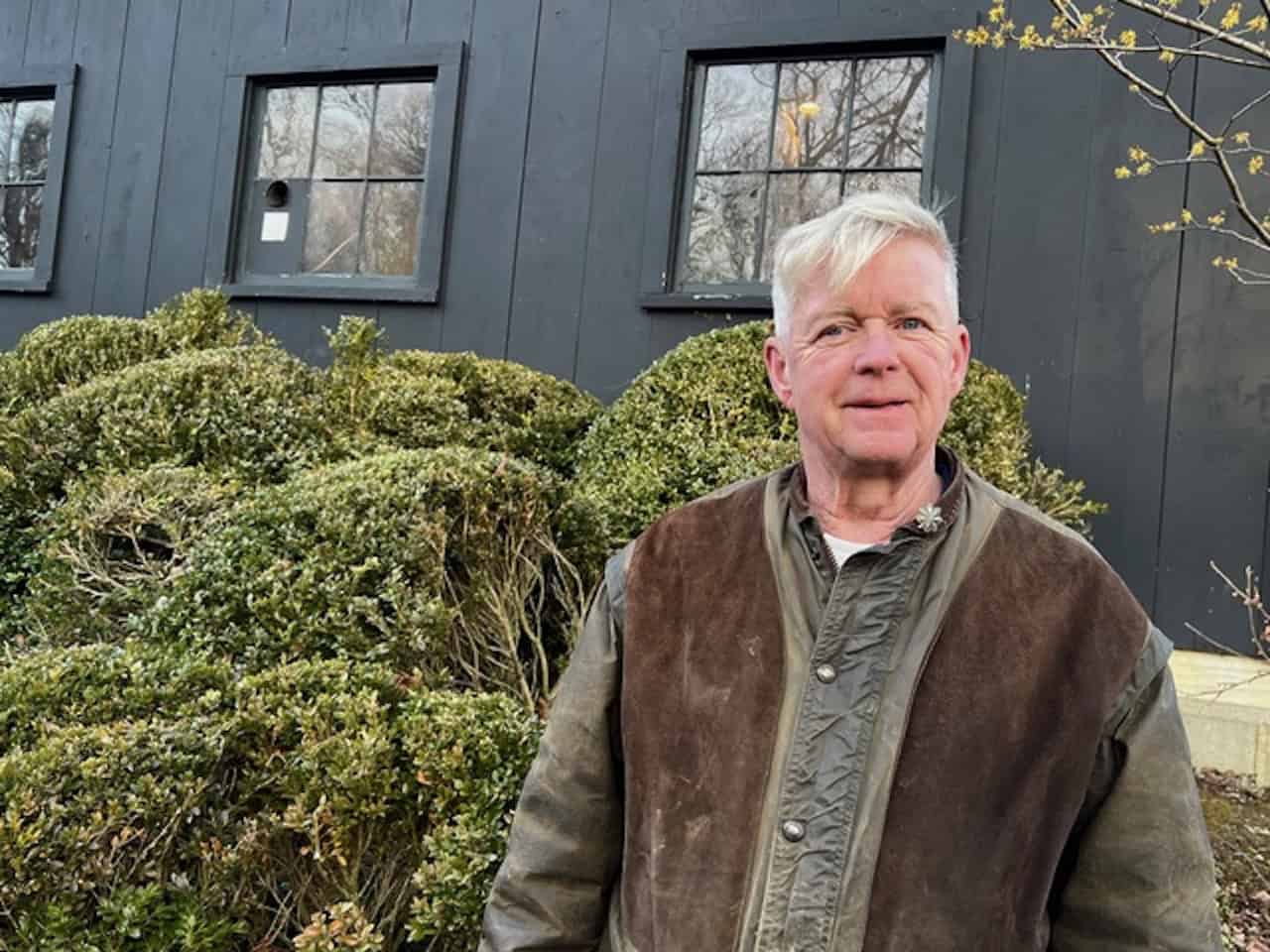
Matthew Larkin of Black Barn Farms and the Chairman of the Berkshire Botanical Gardens: Historic landscape designer & topiary creator
Christine recently caught up with the multi-talented Matthew Larkin of Richmond, Massachusetts. She learned all about Matthew’s Black Barn Farms, his topiary work, as well as his role as the chairman of the Berkshire Botanical Garden.
What’s the Black Barn Farm?
Black Barn Farm specializes in historical garden design and topiary. Our activity centers in this barn, where we make topiary frames, custom furniture, and lighting for our interior design company, Grantlarkin. My design office and library are upstairs. My wife and I needed workspace. In 1997, we found this 1840 barn in Falls Village, CT; disassembled it; and put it back together with some exterior changes to go with the eyebrow window house that we had finished renovating. Back then it was inexpensive to find an old house to fix up that also had acres of land.
You majored in art history at Skidmore and minored in art. How did topiary enter your life?
A friend of ours had become the executive director of the Green Animals Topiary Garden in Rhode Island and invited us to come up to visit. The living animal sculptures captivated me, and I decided to learn about topiary art. I also realized there was no place to purchase large scale topiaries, and I’ve always enjoyed being outside and making things. Today 35 years later, topiary has taken over our property.
The garden was initially laid out with a 100-foot allée of Donald Wyman crabapples that creates the “spine” of the garden. It terminates in a gate that leads to the pool garden and a bronze fountain. Two other gates form an axially symmetrical cross that leads in two directions, one to the topiary yard, and the other, through the pavilion to a beech tunnel and maze. It’s a private garden for our enjoyment although sometimes we open it for a garden conservation tour. Topiary has become my passion.
How do you define topiary?
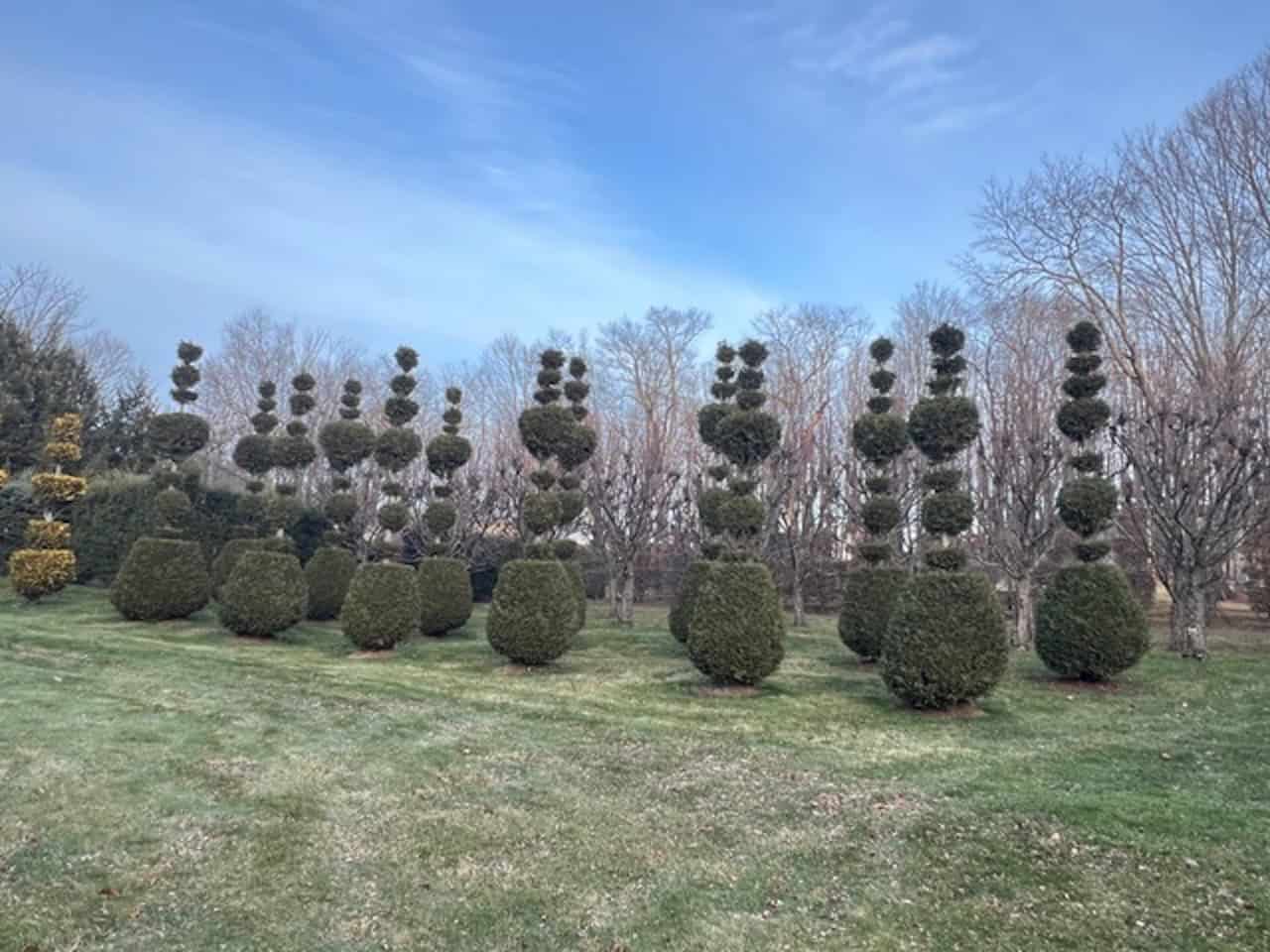
Topiary is the art of clipping and reining plants into formal shapes. It may go as far back as ancient Egypt, where tomb walls show depictions of gardens with date trees shaped into cones. Topiary-adorned gardens were a status symbol for wealthy Romans, as evidenced in wall frescoes and mentioned by Pliny. During the Italian Renaissance, with wealth and classical themes, topiary became practiced again and spread across Europe – think of the parterre formal gardens in France and the whimsical designs of the English. After enthusiasm for romantic, wild natural gardens faded, topiary came back into style again in the 19th century, especially with the Art & Crafts movement. Today topiary gardens remain valued in Europe but never really took hold in the United States.
How did you learn?
There really wasn’t anyone to teach me, so I started out reading and researching. I took a welding class at a local high school to learn how to make frames. We went to England and visited gardens and talked to gardeners. Levens Hall, established in 1697, is the world’s oldest topiary garden and where World Topiary Day is celebrated in May.
I created a reference library, and drew my own ideas based on 17th and 18th century designs. I planted 95 hornbeam trees 12” tall 15 years ago and learned by doing – when to clip and how to clip. If you clip a branch two shoots will emerge, if you clip each of those, you’ll have another four. Plants respond quite quickly to trimming and clipping.
What trees do you use for topiary?
Yews (Taxus) stay green and grow quickly. Boxwood (Buxus) is now surviving warmer New England winters, Arborvitae (Thuja) is easy to prune; hornbeam (Carpinus) makes a fast growing, easy-to-trim hedge, and beech (Fagus) keeps its golden-brown leaves until the spring. Topiary is beautiful in all seasons.
What sort of location, soil, and light are required for topiary?
The creation of topiary requires the basics that most plants require: good soil, light, and water. The soil at my property is medium clay, which is helpful with retaining moisture, but we add compost and sometimes coarse gravel to add drainage. My philosophy with planting is a bit of tough love; they get plenty of water for about a month, and then they are on their own. It seems to work well.
I feed them with Holly-tone in the spring and fall when I remember to do it. A new product “TOPBUXUS” has been helpful with the boxwood leaf miner, and knock wood we don’t have the box blight that has been so devastating in the UK and Europe and has been found in northeast Connecticut. The newly discovered beech leaf disease, caused by a nematoid, is troubling, so we did a soil drench this fall as a precaution and will repeat that twice annually.
How much does a full-grown topiary cost?
Depending on size and detail, the plant itself costs between $5,000 and $15,000, plus the charges for digging it up, burlapping it, and shipping it. Then there’s installation on the other end. Lots of people call or visit who are interested, but they back away when they understand the expense.
How do you sell topiary trees?
Basically, it’s word of mouth. Marketing doesn’t interest me – I’m not super motivated. There aren’t many sources for fully grown topiary trees, so it’s easy to find me on Google. I ship my topiaries all over the country.
In 2019 we moved a topiary garden I created from Greenwich, CT, to the Berkshire Botanical Garden and created Lucy’s Garden. A high-end nursery in the Hamptons is trucking large boxwoods up here for me to shape into chickens for a client and then ship them back to Long Island.
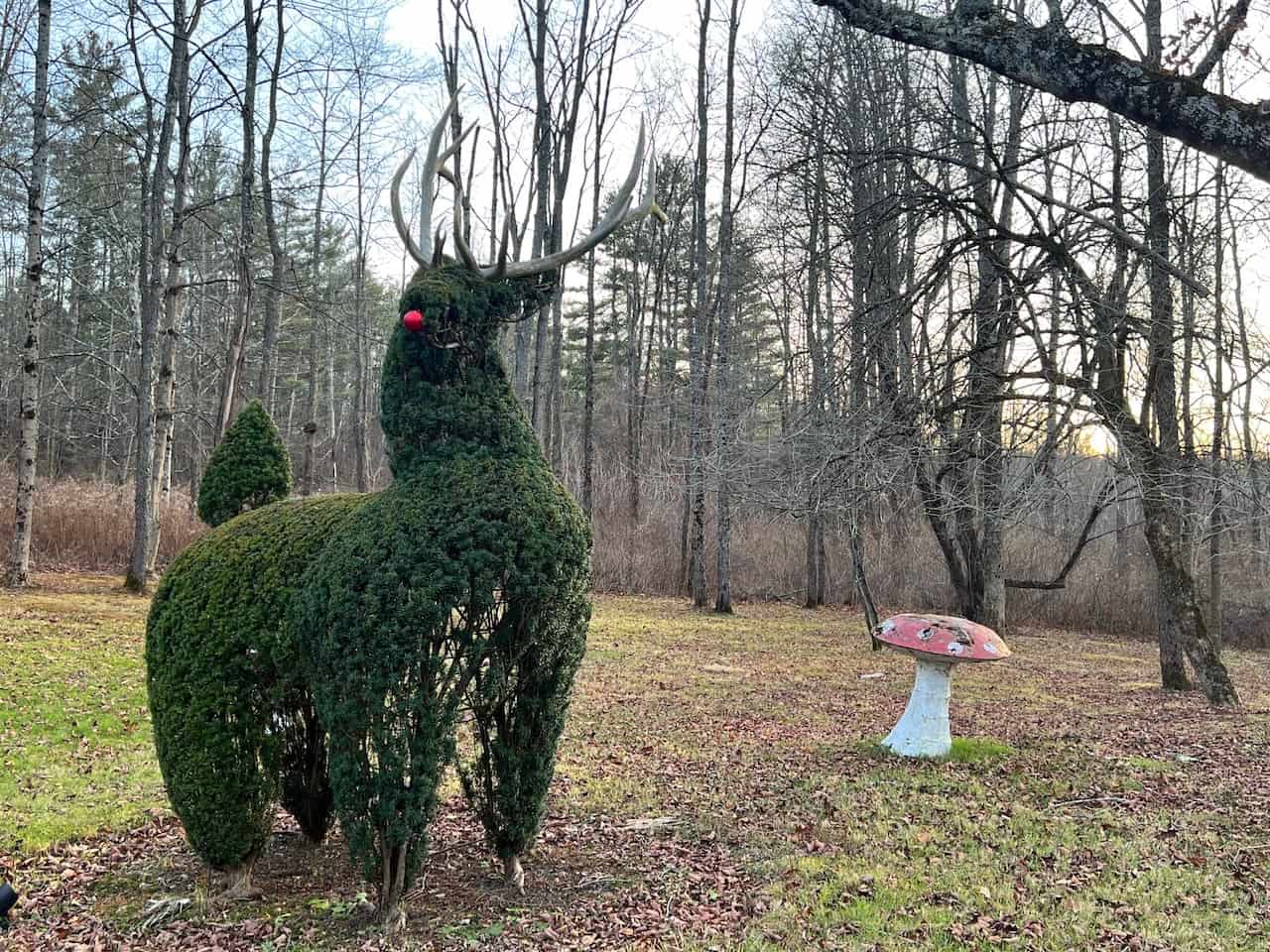
A topiary stag at Black Barn Farm is often a selfie location for deer hunters.
What about maintaining them on an ongoing basis?
That’s the labor-intensive part, and it takes time. Just about when I finish clipping in the spring it’s time to start the second clip in the fall. The topiary garden that was moved to BBG was donated because the owners Lucy and Nat Day were selling their house and knew that many buyers would not appreciate or maintain the topiaries.
Is this sort of gardening physically demanding?
Try moving heavy orchard ladders to get to the top of a tree or leaning over a five-foot-wide hedge that is 16 feet high and 153 feet long. Actually, I appeared on a PBS series on gardening fitness called “How to Take Care of Your Body While Taking Care of Your Garden,” which was hosted by my friend Madeline Hooper, the creator of Rockland Farm in Canaan, NY. The trainer Jeff Hughes’ suggestions really helped me with an achy back.
What was a surprise?
How quickly plants respond was a wonderful surprise. And then the deer. The first year the deer stripped my newly planted trees down to the stems. So, I put up an electric fence – unsightly but very effective. Years later when a shelter magazine came to take photographs, they insisted on taking down the fence. We didn’t put the fence back up, and miraculously the deer never returned. I wonder if the memory of the shocking electric fence was somehow passed on from generation to generation.
A surprising delight is watching the blackness of a mother bear and her cubs strolling slowly through the garden.
Have you ever thought of writing a book about topiary?
Not really. There are so many images on the Internet, and now there’s Topiary Tuesday on Instagram and Pinterest with everyone sharing their own photos of topiary.
What’s the most demanding aspect of a topiary business?
Anxiety about time. If clipping isn’t done at the right time and in the right way the plant will get out of control. I like things to be in order.
You play an important role in expanding the Berkshire Botanical Garden. What is happening there?
I have been the chairman of Berkshire Botanical Garden for about 15 years. When I took on that role I knew it was a diamond that just needed to be polished. Over time we have restored the historic Center House, adding a gallery for the presentation of botanical, landscape, and related art works; a botanical library; a teaching kitchen and classroom; and office space for staff. After commissioning a master plan from the landscape architect firm Nelson Byrd Woltz in 2019, we are in the final stages of completing the first phase with the addition of the Glass House, a 5,000-squar- foot conservatory to expand our collection and serve the community in various ways. We completed the “Mother Earth Lodge” in ‘24, a post and beam structure for our popular “Farm in the Garden” camp, and a stone amphitheater in the woods for outdoor programming.
It has been my pleasure to design these new features. Working with the executive director, Michael Beck, a dedicated team has grown that supports the newly “polished” garden, with much more to come. I look forward to seeing our historic garden shine into the future. •
To learn more about Matthew Larkin and his work, please visit blackbarnfarm.com.
Matt Larkin after an afternoon’s work before the snow storm.