Featured Artist
MAPPING THE ART WORLD
Sharon Bates is a multidisciplinary artist who balances her own studio practice with an active curatorial career. She currently runs the Millbrook Arts Project, a community art space and is the founding director of the Albany International Airport’s Art & Culture Program, where, for almost two decades, she developed the public art program, which has become a national model.
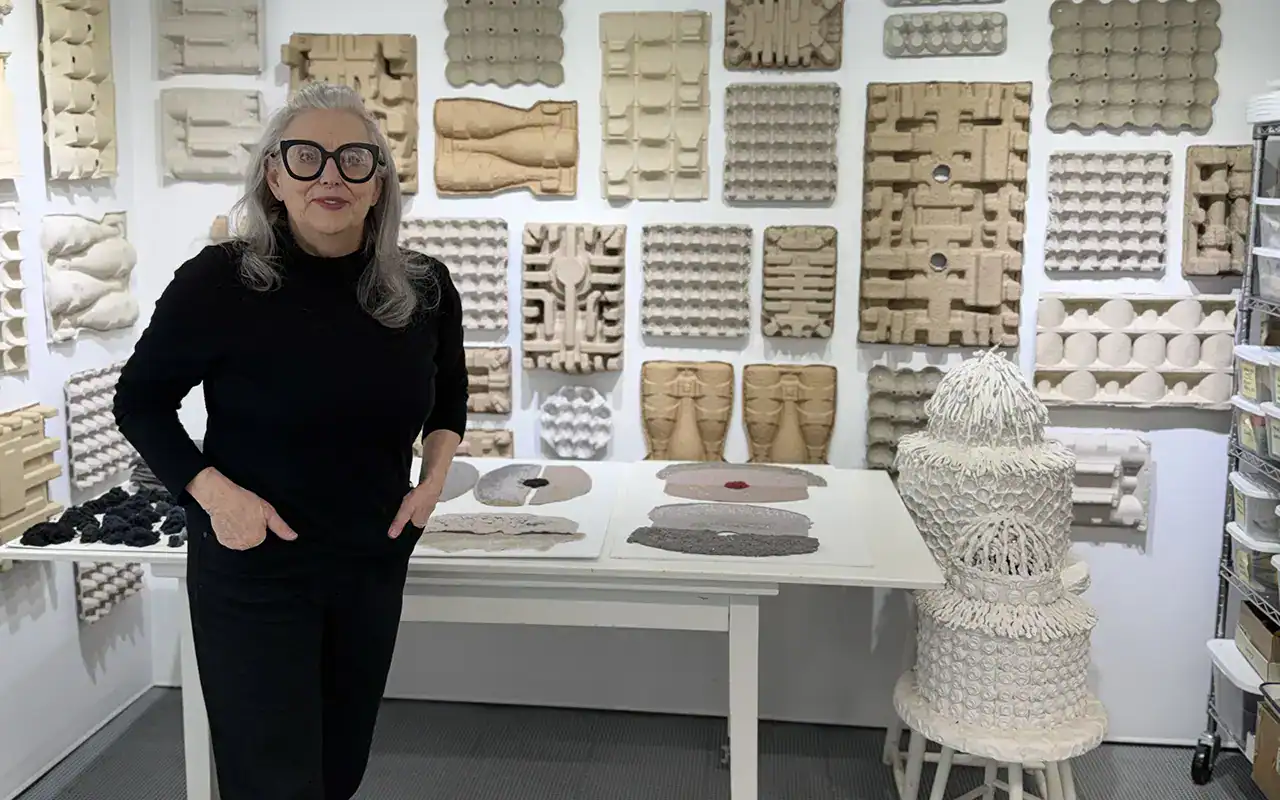
I met with her at her studio in Millbrook, NY where her home is filled with artwork by other artists – some collected, some gifted, each piece thoughtfully placed in conversation with the next. Bates often works with found objects or discarded materials, treating them as a medium and transforming cast-offs into sculptural forms that retain traces of their past lives. Her work is deeply tactile, drawing viewers in; each piece carries a narrative shaped by its physical qualities, a place, or an experience.
What was it about this area that prompted the move?
I’ll give you the quick story: my husband and I bought our house in 2019 and moved here from Albany in early 2020 to be near our daughter, son-in-law, and especially our two grandkids Finn and Beatrice. We both had retired from our jobs and moved right before COVID hit in March. Suddenly, we were thinking, “oh my, what did we just do?” We had moved to a place where we didn’t know anyone, and then we were thrust into isolation for a few years. It was a real adjustment period for everyone, of course, but especially for us. We had to figure out how to translate the active life we were engaged in up in the Capital Region and how to integrate ourselves into the Mid-Hudson Valley art community. Naturally, during the pandemic, there were no gallery exhibitions, no public programs, and no real opportunities to meet fellow creatives. So, we just stayed home and renovated our house. We bought the property because it had a great little two-car garage out back that we hoped to turn into a proper studio, but in the meantime, we’ve both established workspaces inside the house to create.
Fast forward to 2022, we teamed up with two other local artists and applied to participate in Upstate Art Weekend’s Open Studio programming. We were accepted and didn’t know if we’d get two visitors or 2,000. We felt that even if our immediate neighbors were the only ones that showed up, at least they’d get to know who we were, and we’d get to know them. The event was a weekend of two 94-degree July days, and we were shocked that we had over 200 people attend!
That is fantastic, can you talk about the Millbrook Arts Project and how you set this up?
By our third year in Millbrook, I was asked to join the board of the Millbrook Arts Group. It is an all-volunteer cultural organization that has been active for more than 30 years. Up to this point, MAG hadn’t been involved in much visual art programming – their focus primarily involved the presentation of outdoor summer concerts, a winter concert series at the Millbrook Library, and various literary and children’s programs. Together with June Glasson, an artist and a fellow MAG board member, we were brought in to develop opportunities for contemporary visual artists.
I had been helping the library install some community-based exhibitions, and during our second year of Upstate Art Weekend, MAG became an organizational participant, and we organized Millbrook Arts & Open Studios, which involved even more members of the community. MAG put out an open call to artists in the community, and I curated a group exhibition titled On the Map.
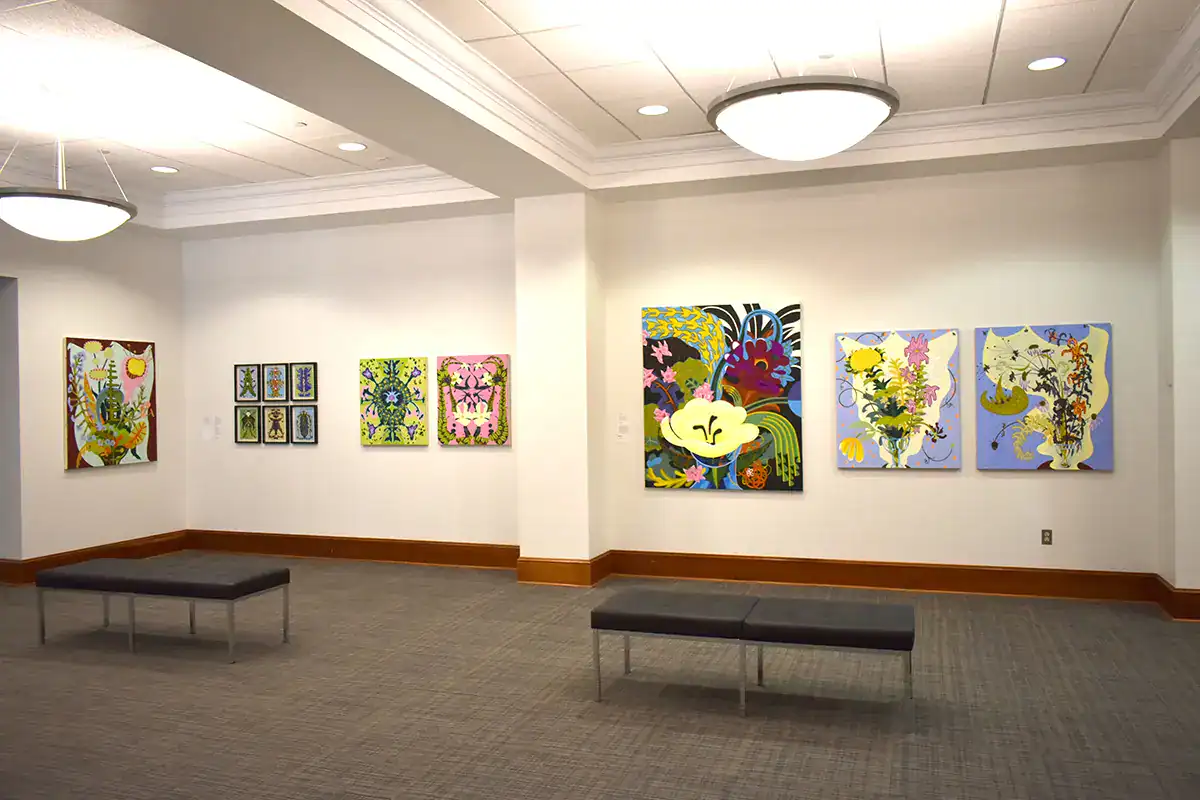
In preparation for this exhibition, I approached MAG’s president, Ann Gifford, and asked if the organization would be willing to provide funding to renovate the library’s exhibit space. Between MAG’s contribution, funding from Friends of the Millbrook Library, Millbrook Library repair and maintenance funds, and some individual contributions, we raised over $12,000! We painted the walls, installed new carpeting, added museum-style benches, and removed the wire hanging system to give us more flexibility.
We were also granted access to the Thorne Building, as it was in the process of being converted into a community space, and we presented a pop-up version of the On the Map exhibition. The expansive scale of the empty building supported more experimental installations, including sculptural works that responded directly to the space and were also placed on the grounds in front. That UPAW weekend encompassed the library exhibition, the Thorne Building pop-up exhibition, open studios hosted by seven artists and a concert of local singer-songwriter Emi Night and the Strawberry Runners at the Millbrook Bandshell. The program has continued to expand, with 12 artists opening their studios this past year.
Since the Millbrook Arts Group didn’t have a physical space, and the Millbrook Library had a gallery space but no curatorial staff, in 2025, we formalized a joint venture, establishing the Millbrook Arts Project, a community art space. Our mission is to provide exhibition opportunities for visual artists, and to enhance the understanding of contemporary art to Millbrook and our surrounding communities.
In effect, we created a new organization from the ground up, developing its name and visual identity, governance policies and procedures, artist contracts, application frameworks, and a web presence. Jen McCreery, the library’s assistant director and adult programming director, is the acting gallery director, and I am the gallery curator. In our inaugural year, we presented the work of 14 artists in six curated exhibitions that included special artist talks, workshops, and programming. I wanted the first season to be very impactful and to have strong shows with both local artists and artists invited from further away that brought new visitors to the gallery from many Upstate and Downstate communities.
This year we were thrilled to receive applications from 117 artists through our open call. MAP has scheduled five curated exhibitions, each for an eight-week duration along with community-based shows that include Art Blast, an exhibition of student artwork from the Millbrook schools, and Needlework: A Living Tradition, in collaboration with the Millbrook Historical Society, Millbrook Library, Millbrook Arts Group, and Skyllkill Needlework Guild.
I’ve noticed that across all communities, libraries are truly stepping up as vital hubs for creative work and civic engagement. It’s a brilliant evolution; as traditional book circulation shifts, libraries are reinventing themselves through these collaborative partnerships.
Well, you know, in the past, libraries were often the cultural centers of their community, with galleries and sometimes even their own museum-like collections. In our small community, the library is truly our cultural hub, hosting lectures, movie nights, exercise programs, bridge classes, monthly jam sessions, a myriad of children’s programs, and most recently a community dance party!
We also hosted a community-based exhibition and fundraiser, titled the Salon Hang. More than 100 pieces were installed from floor to ceiling. Anyone from the community could bring in a piece of artwork that they had made; it just had to be for sale and half of the proceeds went to benefit the library. On our first fundraising art event, we sold over $10,000 worth of work.
So, can we step back and discuss your earlier art practice and what prompted you to have a career working in the artworld?
Even as a kid, I thought of myself as an artist and was always drawing or involved in some type of craft project. I left Rochester, NY in 1978 and spent twelve years in Los Angeles, arriving when I was 24 with a very specific vision for my life: I wasn’t going to marry, I wasn’t going to have children; I was going to be an artist!
I was working my way through community college with my sights on an art degree from UCLA. But, as they say, life had other plans! I met my husband, married, and was pregnant my first year in California. Even so, I never let my art practice lapse. Along the way, I worked for a variety of shops, engaged in window and merchandising displays. I made connections with several art consultants, who sold my work to corporations, department stores, and private residents. Eventually, I worked for a high-end antique store that opened a gallery, where I began organizing exhibitions of early California plein air painters, works of American regional artists from the 1940s and works of the WPA.
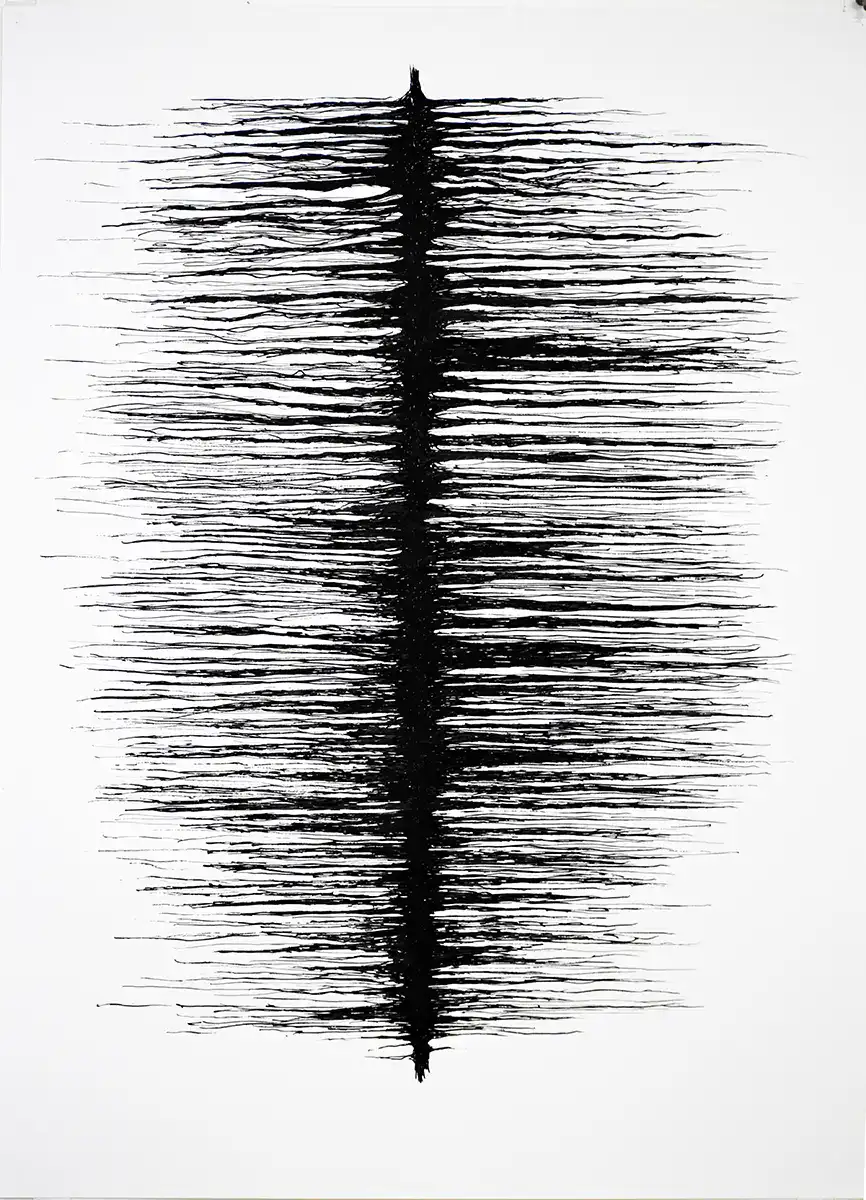
I moved to Troy, NY in 1998 and was hired as the gallery director for the Rensselaer County Council for the Arts, which became a stepping stone into deeper community involvement. Throughout this time, I continued developing and exhibiting various bodies of my own artwork that incorporated found objects and domestic patterned textiles, often creating site-specific installations that existed only temporarily. In my drawing practice, I focused on ink drawings of sculptural forms made through a process of non-thinking, gesture as a kind of language. My interest always seems to have been in shapes and objects that feel both primitive and futuristic.
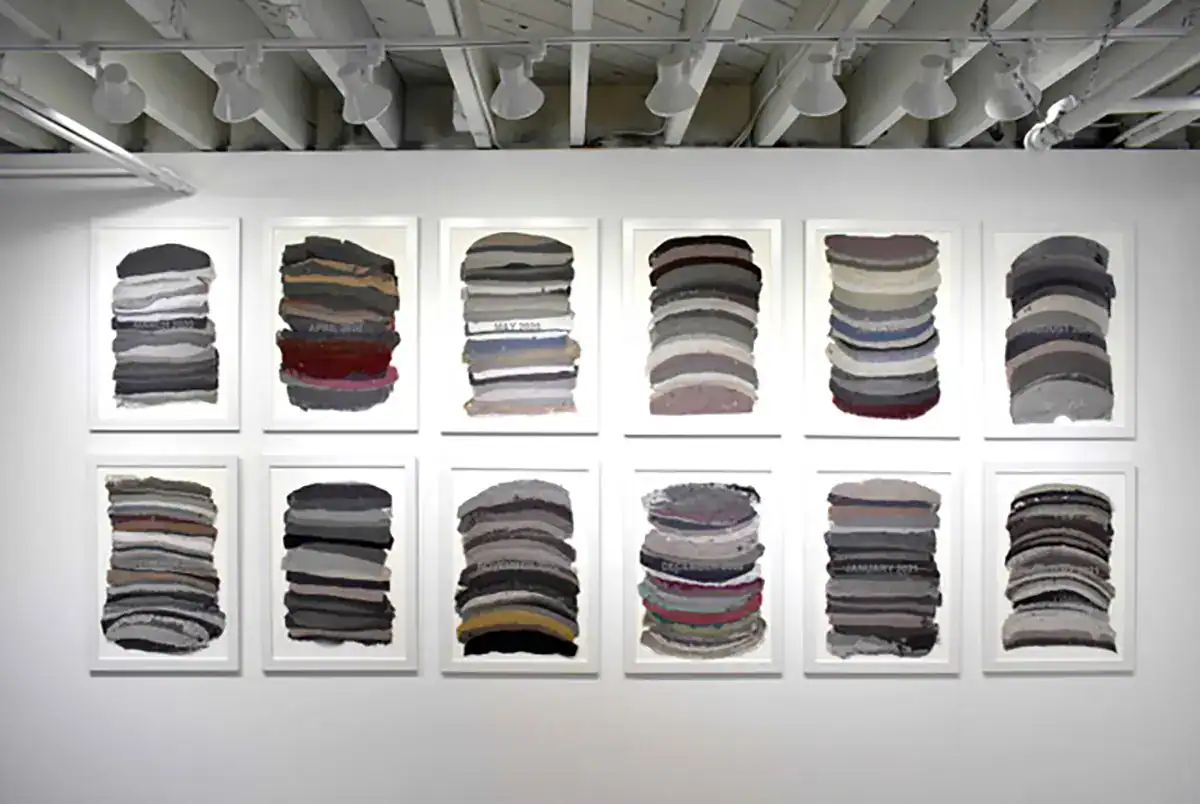
After relocating my studio several times, I have moved away from using sculptural objects, as they take up way too much storage space. Most recently, I’ve been interested in cast-off materials that have presented themselves to me from around the house, including dryer lint. I am drawn to its softness, density, and subtle variations in color; also it is plentiful and a free by-product of doing laundry. Pulling it directly from the dryer, I began laying crescent shaped pieces on sheets of cardboard all around my basement. Overlapping sections came to resemble geologic slices of the earth, a timeline of sorts. In 2020, right after COVID-19 and the Black Lives Matter uprisings, the Dorsky Museum put out a call to artists, asking if “artmaking can really sustain us.” I made a work that consisted of 12 framed sections of the assembled lint pieces, one for each month of 2020. On the inside of the glass, in frosted vinyl lettering, I placed the name of the month and year, starting with March 2020 and titled it: 365 Days of Grey: A Year of Covid in Dryer Lint.
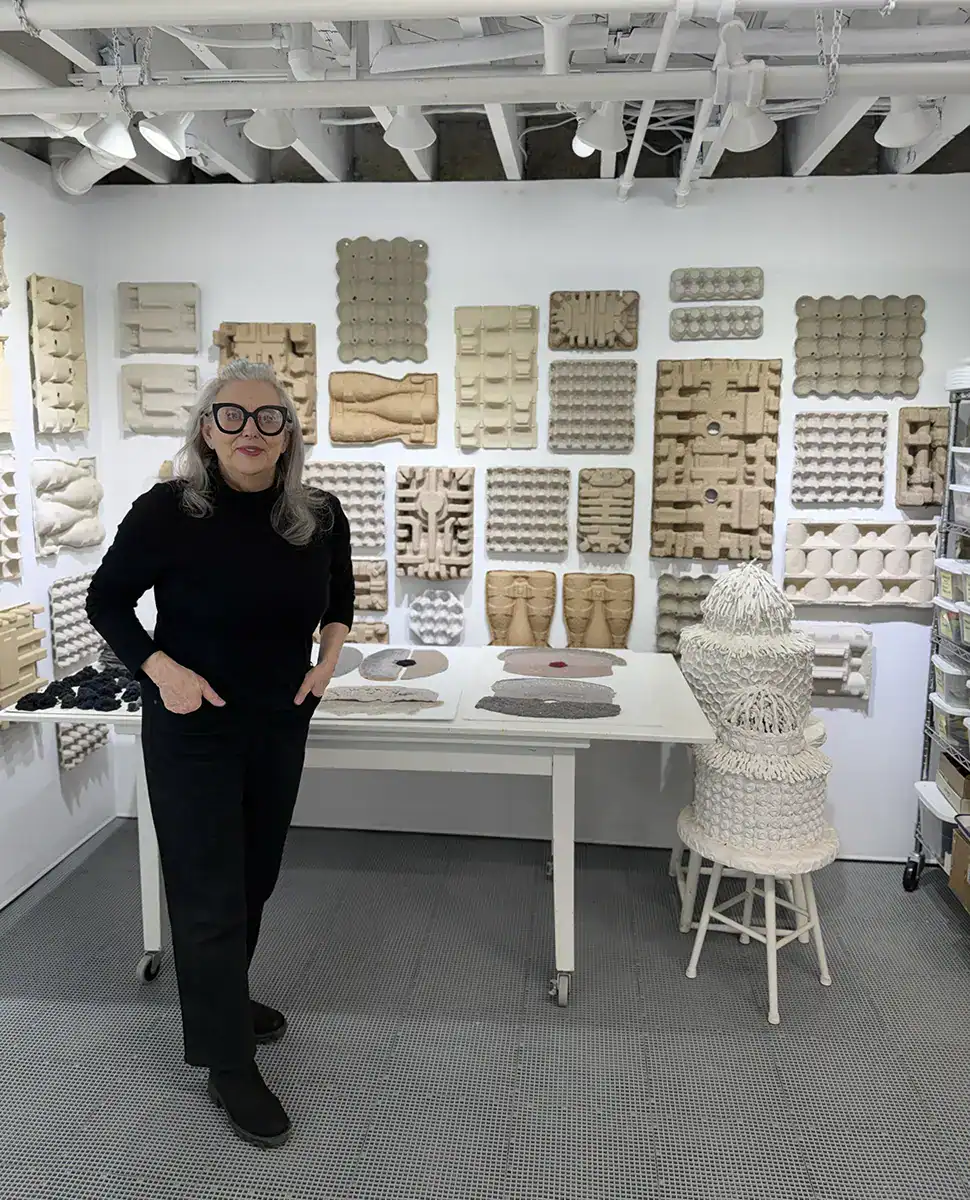
In addition to dryer lint hoarding, I started collecting molded paper packaging from stuff ordered on Amazon, another material that came into our home during the isolation of COVID-19. The pieces I was most interested in were highly textured and came in different shades of brown, grey, and white. When arranged on a wall, they resembled abstract Mayan reliefs. An employee and friend from our village liquor store started saving the most interesting packaging from wine and liquor shipments and would periodically show up with a great stash for my new work.
It is an exercise in radical recycling – using the ubiquitous packaging of our lives and documenting our consumer habits. I take the lint from my dryer, and I put it in a wire cage for the birds to line their nests. What advice do you have for an artist today?
With any creative pursuit, you must have an intense and consistent desire to keep doing it. Continue making work, even when you don’t feel inspired and even more importantly, make sure that you create an interesting life for yourself.
Unfortunately, it’s not realistic for most artists to support themselves through the sale of their work. It seems there are many more artists in this world than patrons. But the more you share your work, invite people in to see what it’s like to live with art, and talk to them about your ideas and processes, the more the public will begin to understand and appreciate art in their own lives.
Before we moved back east, my husband and I worked with a career coach in LA who had gone to CalArts. He came from an art and film background, and his approach was incredibly practical: look at your schedule and commit to time in the studio, and treat your art practice like a small business. He used to say, “if you make one postage-stamp-sized artwork a week, by the end of the year you’ll have fifty-two pieces.” That really stayed with me.
Can you talk about site-specific work and the curational projects you worked on at the Albany Airport?
Throughout my career, I have been rooted in the belief that contemporary art should be shared with the public. I’ve primarily worked for non-profit organizations that create opportunities for those who might never step foot in a traditional museum or gallery.
My most rewarding career opportunity was founding the Albany International Airport’s Art & Culture Program in 1998. I was hired to transform the new 250,000-square-foot terminal from a mere ‘drive-through hub’ into a cultural destination. By establishing a dedicated pre-security gallery, several terminal galleries, an exhibition case program that featured satellite exhibitions from museums and cultural organizations, and a site-specific installation program, we invited the community, travelers, ‘meeters and greeters’, and the 1,000+ airport employees, to engage with art.
This program didn’t just beautify a municipal space; it engendered a deep sense of civic pride, proving that when you bring art to places where people live and work, it changes their relationship with their city and its artists.
During my eighteen years as director, I curated 40 large-scale exhibitions in the 2,500-square-foot Albany International Airport Gallery on our third floor, which hosted artist talks and receptions and became one of the premier exhibition venues in the Capital Region. I also curated numerous group and solo exhibitions in the Concourse A and Concourse B galleries that featured the work of artists who lived and worked in the airport’s service area, which included western Vermont and Massachusetts. One of the most exciting opportunities for artists was our site-specific installation program. Artists were invited to develop proposals to create large-scale sculptural work that responded to the airport environment and remained in the terminal for several years. Works varied from the piece, American Gothic, a sculptural homage to Grant Wood’s iconic painting, which featured a hand-drawn and sewn inflatable sculpture of the artist’s parents as American travelers, to a piece titled Healing Wings by Lillian Mulero that consisted of 3,000 origami peace doves decorated by children from 35 local schools as a memorial to the tragedies of September 11. The airport was a fantastic space to work with, and the creative possibilities felt limitless. The art and culture program has been going strong for almost three decades and has become a national model for public art. More than three million people a year go in and out of the airport, and artists we exhibited would always tell us that they never had more people comment on seeing their work.
What a great way to arrive from a flight to see art. I love installations at airports. When you’re developing an exhibit, what’s your process: do you go on the theme, the title, or from an open call where people have responded to something?
Depending on the gallery or the organization, I have incorporated all of those processes. After more than 30 years of working with artists in the Hudson Valley, I’ve built a deep network of creative relationships. At the airport, we curated exhibitions by inviting artists whose work we felt represented an idea or a concept that we wanted to explore. I was operating in a highly political and public environment, which taught me early on the importance of navigating institutional contexts with care.
When we were assembling the inaugural 2025 MAP schedule, we moved quickly, so rather than issuing an open call, the four other members of the selection committee and I suggested artists whose work we were interested in and made likely pairings after reviewing the work. For the 2026 MAP season, we reviewed the work of 117 artists who responded to our call for artists. Connections emerged organically, some leaning more toward abstraction, others more representational or conceptual.
Bates brings an infectious enthusiasm not only to her own practice, but to making art accessible through her curatorial projects. Working with emerging artists as well as with those more established, she is interested in connecting their work with new audiences. Keep an eye on the calendar and make the trip to the Millbrook Arts Program, for Upstate Art shows this summer. And as we engage with our local libraries, remember to look beyond the books – there are hidden gems waiting on the walls as well. •
For further information about the Millbrook Arts Program, a community art space and to see more of Sharon’s work: Millbrook Arts Project: millbrookartsgroup.org. Email: sharonnabates@gmail.com. Website: sharonbatesart.com. Instagram: @sharon_a_bates