
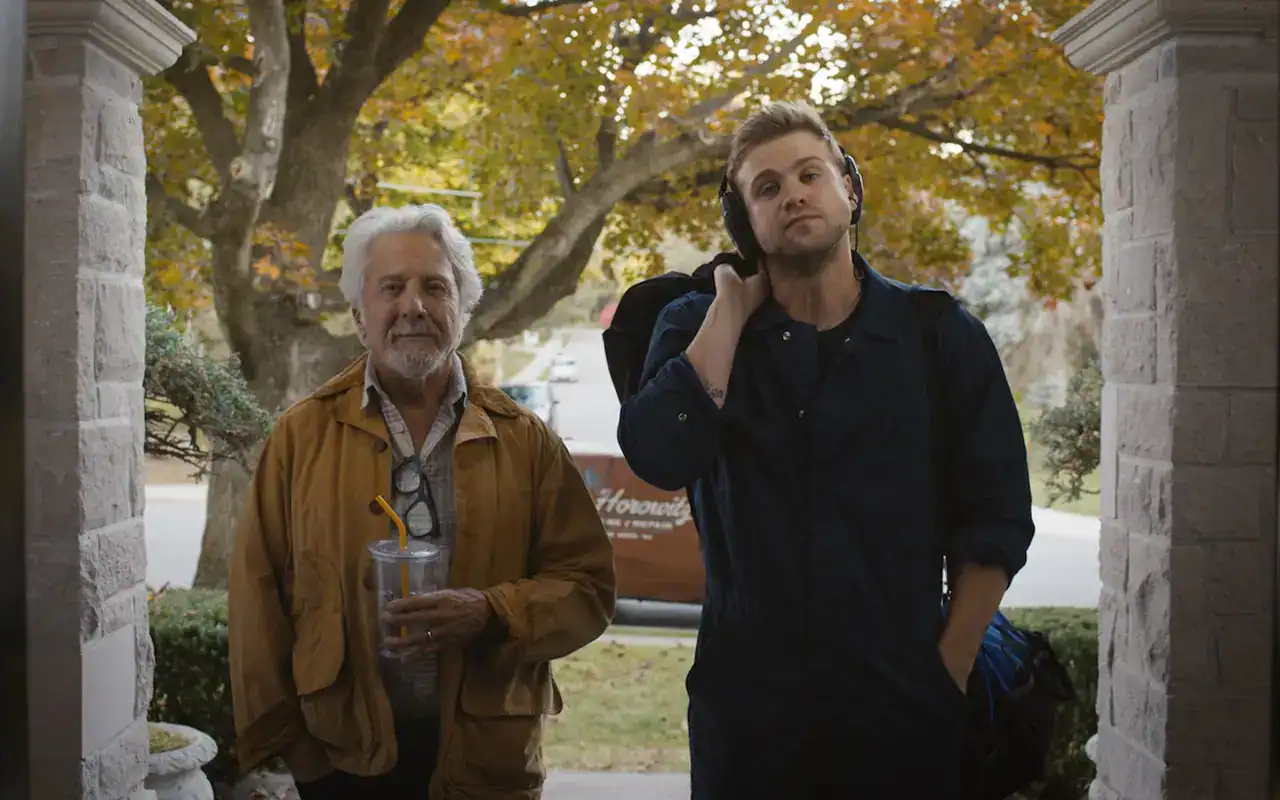
It would likely be reason enough to see “Tuner” knowing that 88-year-old Dustin Hoffman appears in the film. One of the greatest, most awarded actors of our time, one could be justified to drive several hours just to hear him read the phone book … if we still had phone books. Fortunately, we can still marvel at his talent in “Tuner.” It’s a wonderful film, made more wonderful in every scene where Hoffman appears.
What’s the film about? Well, it’s an action film, a love story, a heist film, an exploration of safe cracking and piano tuning, a film with great music … and an all-around delight. If, perhaps, you can’t find it in your schedule to go see it on a large screen with an audience to share the magic, then write “Tuner” on one of those sticky notes that you put on the refrigerator and make sure you watch it when it appears on a streaming service. It would be a shame to miss out.
Daniel Roher, a documentary Oscar winner, directed the piece, from a script he co-wrote with Robert Ramsey. The intriguing premise revolves around an apprentice piano tuner Niki White (Leo Woodall) who has the rare hearing disorder – hyperacusis. “Allergic” to loud noises, Niki has perfect pitch and an innate ability to go through the arduous task of tuning pianos.
Through the gregarious antics of his mentor, Harry Horowitz (Dustin Hoffman) Niki meets concert pianist and budding composer Ruthie (Havana Rose Lee) and, as one might expect, they become a couple. The thing that “throws a spanner in the works,” as the English would say, is that just as his beloved Harry falls gravely ill and needs hospitalization, Niki is almost unwittingly caught up by a gang of thieves led by Uri (Lior Raz) who use their cover as a security company to conveniently visit the homes of absent clients and make off with money and jewelry. The amazing ability to hear the tumblers in a safe make Niki a critical part of their forays. The “tuner” becomes a safe cracker.
We’ll certainly not ruin the story with its engaging twists and turns as it careens to a most satisfying conclusion. It should be duly noted, however, that love has a way of conquering all.
One of the most striking things about Roher’s initial foray into scripted drama is the film editing. The pacing, the choice of images, the rapid way in which the story is moved forward without leaving the audience breathless is superb. Greg O’Bryant, the credited editor, has not been showered with prestigious awards in the past. If “Tuner” is an example of his craft, that may soon change.
Few of us saw “Tuner” coming … but we should all see it before it goes.