This Month’s Featured Article
Brotherhood Winery blends history and good vintages
I’d been thinking about a road trip to check out Brotherhood Winery, in Washingtonville, NY. The editor asked if I had a food issue story. Done and done. Scenic ride down the Taconic, dodge the traffic on I-84, a couple of turns, a charming ride through horse farms, and a low, one-lane railroad underpass and there it was. And there it was again, as I missed the first turn into their road but found the other end of it.
Short version, worth the trip. Well worth the trip. Retail manager Juan Sanchez set me up with long-time employee Kevin Young to gather information. The book The Story of Brotherhood, by Robert Bedford supplied more.
Spoiler alert: it is not, as the name led me – and, I have discovered, others – to believe, associated with any brotherhood as in a religious order.
Brotherhood did not start out to be a winery, nor did it start with that name. Founder John Jaques was a cobbler, moving to Washingtonville in 1810. He planted his first vines in 1835, planning to sell grapes. Wine was not considered then because the family was very religious. In 1837, he took grapes to New York City and sold them for 15 cents a pound. The next year, the price dropped by two cents, and he refused to sell his premium fruit. Jaques brought the grapes back and made his first wine, which, according to his sons, was primarily intended for communion purposes and connoisseurs.
Little did any of them imagine that almost two centuries later their winery would be the oldest continually operating one in the country, winning the Grand Prize in Wines and Champagnes at the 1904 St. Louis Exposition, surviving the Depression, producing a Riesling served at the White House, and becoming the largest wine distributor on the East Coast, shipping some 1.2 million gallons a year.
Then the Jaques Brothers
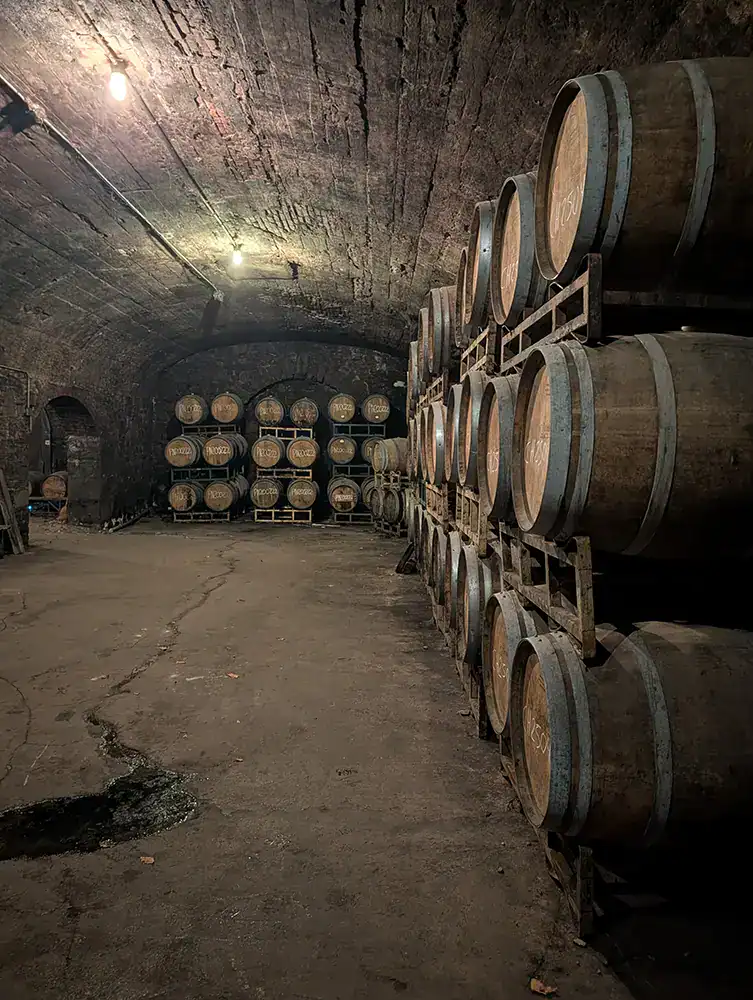
Once he started making wines, Jaques dug into the business. Literally. In 1839 he made the first wine cellar in the county, all dug by hand. A local mason constructed the two-foot-thick brick arch walls and ceilings that defined the rooms and walkways. The second vault was added in 1855.
The first wines bore the name Blooming Grove. When Jaques’ sons Oren, John Jr., and Charles took over the business in 1858, they changed that to Jaques Brothers.
They began advertising in newspapers, which sprang up in that post-Civil War era. The nearby Newburgh branch of the New York and Erie Railroad made shipping easier and cheaper, and business grew. An endorsement of the wines from the Presbytery of Hudson helped demand for the sacramental wines double, then triple.
Unfortunately, when two of his brothers passed away, and then 200 gallons of grape brandy was seized by the US Department of Revenue, Charles could no longer maintain the business and reluctantly sold it to New York City wine merchant Jesse M. Emerson and his son Edward in 1886.
Brotherhood of New Life
They brought the name, having previously taken over Brotherhood Wines, a part of the utopian community ‘Brotherhood of New Life.’ Their wine quality compared favorably with Europe’s best, enabling expansion of the business through eastern and midwestern states. After several revisions, the labels now say ‘Brotherhood Est. 1839 America’s Oldest Winery.’
A new building was erected above the vaults in 1894. In 1906, a tunnel connecting them created the largest underground wine cellar on the East Coast.
Edward Emerson’s comment, “When centuries have come and gone, this building and its many vaults will still be here as an everlasting monument to the memory of the Brotherhood Wine Company,” has turned out to be prophetic.
Long a prohibitionist-fighter, Emerson resigned himself to closing when the World War I war emergency stopped alcoholic beverage production, until he and director Louis L. Farrell found a dispensation allowing them to sell sacramental wines. When Emerson unexpectedly passed away in 1924, Farrell used his connection with the Roman Catholic Archdiocese of New York to expand sales which, along with a great deal of perseverance, kept Brotherhood open throughout Prohibition.
Consortium ownership
A succession of Farrells held the helm for almost 50 years, until Brotherhood was sold to a consortium of local business partners near the end of the 1980s recession. Winemaker Cesar Baeza had been brought in as an assistant in the early 1970s; he took charge to restore the winery to its former glory.
The consortium ownership evolved into the current Beaza, Castro, and Chadwick partnership. They continue to add wines to their list, producing hundreds of thousands of cases annually, while preserving the legacy started almost two centuries ago.
In the 1950s, New York State recognized their historic significance and added the ‘underground winery vaults’ to tourism guides. Wine tasting tours were started in the 1960s, and a New York City newspaper article on those brought throngs to get their free samples. Louis Farrell, Jr. realized this unplanned and unexpected popularity could be a financial salvation, and Brotherhood became possibly the first venue to create wine tourism. In 1964 it was listed as a tourism stop in New York State’s Vacationlands guide.
Milestones and becoming the White House wine
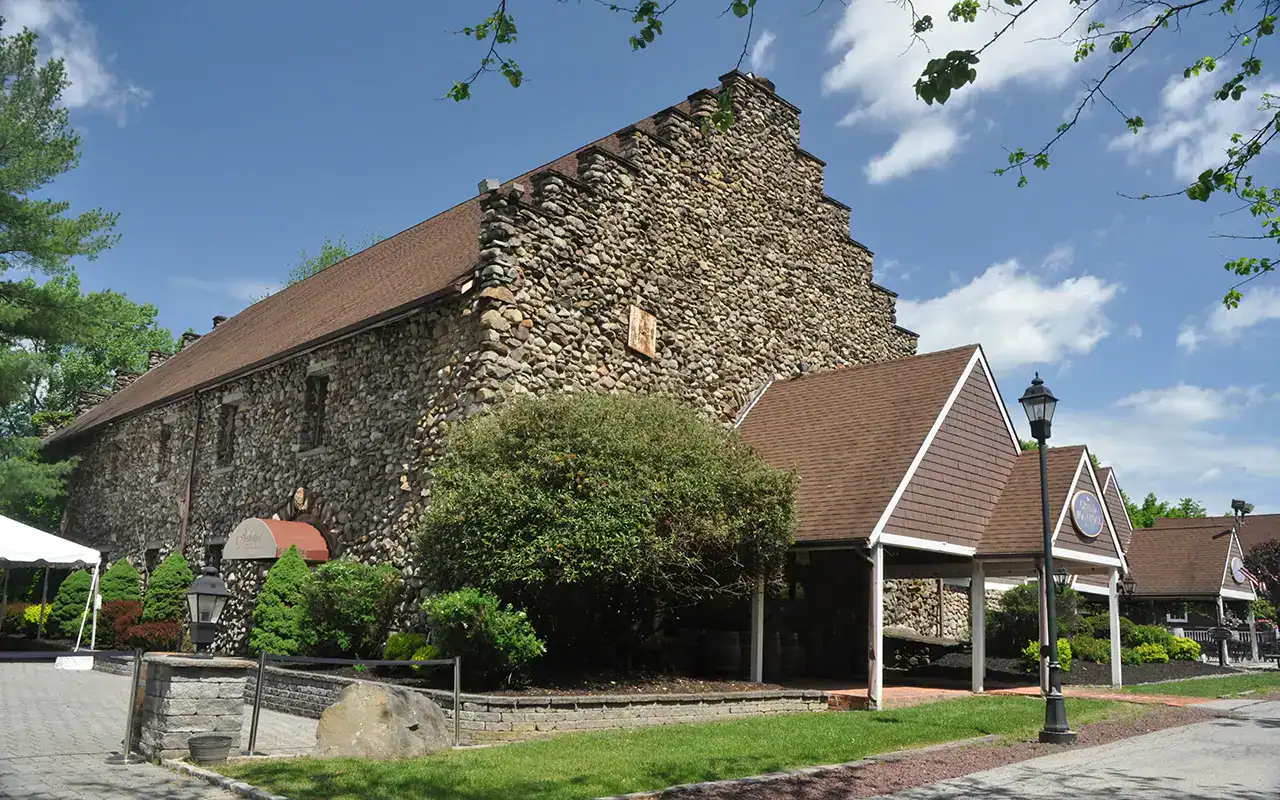
The 150th Anniversary was celebrated with many special events in 1989. Ten years later tragedy struck when a devastating fire destroyed most of the main building, leaving little more than the stone ends. Rebuilt as close to the original as possible, the space now holds several tasting stations and a well-stocked wine assortment.
In 2000, Brotherhood was added to both the New York State and National Registers of Historic Places.
The Brotherhood label wines are generally New York State grown grapes, with a concentration on those from the Finger Lakes for riesling and pinot noir, and from the north fork of Long Island for chardonnay, cabernet, and merlot. Concord and Niagara grapes grown at the winery are used for their altar wines, which the winery still sells to religious organizations.
Since the 2005 purchase by Chileans they have also been, Young said, “Loaded with affiliated wines from California and Chile,” as well as distributing French and Italian imports.
He noted that wines considered to be the specialties are, “Oh, a bunch of ‘em. Our riesling is the first New York State wine to be put on the table at the White House.” This happened when it was brought to President Bill Clinton’s attention that only California wines were being served, and he determined that one from each state should be made available. This ‘White House wine’ is by far the number one seller.
In addition, “You can always find the traditional ones: cabernet, merlot.” Brotherhood also offers seasonal specials, for example a sweet, rosario wine in May and a mulled holiday wine in December.
There are also sparkling wines and “a couple called champagnes – we’re grandfathered in to call them that.” Their late harvest riesling compares to ice wine.
Music, events and history
Music and special events for occasions such as Mother’s Day, Valentine’s Day, and the annual Grape Stomp (think the classic I Love Lucy segment) draw people in. “People love music,” Young observed.
He then stressed, “If people come here, they’re gonna see beautiful structures. The underground cellar is phenomenal. Most important is the history, too often we forget about that.”
If I’d not been on the story, I may have passed on the tour. It would have been my loss. Do not, repeat, do not take that chance. Unless, perhaps, if you are claustrophobic or fear being underground.
The tour begins on the patio, where Young shows off the building, now housing the restaurant, which in its day was the home of a beer hall, massage parlor, and healing cottage.
Do any other wineries have a chapel? The centuries-old First Presbyterian Church of Washingtonville building was moved to the farm by Jaques; it was scheduled to be demolished, but as a trustee and ruling elder, he could not let that happen. It is used now as a tasting room for bus groups: “Blessed with wine in a church,” he quips.
Moving on, to a long window on the world of bottling the wines. One machine does it all, with one or two workers watching as bottles are filled, capped, and labeled, then sent along for packaging.
Now it’s time to go underground. Stone steps lead to a walkway lined with early wine-making equipment, including modern-for-the-time hand-operated presses and corking machines, and some of Jaques’ shoemaking tools. Information about the Brotherhood’s history is posted on the walls.
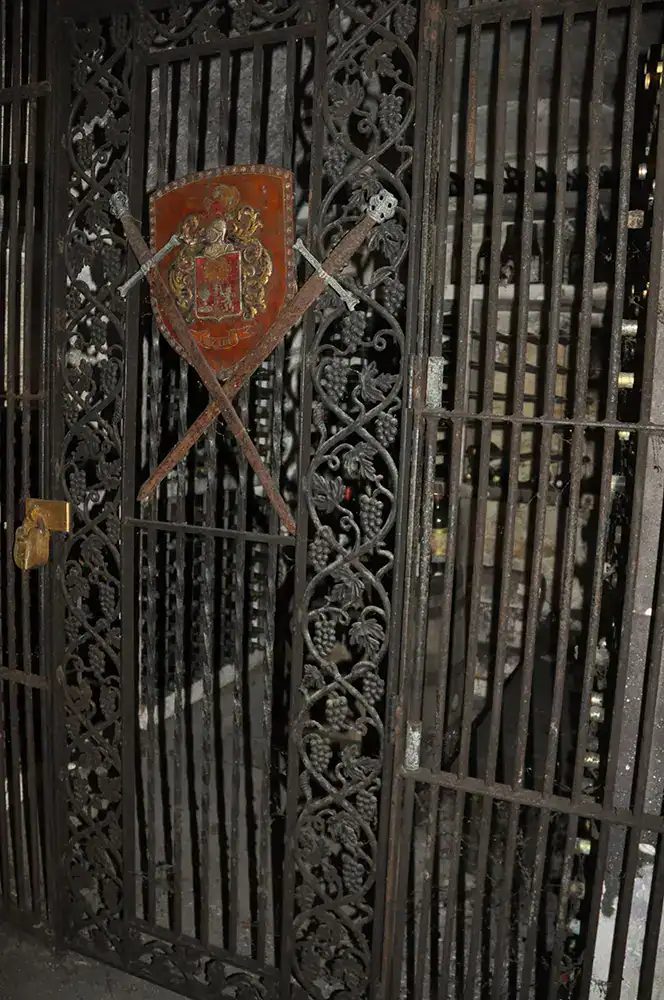
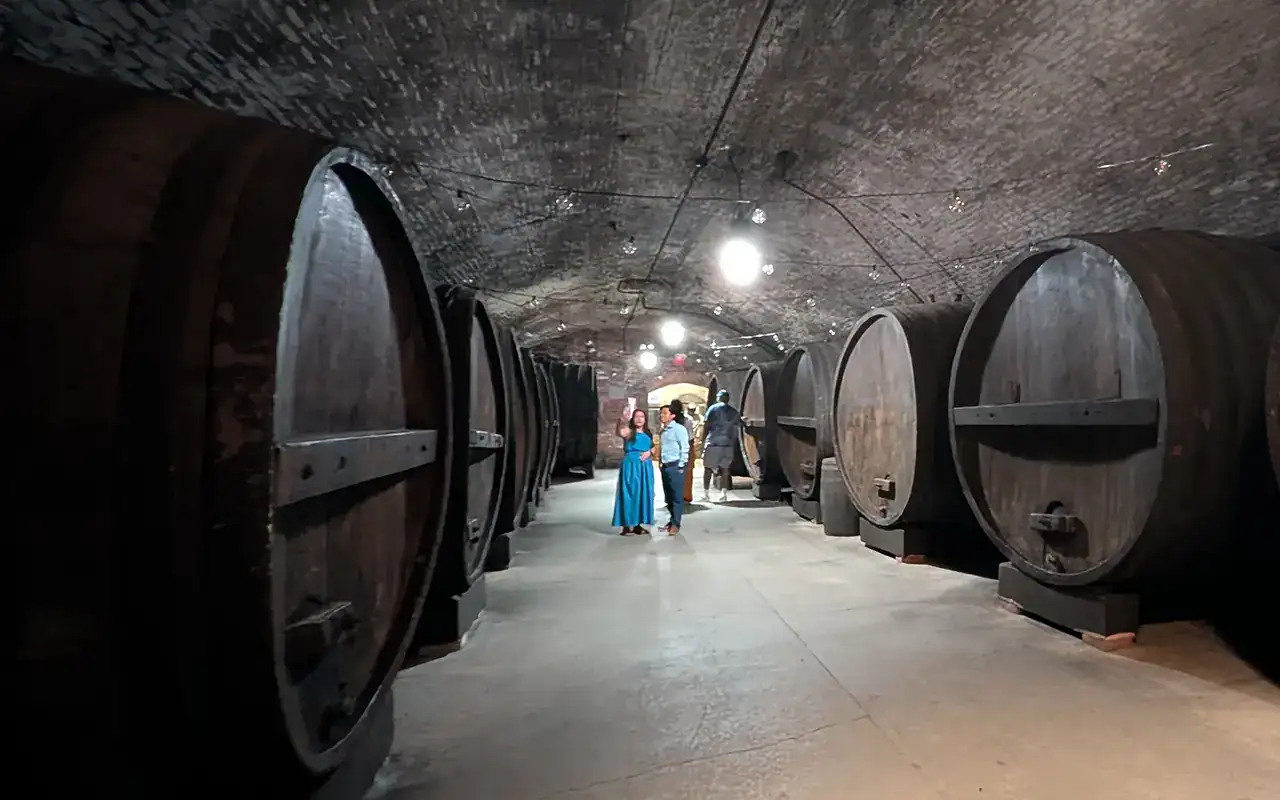
The first vault, 14 feet deep, 17 feet wide and 72 feet long, holds the original huge oak casks, each able to hold up to 3,500 gallons. This leads to an open space with two rooms off it. One is a small niche for the Farrell family private cellar, complete with iron bars and a door with a large ‘F.’
The other holds racks of champagne bottles, carefully tended and turned regularly. A saying from the 1899 company booklet, on the rock wall outside this says, “May all your pain be sham, and all your champagne good, And if you’d real champagne, there’s none like Brotherhood.”
A tunnel from this room, 39’-7” long and 6’-3” wide leads to the newer vault, 15’-0” deep, 28’-10” wide and 86’-10” long.
The original tasting bar is still in the first room of this. A final room is filled with more casks of wine, aging at controlled temperatures and checked weekly for their progress.
Although he denied knowing any ‘mysterious activity’ mentioned in the web page write-up, Young did relate that early in his working at Brotherhood, back before there were lights through the wine cellars, he went in with a small flashlight and was startled by a pile of clothing on the floor in one section. “I went to get some protection and a bigger light,” he recalled, excitedly and a bit fearfully telling the person who had asked what he was doing, “There’s some clothing down there!” and patiently was told, “Kevin, it’s Halloween. That’s for our Halloween tour.”
Walking through, one can only imagine, and gain much respect for, what it took to build these impressive, still in use, rooms.
Back into the sunshine, it is pointed out that we have walked under the building now housing the restaurant, and the drive between the buildings.
On to what we’ve been waiting for: wine tasting! Young’s informative patter about the wines served included the suggestion for a port, “Pour a tablespoon on your oatmeal – at 18%, your day’s gonna start just fine!”
The tastings ended with his advice, “Drink what you like, like what you drink. Don’t be a wine snob!”
Keeping this in mind, I wandered through the many, many, many appealing choices in stock. Don’t ask how many came home with me. •
Visit Brotherhood Winery at 100 Brotherhood Plaza Dr, Washingtonville, NY; reach them by phone at (845) 496-3661; or find out more through brotherhood-winery.com.