Featured Artist
Looking through the undergrowth – Amanda Jones
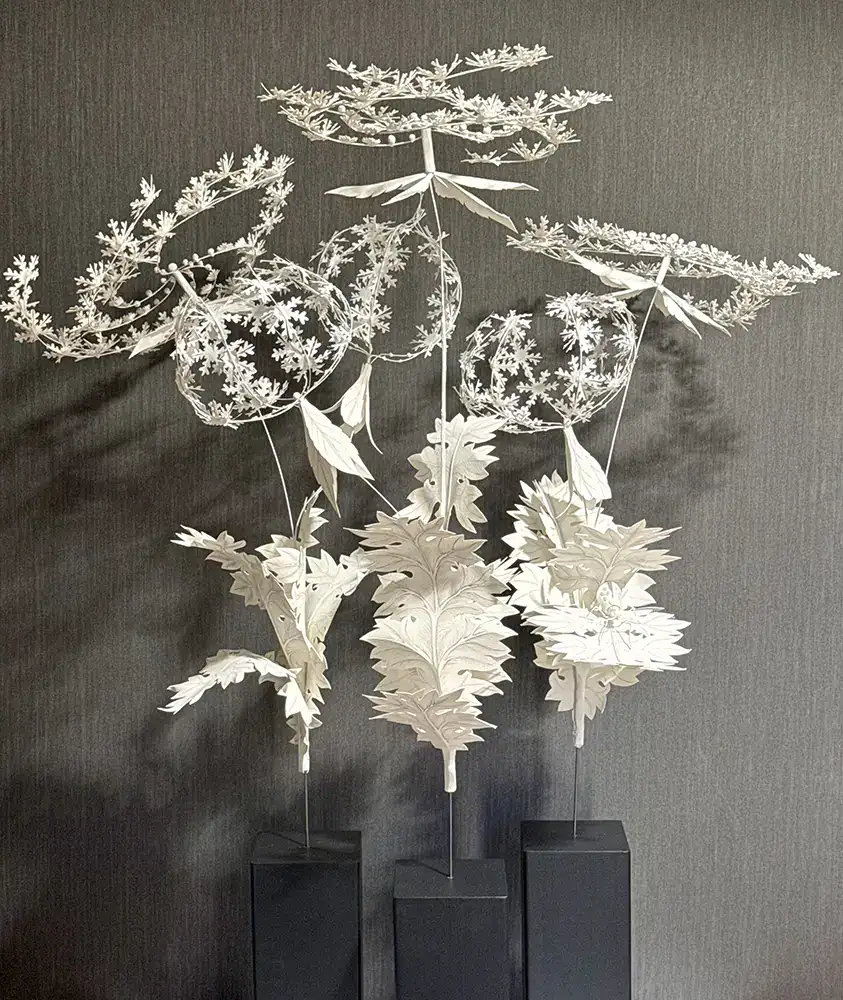
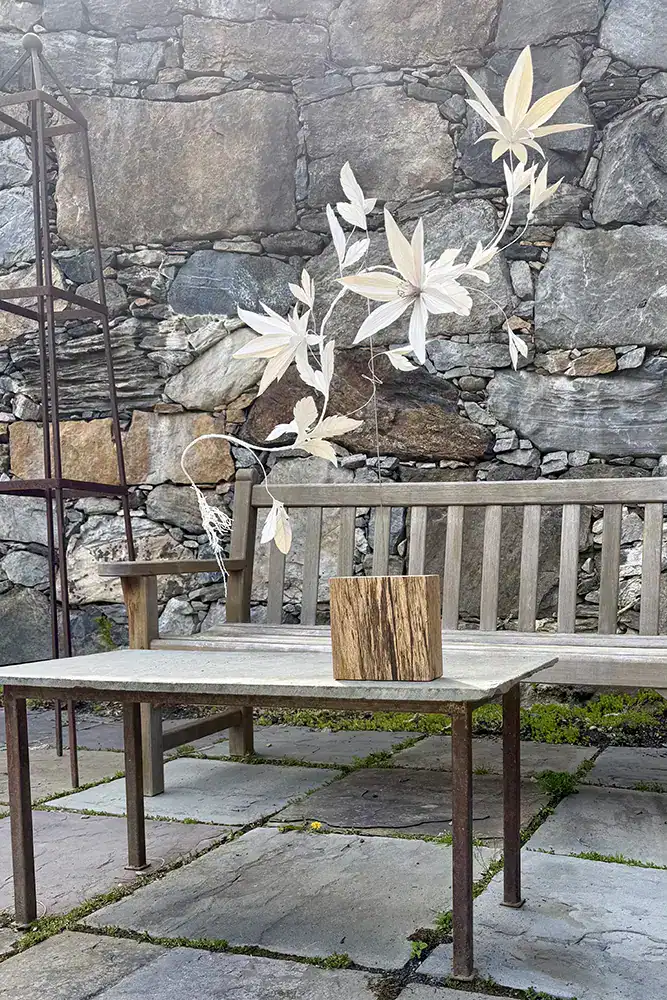
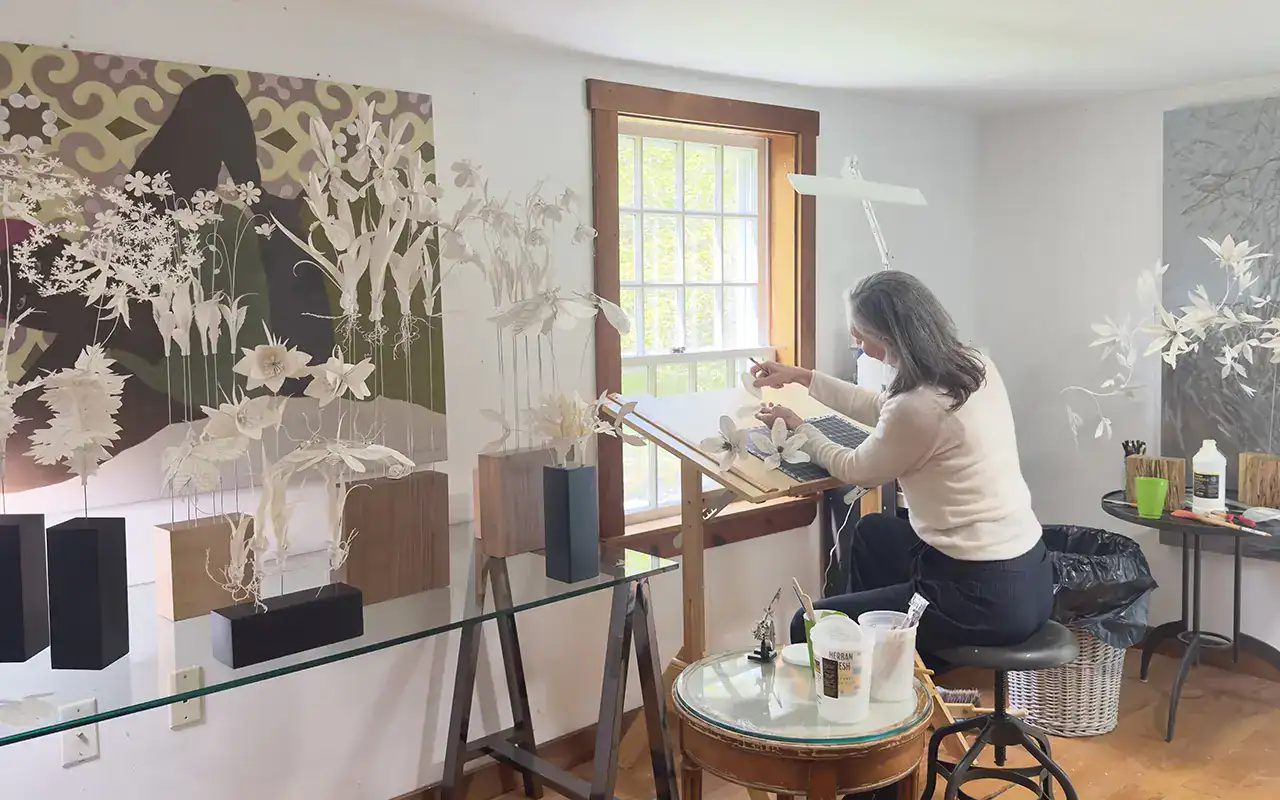
The roar of the waterfall is the first thing that greets you as you step into Amanda Jones’ studio, set beside the river in a converted mill house in Salisbury, CT. The space feels like a woodland that has folded itself indoors: the room is filled with delicate paper sculptures of flowers, leaves, and trees – every branch inhabited by insects, seeds, and birds. You move through carefully, looking closely as flowers climb the walls, their roots exposed and entwined with the creatures below. It is almost impossible to believe that everything is made from paper.
“I have to ship my work, and currently it’s all paper, which makes transport complex. I was nervous unpacking this new work, wondering what had survived. I box everything myself, cushioned in paper with plenty of air around it when I move studios.”
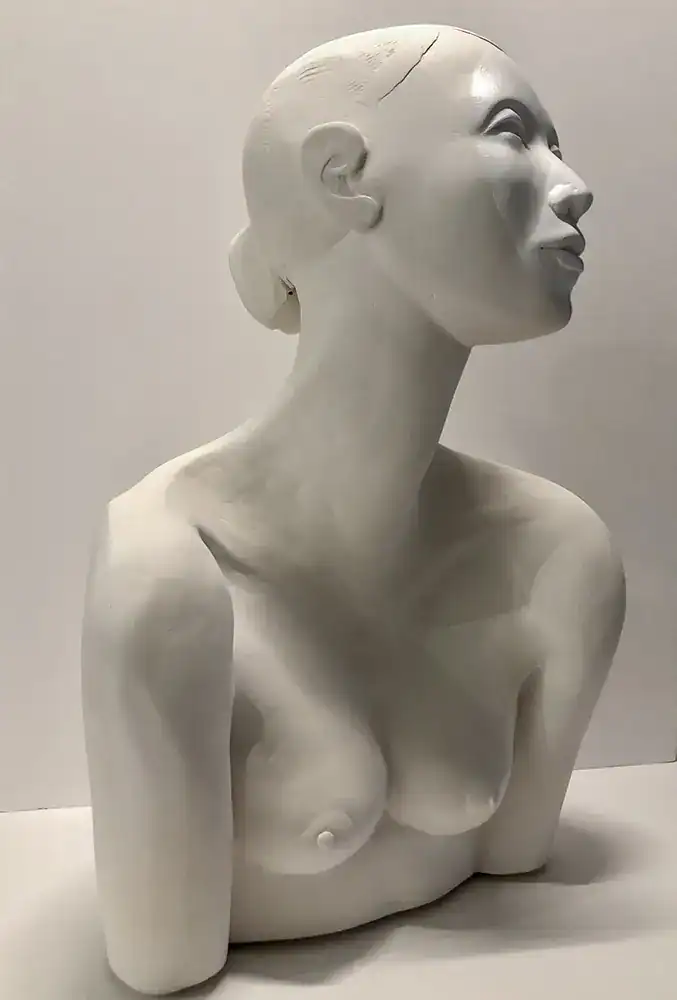
Jones grew up in Cape Town, South Africa, before moving to Europe – first England, then eventually Florida. She now divides her time and studios between Salisbury and Florida, with her husband Dave. Her ceramic women are elegant, watchful presences, that seem to follow the viewer around the room as light and shadow shift across their forms. Large oil paintings, often depicting women, serve as backdrops throughout the studio, each built up through multiple translucent layers applied with extraordinary delicacy. Surface, both its depth and texture, is central to her practice, as is the three-dimensional installation work, where every angle is carefully considered. Whatever the medium, Jones brings the same exacting attention to detail.
What are your earliest memories of making art?
As a child, I just loved color. My favorites were red and yellow, and they always had to go together. The earliest image I remember being truly proficient at was drawing trees: pulling up the trunk, drawing in the branches, adding the leaves – and it looked like a tree. There was real detail to it.
That’s so interesting. I recently spoke to someone who observed that if you ask a child what they love doing and then ask that same person decades later what they ended up doing, it is often precisely what they loved as a very young child. Was anyone in your family artistic?
My grandfather was, he worked exclusively in pencil, and he also professionally retouched photographs, working on portraits to refine them, adding a little color or softening details. So, I grew up around that. My grandmother was enormously creative with textiles, always sewing, knitting, and crocheting; she adored it. As a child, I spent hours making things with her, using little swatches of fabric and buttons, whole boxes of buttons, like a treasure chest.
I grew up with boxes of buttons too! So, when did you begin making work seriously? Did you train formally, and who were your early influences?
I went to college in Cape Town to study graphic design. As a child I was instinctively drawn to Van Gogh, and as a teenager I fell for Paul Klee, Mark Rothko, and Henri Matisse, artists who made those gravitational, elemental shapes I loved. I also learned shorthand and typing, which were requirements for most jobs at that time, which eventually led me to a position at a large building restoration company. I’d always loved architecture. I oversaw the corporate identity work, and since the company was constantly acquiring new businesses, there was always a new logo to develop. They also produced quarterly magazines, which I assembled myself, taking the photographs, writing the copy, and putting the whole project together. In 1984, Dave and I married and left South Africa. He was working for Apple at the time, and when Steve Jobs decided to pull out of the country, under considerable pressure from Stanford over apartheid, the company moved us to the UK.
And how did you find life on a different continent?
The UK didn’t feel that foreign to me, honestly. I grew up seeing myself as more English than South African. My grandparents were English, and my mother considered herself Scottish. We had Christmases with fake snow and paper icicles in the heat of a South African summer, so I’d always had this longing for England. Luckily, I was able to keep working for the same company, which had a London office, commuting two hours each way from Buckinghamshire, which meant a great deal of book reading. I loved it. We lived in a village called Nash, our first home together, attached to the Victorian Gothic village hall. It was there I began to garden seriously, which still feeds my art practice. Through the company I worked on the façades of the Old Bailey and the Houses of Parliament, photographing the restoration work from the roof of Westminster Cathedral and the Public Records Office. Extraordinary old buildings filled with stories.
Especially with all that carved stone and wood, by Augustus Pugin who was a pioneer in Gothic Revival. I can see where your sense of three-dimensionality was nurtured. Grand buildings are real art forms. So, when did you begin painting?
I have always painted. While working in graphic design I also undertook book illustration – cookbooks and children’s books through a Cape Town publisher. When we moved again, this time to Paris for Dave’s work, I began painting in watercolors and continued freelancing in graphic design for Apple and others. Eventually we moved back to Scotland to The Meldon Hills near Peebles, a very old house with floorboards dating to the 1600s and a real weight of age to it. There I started working in oils. I built another garden there. I love my gardens, but they’re always hard to leave.
My childhood was nomadic, which I enjoyed, and we always seemed to live in buildings under restoration. My father was involved in much of that work, so moving comes naturally to me. From Scotland we went to Amsterdam for two years, into an old school building, and then to America in 1993, first to Silicon Valley, then eventually Florida. Through all those years of travel, I have continued my art practice.
What drew you to this part of New England?
After ten years in Florida, we decided we needed somewhere cooler in the summer. We thought initially we might move back to Europe, so we went to France, spent a week looking at houses, and found several we loved, but on the flight home Dave said to me, “I can’t do this. I can’t manage an international career and a home in another country.” He suggested I look at New England instead. A friend, Rebecca Ward, told me she had a listing she thought wasn’t for me: “built for dwarves,” she said, but we came up and fell completely in love with the river. We essentially bought a bridge with a small house attached. The mill house was already here, so we restored the old house next door, bringing it closer to its original state, and built a new barn. But it’s all about the river, the stone, the movement of the water. It has an energy to it, like a corridor to the ocean. It’s nothing like a lake; its moving water is alive. A lake can sometimes feel heavy to me. But here, wildlife passes through daily: a bear with cubs, beavers above the waterfall, otters, and herons hunting the brook trout. This place is constantly alive, and thats invigorating, and it is pulled into my work.
What motivates your practice?
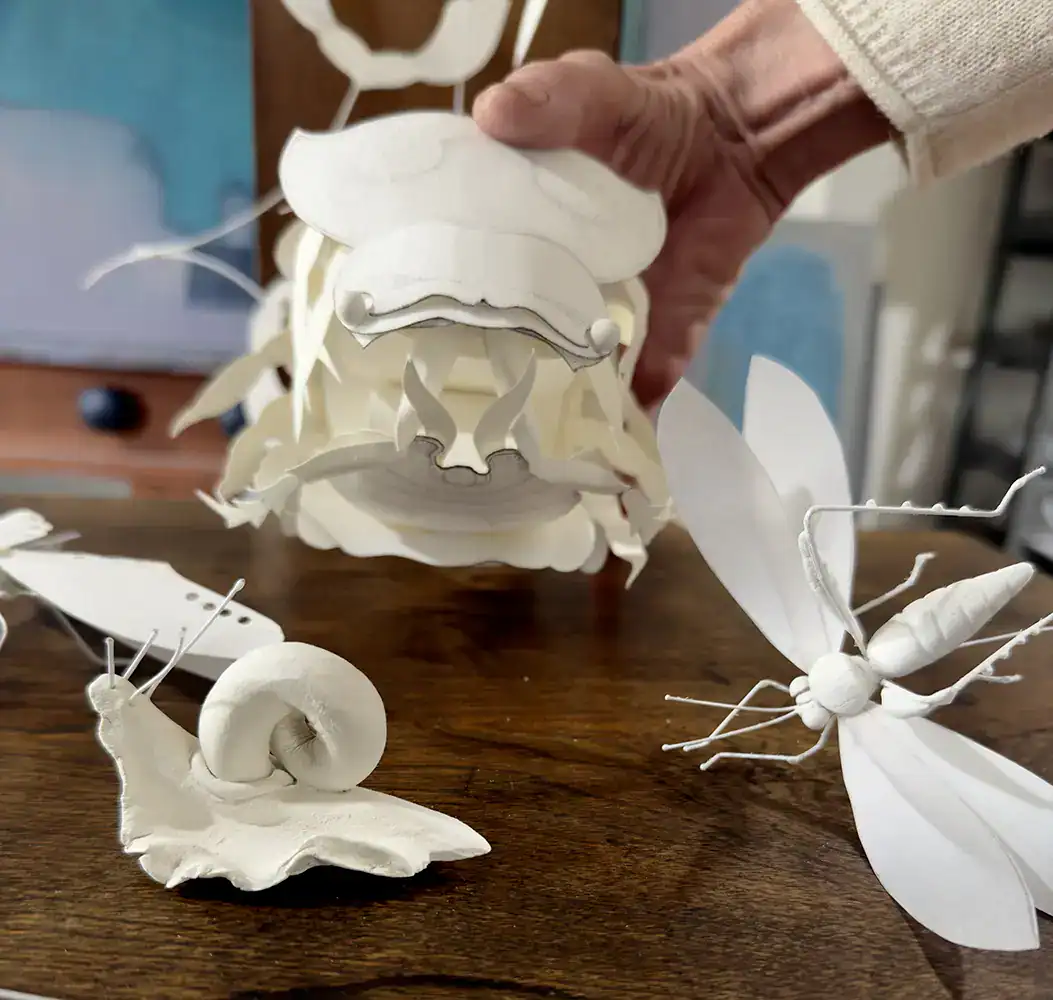
A deep curiosity about space and form. I am fascinated by anything and everything that creeps, crawls, slithers, or is simply just there to be observed. I have been known to spend weeks studying a single tree snail, tracking its course through the vegetation and patio to prevent a sad and crushing end! My mind needs to be exercised, not exorcised! I’m always exploring, constantly trying new work. When I’m really in the zone, I can be in the studio from seven in the morning until six at night. It’s complete chaos – my husband can’t bear to be in the room. But I’m so focused I just keep going, keep editing, and then finally I clean up, which is its own kind of catharsis. When you’re cleaning, you’re thinking, “I could use that again,” “this needs to go,” or “I need to look harder at this piece.” It’s all part of the process. Editing is the hardest part.
I also love working with interiors. Each new studio is a fresh playground, and the work carries on. Gardens are grounding in a different way: they’re structural, and they require form, shape, and color. I’ve always felt the outside is part of the inside; a garden is simply another room.
I understand that completely; you can go to bed feeling elated and wake up the next morning to find a piece hasn’t quite worked. Making art is unforgiving. Is there a particular project or series you’re most proud of?
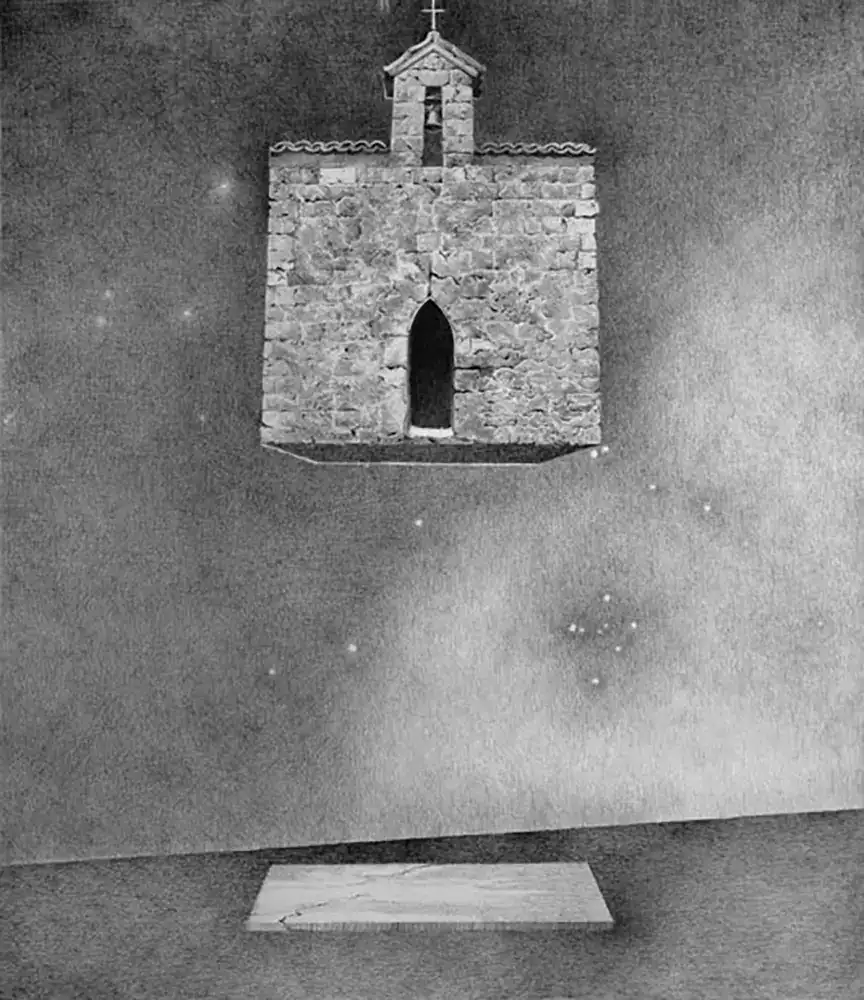
I made a series of pencil drawings beginning in 2008, buildings I had visited or remembered, always interpreted from a photograph I had taken. Each drawing followed a consistent format: a point at the top and a point at the bottom, with a small world contained within. They often featured a constellation in the night sky. The series was a memorial to my younger brother, who died too young. He had a difficult childhood and never really had the freedom to explore the world. He eventually moved to Scotland, became a brilliant chef at a small hotel on the east coast near Findhorn, and then, just when he had found his life and was doing what he loved, was killed in a terrible car accident. I wanted to share with him some of the things I had seen and loved.
That is a deeply moving project. Do you have advice to give a younger artist?
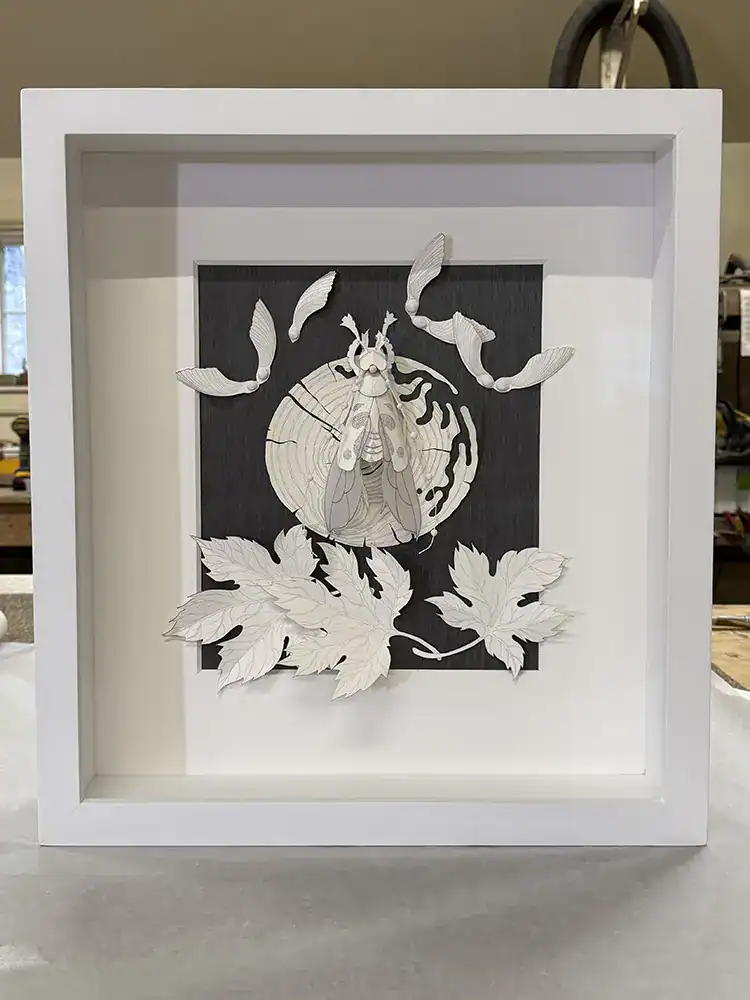
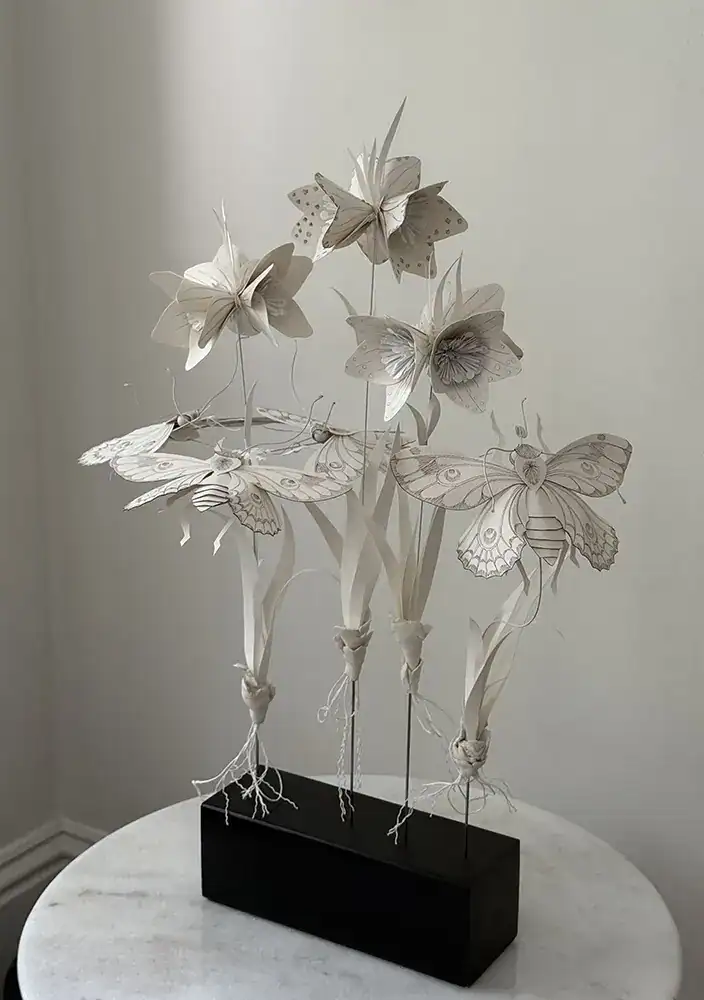
Focus, persevere, keep working, and never become complacent. Always keep it fresh. I’ve also made another series of paper houses, stacked and tapering, each one decorated with flowers. Their narrative drew from Norse mythology, the two ravens of Odin, who were his eyes and his ears. With the works on paper, the themes have evolved organically. I began with buildings, then the buildings started to be decorated, and from that came the three-dimensional insects and flowers, which led to everything I’m making now.
Is there a collaboration or project you still dream of?
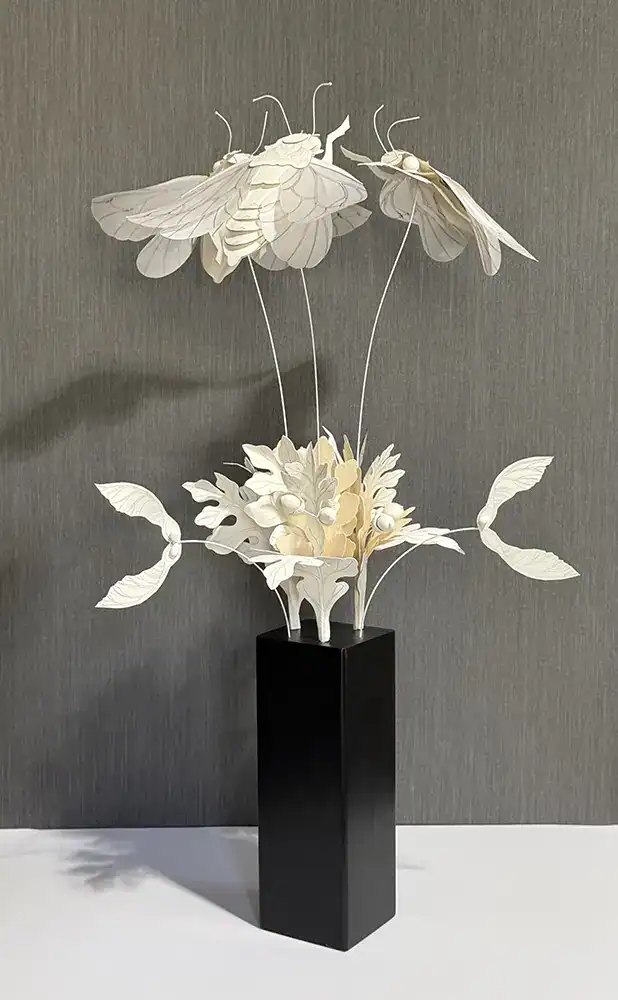
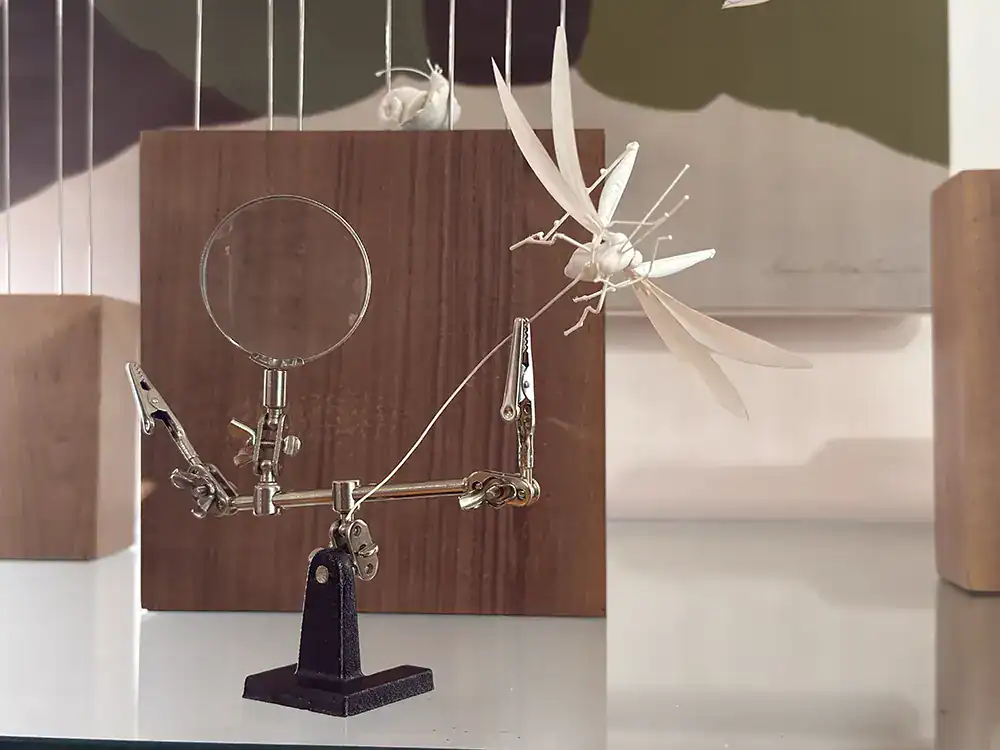
For a future project, I would love to create a large-scale garden installation entirely in paper. That would be something. These pieces here are from the garden, with flowering fritillaria and sycamore seeds cascading down the wall. I’d love to make a series of mobiles as the pieces respond to the slightest breath of air or movement in a room. This single cicada required around 25 individual pieces of paper. Creating it took an enormous amount of work. I used a fly-tying tool, designed for tying fishing flies, to hold and manipulate the tiny details. I often say I need to be an octopus to make some of these pieces!
So deceptively simple. I love the way you build a narrative into your works. If you could have any artwork in the world to live with, what would you choose?
A Brancusi sculpture. I love the forms, the way he made these totemic pieces, the line, the angle – the utter simplicity. And Nick Cave’s work; his installations are phenomenal, particularly the one at MASS MoCA. Staggeringly wonderful.
Stepping out of this secret garden with beetles and butterflies winding through the undergrowth, a small snail keeping watch, everything shifting almost imperceptibly with the faintest movement of air, each piece suspended like a thread of gossamer, you suddenly remember that all of it is paper delicately made and yet so alive. Jones brings the woodland to life inside with her intense observation and attention to detail. I highly recommend seeing her work in person. •
To learn more you can visit Amanda’s website, amandahortonjones.com, check out her Instagram @amandahjones1959, or email her at amandahjones@mac.com. Amanda Jones’ artwork is currently on view at Bunny Williams,100 Main Street, Falls Village, CT.