This Month’s Featured Article
“Directing always on my radar,” says award-winner John Saunders
Watch a movie, television program, or stage show. The movements, emotions, expressions, emphasis – the whole feeling, look, and presentation of it involves many people, but when it’s added up, it all comes down to the director. He or she carries the weight of the show on their shoulders, from first deciding to take the project on through opening night.
John Saunders is a director. He is also the producing artistic director of The Mac-Haydn Theatre in Chatham, NY, having taken that role when Lynne Haydn passed away in 2018; co-founder Linda MacNish passed in 2002. We talked during his directing The Secret Garden for its fourth time on the professional musical summer theater stage; Saunders had played the leading role of Archibald Craven, and so has an intimate knowledge of the show.
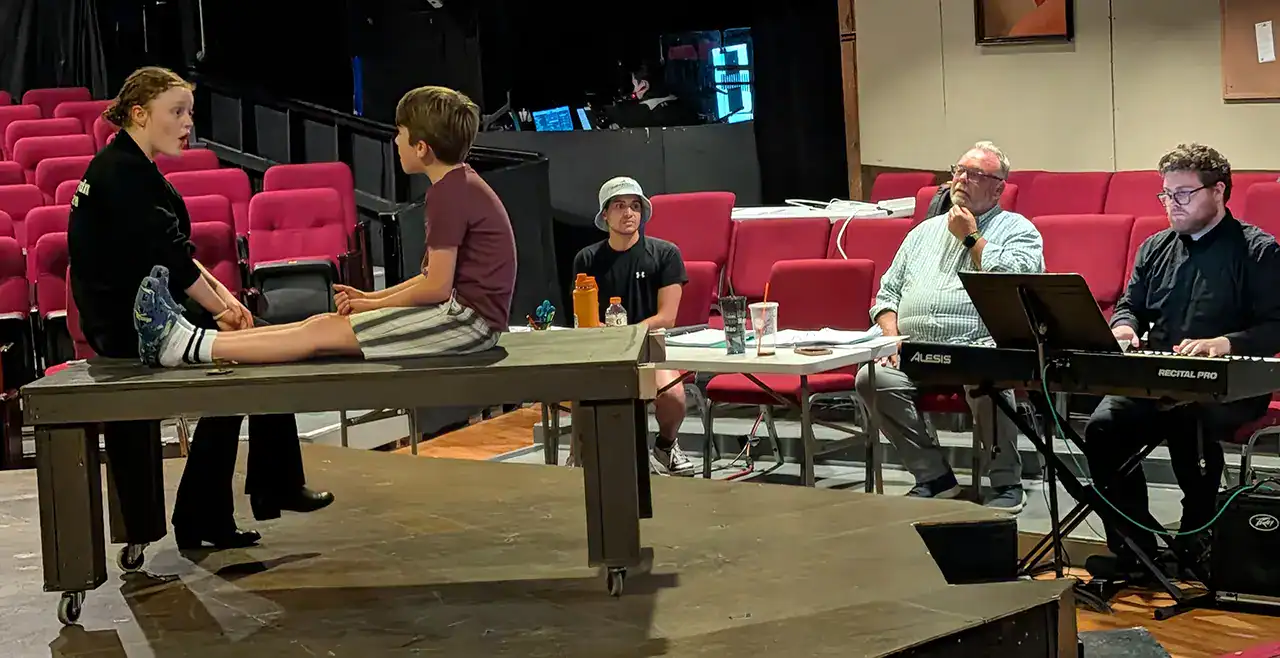
Seeing him work through blocking a scene, a week before an audience of volunteers will see the dress rehearsal, shows how he has arrived at many highly praised and award-winning musicals at Mac-Haydn.
Behind the scenes
In traditional stagings, a small chorus, called the Dreamers, has little to do beyond occasionally illustrating parts of the young girl Mary Lennox’s past. Saunders makes them much more a part of the show, not only describing Mary’s past but also guiding her future, and her grieving uncle Archibald’s.
The scene flows from the Dreamers leading Mary to Colin’s bedroom to Lily as a Dreamer showing her the entrance to the secret garden. Saunders, on stage, instructs, “Turn,” demonstrating how he wants them to make the move. An actor asks, “Are you not gonna be right there?” and they all, including Saunders, laugh.
He rearranges movement, “So we have all this forward motion.” They run the bit the new way, and he throws both hands up for a double ‘air high five’ and proclaims, “Perfect!”
That set, he turns to the actors playing Archibald and Neville, asking, “You guys wanna walk this?” as they go into a powerful duet, and he motions to move them into their places throughout the scene.
This leads to, “Now, where are we? Oh – it’s another storm. Let’s rock and roll!” He walks backwards, pointing people to their spots, while explaining where a set piece will stand. With the piece in place, they do it again. He adjusts one person, turns another, and explains how Mary will weave her way through them to find the source of the crying she hears.
Choreographer Anthony Michael Velez steps in to stylize the Dreamers’ poses, “Be like robots, just from the waist up. That’s it.”
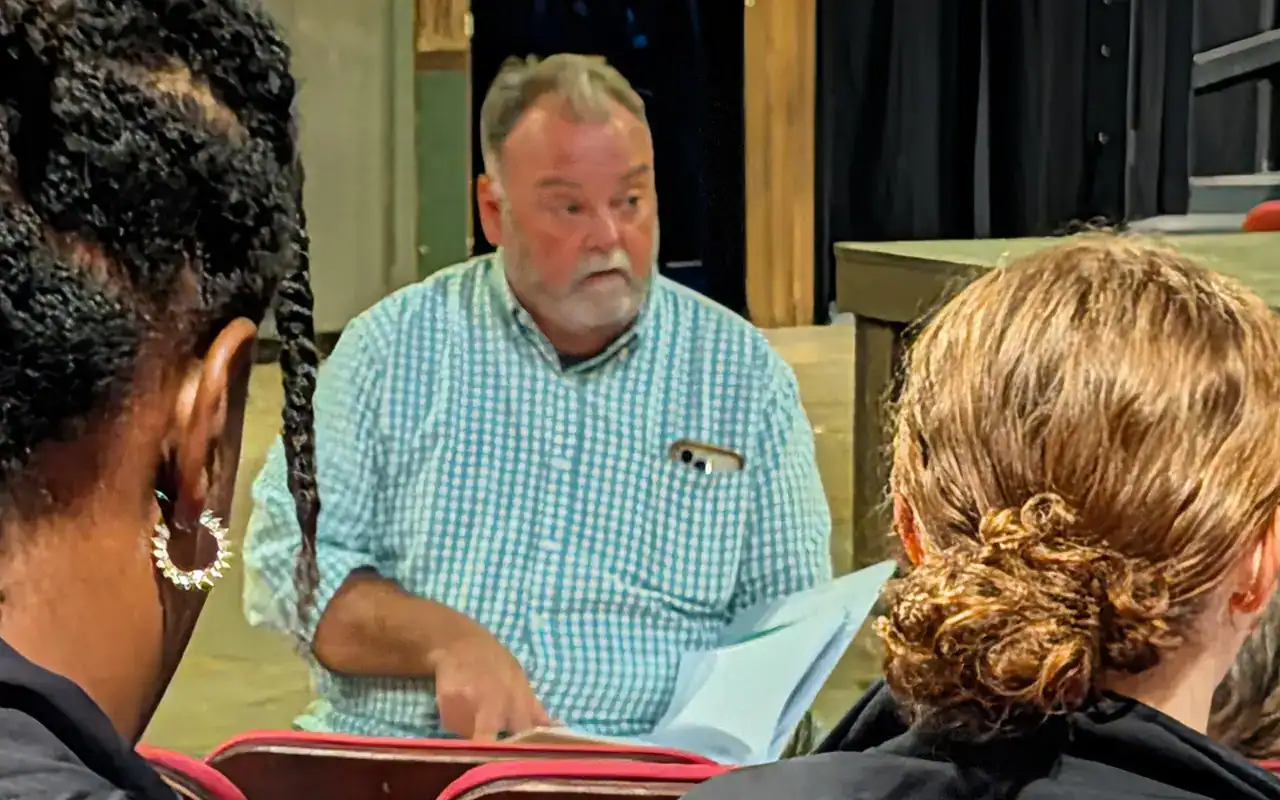
Saunders gathers everyone in a seating section, to read and sing through the scene. “Great! Questions, comments, concerns?”
He gives them all a note, “Lean into that accent. Don’t be scared of it, go for it.” To one actress, “Really nail that ‘C’ – Comin’ a terrible storm,” and to others, “Shoot your line this way,” “Mary don’t go too far upstage,” “Don’t get too close to him, give yourself somewhere to go,” and “Land here for your line”.
The Dreamers characters have all passed away, but he advises one, “You wanna be sick? Okay, you’re sick,” and to another, “You’re not sick yet,” as a part of the scene illustrates the cholera that took them.
He turns to the musical director, “This is a little too slow for me. It needs to build a little more. Try it again, from the solos.” Listening again, he nods approval of the change.
Moving a dozen or so performers around a 12’ by 14’ stage is challenge enough. Then, there are set pieces. Without a curtain to cover scene changes on the in-the-round stage, and to keep the action flowing, these must be integrated into the blocking. This leads to arranging Colin’s bed being taken off stage while the Dreamers move to their next bit, “Mike, do you really need Will on the bed? I need to get you back quicker,” and the response, “Yeah, I do, to steer it.” Running the maneuver several times helps the timing.
During this, he reminds the others, “Gotta get this bed out of here. We’re all creeping in, creeping in. Leave yourself somewhere to go.”
Who is John Saunders?
Saunders started as an actor, playing Jigger in Carousel and the title role in the children’s theater show, Rodney, the Reluctant Dragon in his first Mac-Haydn season. In his second year, he started directing those children’s shows, and a few years later Sugar Babies was his first main stage work.
He has staged an impressive number of shows at Mac-Haydn, as well as at Wagner College, Nantucket Theatre Workshop, and Seacoast Rep, while continuing to perform at Mac-Haydn, in national tours and regional theater.
In the past few years, he gained an enviable three ‘Berkies,’ the Berkshire Theatre Critics Association awards, for Ragtime, Jesus Christ Superstar, and The Fantasticks.
We sat down with him between his finishing an afternoon of directing The Secret Garden and solving a situation with company housing.
We first knew you as an actor. What got you into directing?
Directing has always been on my radar. I always knew I wanted to do it. Talking to Lynne and Linda at my first audition, I said I eventually wanted to direct.
As artistic director/producer, you determine the shows for each season. When in that process do you decide what you will direct?
For me, it’s always about the audience. Mac-Haydn is deeply rooted in classic musical theater, so I start with that to appeal to groups and subscribers. Next, something new every year, something they haven’t seen yet. Then we choose the rest around shaping the company and the skill set needed. I think about the other directors’ schedules and work my way in. I certainly don’t want to do, for example, the first show because I’m working on getting the season open. I also like to give a new director the three-week rehearsal time to work in. If a show is especially difficult technically, it makes sense for me to do it because I’ve been working in the space so long.
Do you have a concept for each show and for what you want the finished product to be?
Every show has to have a director’s concept, especially here, because you have to think about the nature of the space. I think about how the show makes me feel and try to pass that on. I hope the audience will feel that same thing when they see it.
How do you work towards making that happen? And does your plan change as you go through the process?
[With a smile] First and foremost I trust the creative team assembled to build the show. It’s all about trusting the team to be really good, the ones who can add an ingredient to the cake. For example, I told scenic designer Alivia Cross about wanting to have the tree bark made out of book pages. It was me throwing the idea and her putting pen to paper and coming up with how to do it. It’s really not a solo sport at all, but rather a huge group effort. That team, that crew makes my weird little dreams come true.
The classics are usually full of standard things, but you find ideas that make the show your own, like in Secret Garden using the Dreamers more than they are usually featured.
The Dreamers are not just working for Mary, they’re also working to pull Archie back to the garden, to find Mary a home, and also ultimately to get Archie to know Lily is always with him. Using them as the denizens of Paris, and seeing them as ghosts when usually he is there alone, leads to his hallucinating spiraling to “There she is!”
With the director’s concept first and foremost, how much do all the other elements enter into how the look, feel, and presentation of the show ends up?
Oh, quite a lot, especially in terms of scenery and clothing. Scenic design is key here; Olivia Cross solved some of my problems. I go in with a question and “Poof!” there’s an answer. It’s so important to the process.
How do you help the cast give you the performance you want?
It’s technically known as “side coaching.” My idea as a director and actor is to export a little data for them. Don’t tell them how to read a line, but give them something they haven’t clocked yet, “Think about this, what if this is going on?” I give a lot of visual stuff, like Nina Liang, playing the servant Martha, putting the night sky here, the storm here, through her number. Working in the round is nothing like performing in a proscenium theater. He explained to Logan Pavia, Dr. Neville Craven, about the British accent needed, “Speaking is the same as singing, find the cadence to it.”
How is directing at Mac-Haydn, in the round, different from working on a proscenium stage?
Phew! The biggest difference is you have to move the picture more. I use the word “share” a lot. “Let’s cross to two but share to four,” or “face two, but then turn to four.” Movement is important; it then makes stillness important. The picture has to change more than on proscenium. I think it’s thrilling here, it’s fun when the performers are singing right next to you.
How do you feel on opening night when you see the show as the audience does?
It’s my favorite part of the entire process. I think it’s why I love directing so much, I love the hand-off, to see the cast live in this thing they’ve built. I love the audience reaction.
Is there anything else you’d like people to know that hasn’t been asked?
Honestly, I love my job, I really do love my work. I know how lucky I am to do it, I know how lucky I am to have inherited Mac-Haydn Theatre. I love my audiences. I love seeing the kids make it through the summer. They don’t rehearse that much at all, and they put on these magnificent shows. We’re firing so much at them, gotta let them have their process. It’s a teaching moment, that all comes back to the mission. I’ve definitely realized over the years, trust the teams.
Saunders paused his answers to interject praise, “People don’t see singing like this. It’s insane. I’m blown away.” He added, “Newsies is the largest cast we’ve ever had: 32 people. That includes 10 local kids, who are so good. They’ll be working with the professionals.” That runs through August 9, followed by Beautiful, the Carol King Musical, and then Hairspray, where you can see Saunders on stage as Edna Turnblad; he is also directing Daddy Long Legs.
His final comment: “We all want the performers to look their best.” The applause, the people returning year after year to Mac-Haydn, and the awards attest to much of their best coming from his best. •
To learn more about the Mac-Haydn Theatre, visit their website machaydntheatre.org.