Featured Artist
Seeing the Self: Seth Howe
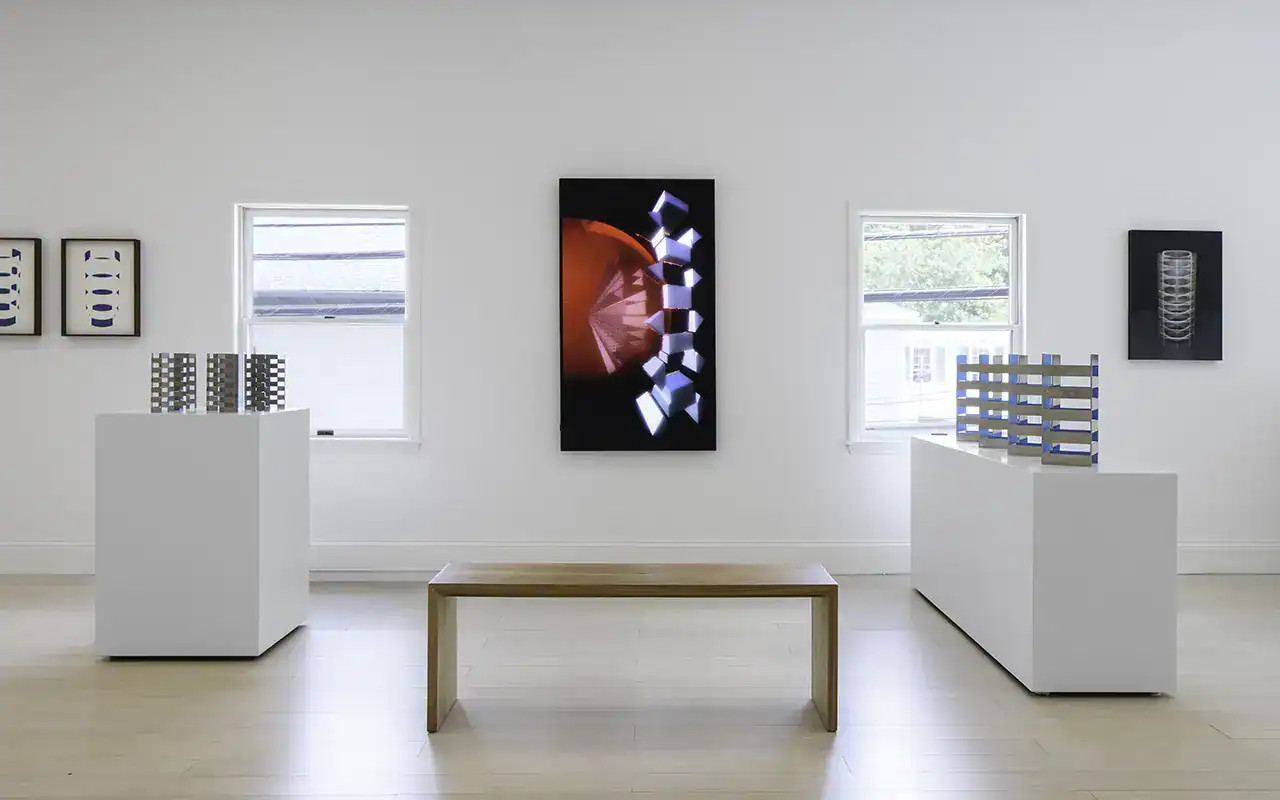
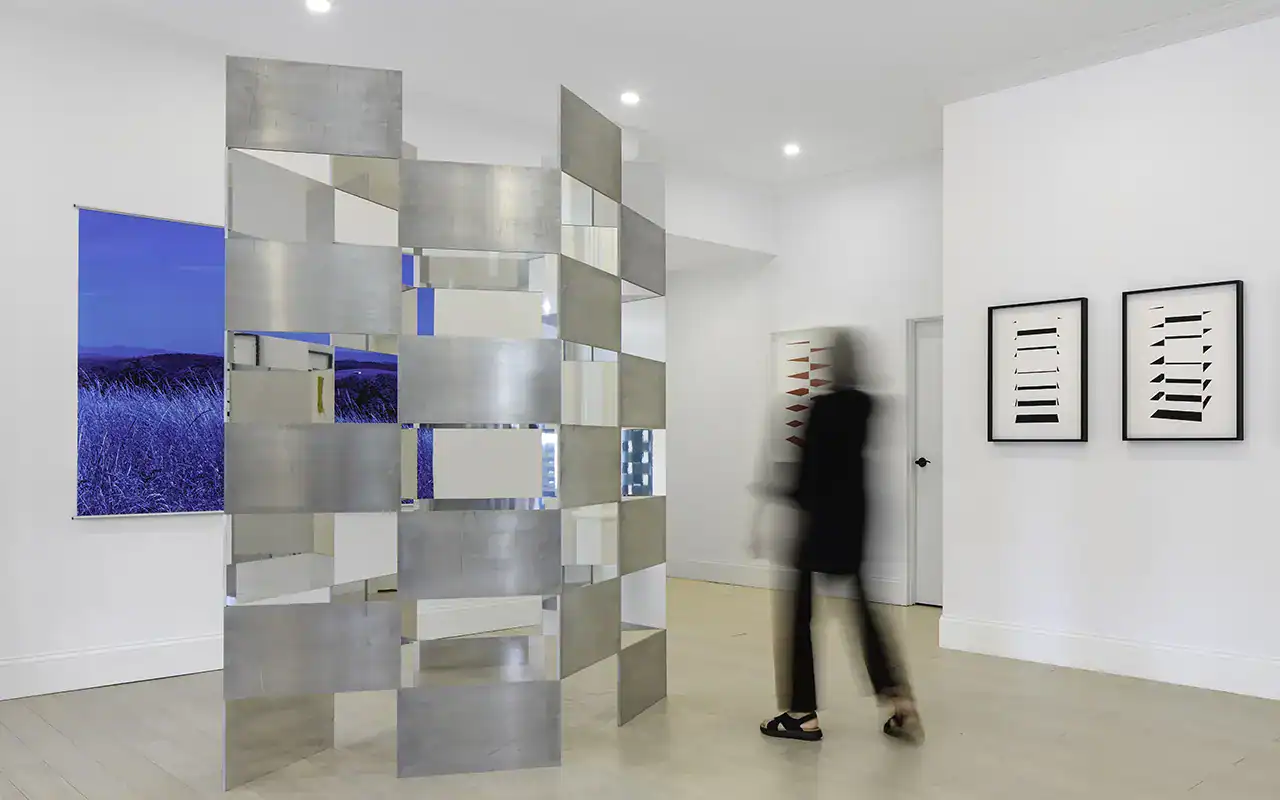
I met artist and architect Seth Howe at his solo show “Architecture of Awareness” at Tyte Gallery in Millbrook, NY, curated by Sharon Bates, to talk about his practice and walk among his three-dimensional works. His minimal, formal pieces are inanimate objects, yet they come alive as you move around them. With each step, you catch fragments of yourself in the surfaces, seeing self and sculpture in the same moment through the spaces. Polished steel and mirrored finishes reflect the viewer, standing as hexagons or rectangles that are reimagined with every showing. The pieces work indoors and out, holding their own within a landscape.
What was it about this area that prompted the move here?
I grew up in Poughkeepsie. When I went to Cornell for the five-year architecture program, I promised myself I’d never come back to this area. I didn’t love the countryside back then, and I wanted a more urban life. But for my architectural thesis, we had to pick a site, and I chose the Millbrook town park, Tribute Gardens, which I remembered from growing up. The thesis was based on a cemetery. I’d spent my fourth year of college in Italy and was deeply touched by the art and architecture there. The cemeteries in Italy are monumental. Returning to Millbrook felt like coming home. My father worked for IBM, so I grew up in a suburban, mid-20th-century environment shaped by the idea of progress, the belief that technology would save the world.
 What pulled you into architecture? What made you want to make three-dimensional objects?
It’s interesting to look back and see what connected me to architecture. I loved figuring out the details of a building, but what drew me was really about space, the perception of the body, and how we move through space. That’s a huge part of architecture for me. I still have an architecture practice, but I don’t run it as a “star architect”. I want to serve my clients, so stylistically the work doesn’t stick to one trend, but it’s all driven through my own lens. Still, feeling the pull of creativity, I went back to art school at 35 for a three-year MFA at Hunter College. Robert Morris, one of my professors, became a huge influence. I left school starry-eyed, thinking I’d be showing in galleries. Instead, I ended up in an office in the Meatpacking District, one of 15 employees, working mainly on hotel projects. It was interesting, but not ideal for me. Eventually I moved to Culver City, in Los Angeles, and was bicoastal for a while. There I designed and fabricated tables, buying sheets of aluminum and using a water jet to cut the tabletop and furniture shapes. Plenty of leftover pieces piled up in my studio, which was in an old bowstring-truss building. One day, I found myself on the floor playing with leftover bars of aluminum, stacking them. That moment in 2013 was the genesis of this work.
It’s amazing how remnants become the seed of all sorts of things. I love to walk and gather. I pick up objects and rediscover them later.
I also make things that don’t make sense until a few years later. When I pick them up again, they suddenly work perfectly for what I’m doing right now. Somehow, I’ve come to believe in a kind of time travel, that we have a sense of the future. Not in the space-time sense, but in some other realm. I’ve become rather metaphysical in my older age. If you open yourself up to that, you might make something and set it aside, knowing it will have a future use.
I agree, I feel creativity is partly about timing. You make things before they’re ready to be received, or before you’re ready to understand what they are.
A thread runs through my work from childhood to now, and it’s remarkably consistent. When you’re younger, less mature intellectually and spiritually, you catch glimpses of where you’re headed, but it’s covered over by layers of parents, culture, and convention. It takes years to strip that away. I believe we all have access to something beneath it, a kind of pure consciousness we’re made from. I’m not religious, but language and convention pile up, and the work is pulling those layers back to find your authentic self. Some people never do. Some do it early. This show feels pivotal, a turning point in how I’m moving forward.
What motivates your creative practice?
I’m more of a philosopher who makes art. I still hold a fantasy about getting my PhD. I started reading seriously in my 20s: the existentialists, the phenomenologists, Merleau-Ponty, Bergson, and Heidegger. I’m fascinated by consciousness and perception – Merleau-Ponty’s concept that we create the world through each experience, in each moment. We interface with something out there, but only through our experience of it, through the lens of the language we’ve created. So, reality itself is a creative act, for everyone.
Consciousness fascinates me: how we move through the world, how we have free agency, to some extent, over our own movement. Everyone takes that for granted, and I felt there was something wrong with that. There’s something amazing in our capacity to know ourselves, to be aware of our own awareness. That’s been a driving force in my work. It’s been muddied by reality and constraints, but I’ve pushed out of that as much as I can. The motivating factor is figuring out what that awareness is.
I call these pieces “seeing devices”. They’re sculptures, material objects with aesthetic value, but that’s not the subject. The viewer is the subject. The act of looking is the point, not what you’re looking at. I try to peel that away for people.
I feel there’s a computer aspect to this too, a sort of disjointed pixelation. I can see a shoe, a leg, parts of a whole. It reminds me of when you had to recalibrate your computer screen, pixel by pixel, to make sure everything was in the right place.
No one’s ever described it that way before, but that’s exactly it: the language of the image. All those dots come together to form a representation. It’s a controlled explosion, one step at a time. Nudging one person slightly to see something differently is enough for me. It’s not a huge statement, but there’s something subversive about it, because it’s trying to dismantle a system of seeing. The art world is filled with immersive projects right now, which feel like entertainment. What I’m trying to portray in my practice is more conceptual: an object within a space, where the human form is part of it and yet stands apart. In some forms of minimalism, the viewer isn’t even given a clue as to how to enter the work. James Turrell and Larry Bell give you a sense of that, an entry point, which is interesting.
What artists inspire you or have mentored you?
Fred Sandback is one of my biggest influences. I used to have a studio at Mana Contemporary in Jersey City, NJ, in an old tobacco factory that had been turned into artist studios. It was right next to a permanent installation of Sandback’s work at The Ayn Foundation, set up by Heiner Friedrich, who also co-founded Dia with Philippa de Menil. When I first saw a Sandback piece, around 1996, it struck me: how could this simple piece of string do so much? I’m trying to straddle that same territory. I wanted to do something minimal in my own language, with the materials I like to work with. Dan Graham and Tony Smith gave me a voice; when I was at Hunter, the main campus had a big Tony Smith sculpture outside. Some of the light artists, too, James Turrell, to some extent. Rachel Whiteread, the English sculptor who works in cement, casting negative space. And Bill Viola is there for video.
Art that’s accessible and has some sort of permission to access it like Walter De Maria’s Broken Kilometer and The New York Earth Room. Finally, Antony Gormley. I saw something of his at White Cube in New York a year or two ago. He filled it with this very delicate structure, not quite a grid. You could only walk around the perimeter. There was a human scale to it, in the sense that he’s taking the human body and making it geometric. Because you were confined to the perimeter, the structure felt fast, lacy, almost delicate. His work is all about the body.
Does your work change shape?
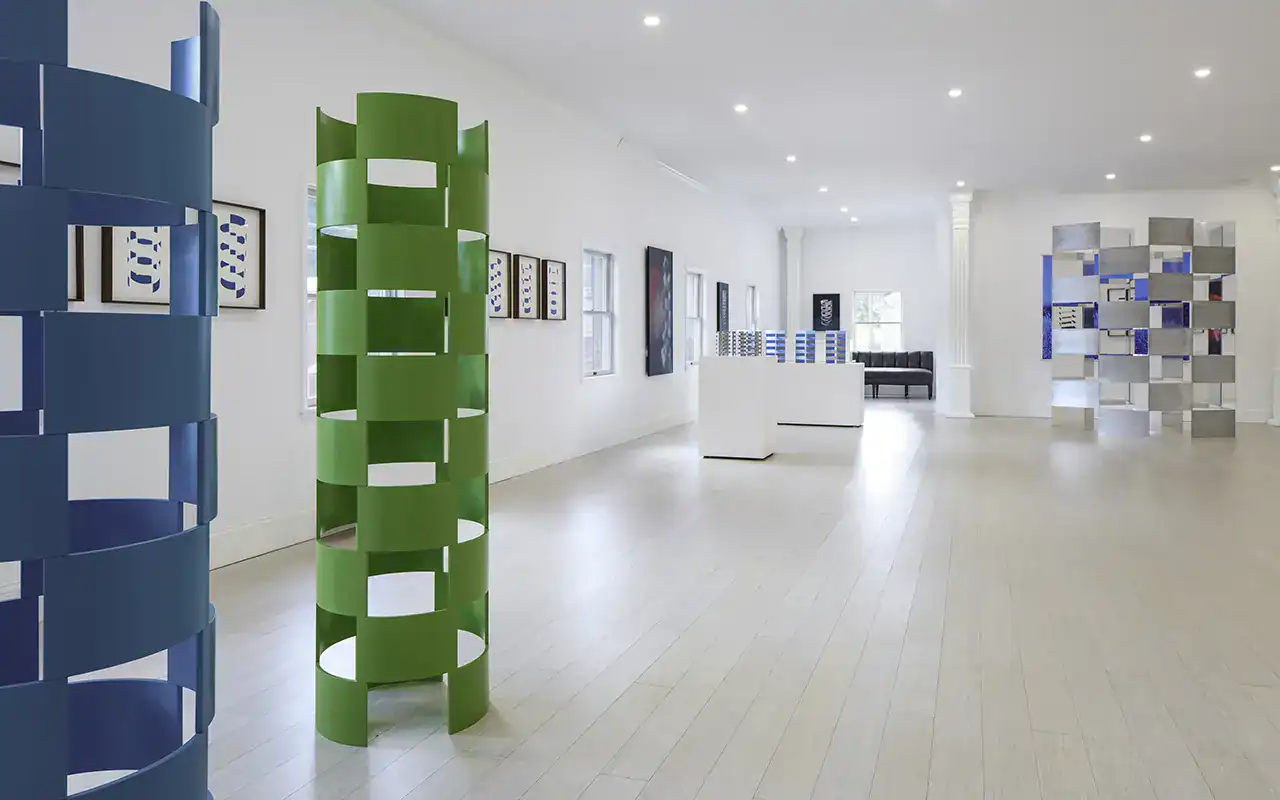
Stack Diamond Sculpture was first shown at FIT in the fall of 2024 as a hexagon. The individual pieces of aluminum weigh around 12 pounds, with linked pins for attachment and a mirror polish on the inside. The exterior is left in a raw state, as it came from the factory; you could make a metaphor about life and its rough edges. Whenever I reset it, a new piece evolves. I live about a mile from here with an apple orchard in my garden, so I kept it outside as a 12’ hexagon for open studios during Upstate Art Weekend this summer. For this show, I wanted a wider footprint, so I curated a diamond shape instead. This one is eight feet tall; I have multiple geometrical shapes I can play with. I also like materials that patina, things that shift with time. During the installation outside, birds interacted with this work which was fascinating.
I’m wondering if you could talk about how you see color composition and how patterns play into your work. I see triangles throughout some pieces.
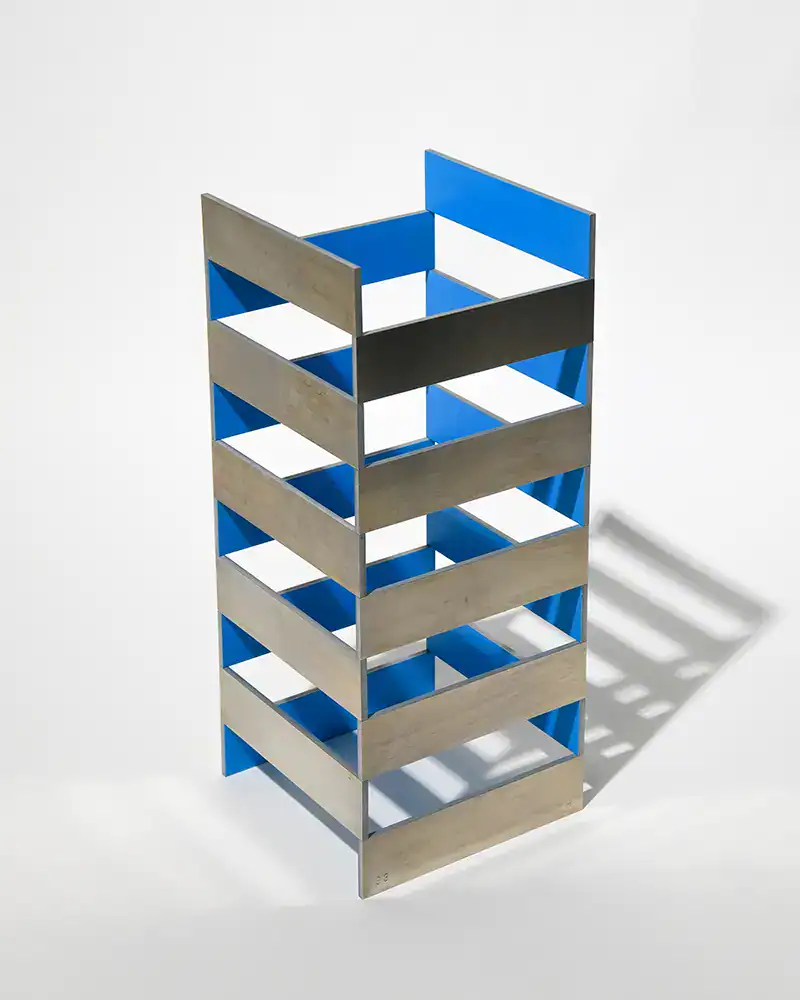
In some installations I paint a wall of color, or several walls in different colors, and the colors blend into the sculpture, activating the piece further. I don’t want anything more than what’s necessary. That’s a modernist kind of ideology. I experiment with 3D printing before going large. I love technology, and 3D printing allows me to easily experiment with the proportion and scale and the way the openings work together, though not in a formal way. It’s more intuitive. The smaller maquettes were my first attempts, during the pandemic. They also brought color into the work. They were cut, pinned, and painted, and that grew into the larger pieces and two-dimensional works. I noticed the patterns of solids and voids. As you move around them, the voids shift, sometimes a triangle, sometimes a trapezoid. It’s a record of what you’re seeing, materiality, and consciousness. In some ways, the sculpture taught me how to see deeper, and how to connect with what I’m interested in: perception, movement, and the body.
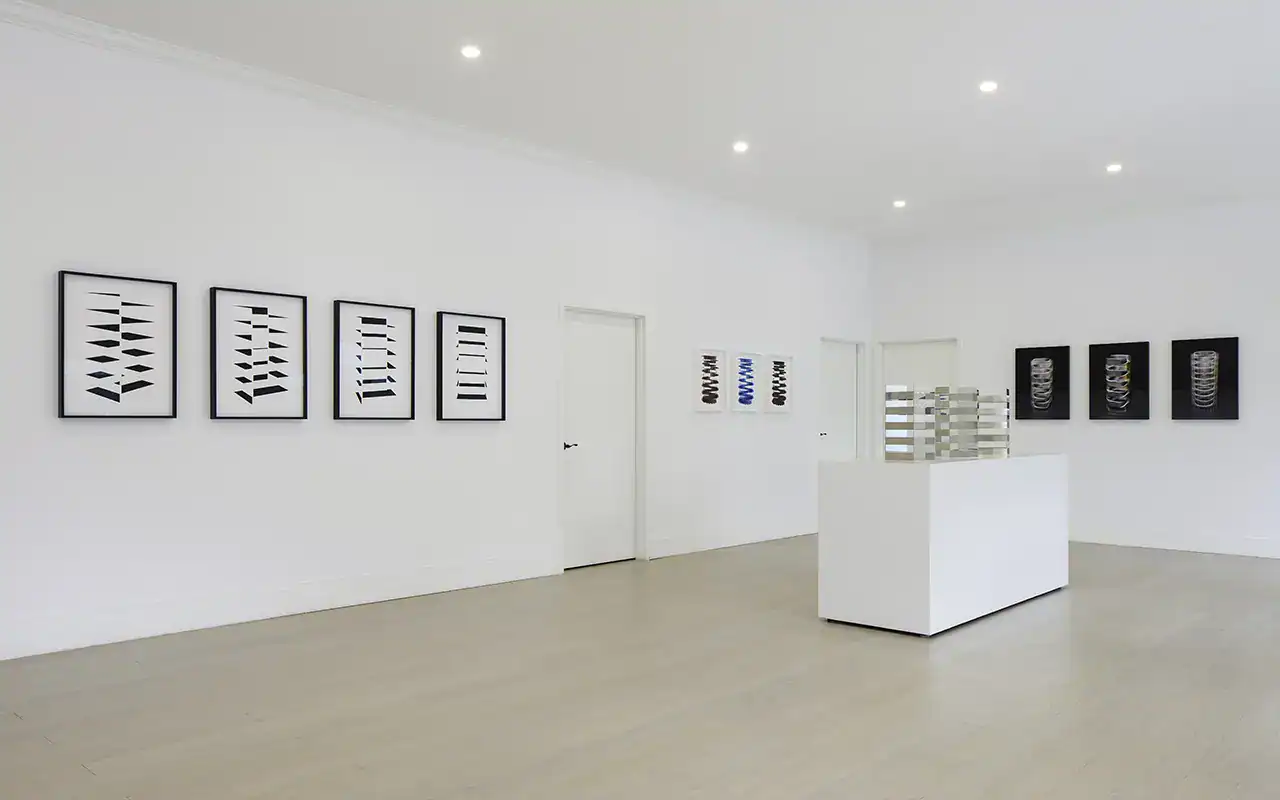
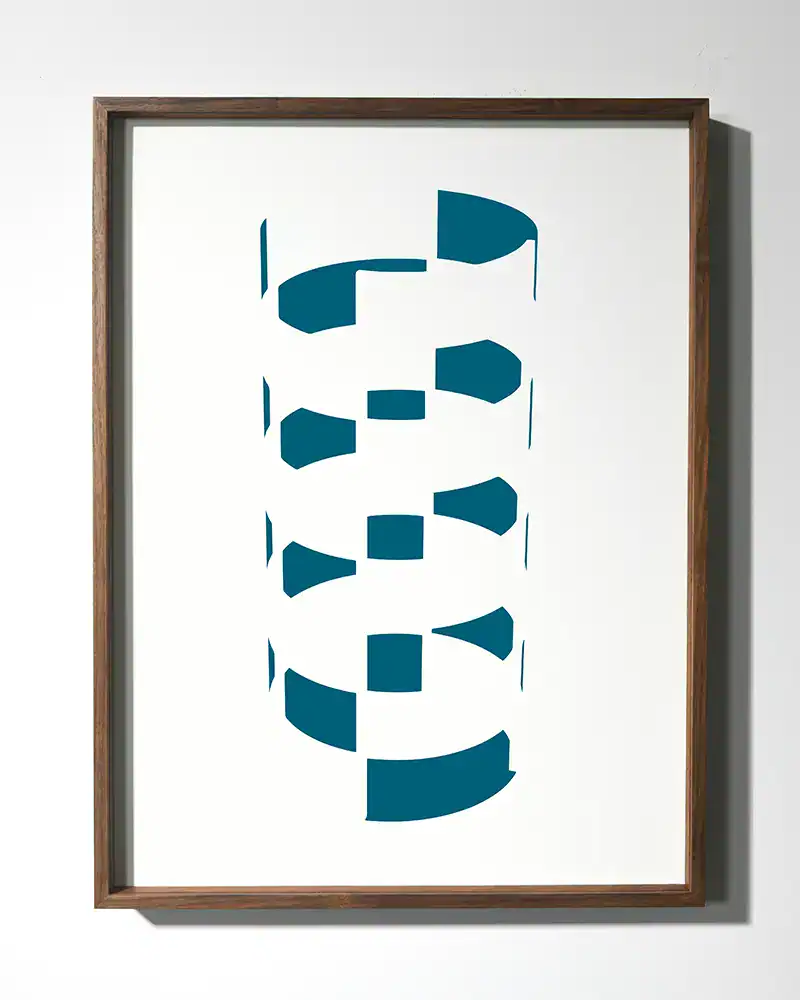
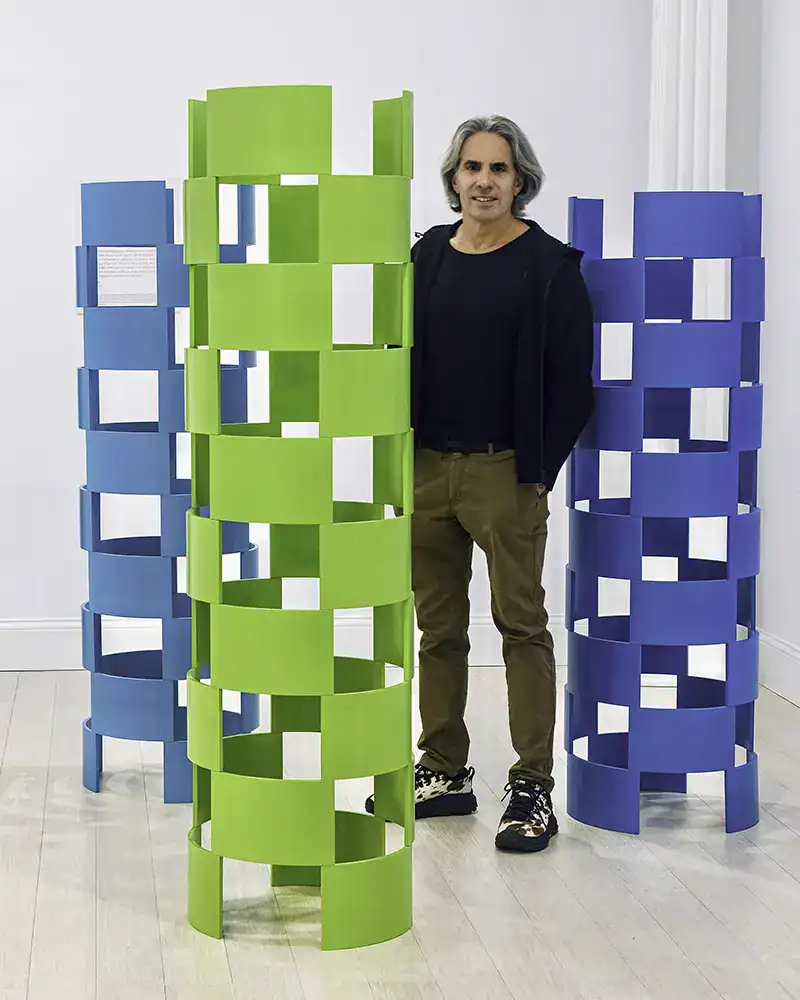
The Cylinder Sculptures Series originated from working in Marfa Texas and seeing the vernacular steel and fuel tanks. The form felt conducive to that environment. These wall pieces are the negatives of those cylinders, they focus on the precise geometry revealed at a single point in the rotation. These prints are called “synchronic”, a term for studying something in its present moment, transposing the three-dimensional rotation into a two-dimensional piece. It’s often used in linguistics, but here it’s about a single moment in time: they are what they are, as you see them.
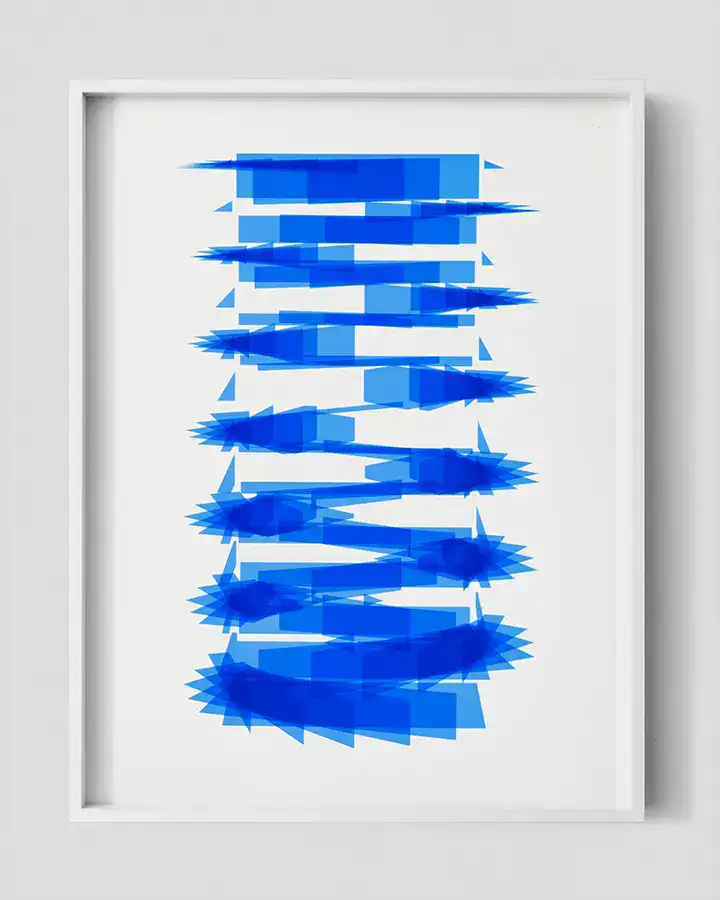
For the Diachronic Rotation Series, I took seven prints and layered them. These are called “diachronic”, the study of things through time, how they arrived at where they are in the present moment. This captures the multilayered prints from the Synchronic Series overlayed with sequential images translating moments across time.
It’s an evolving process, and you’re constantly rethinking a piece. The happy accident, finding bits of material on the studio floor or spilling something, becomes the work.
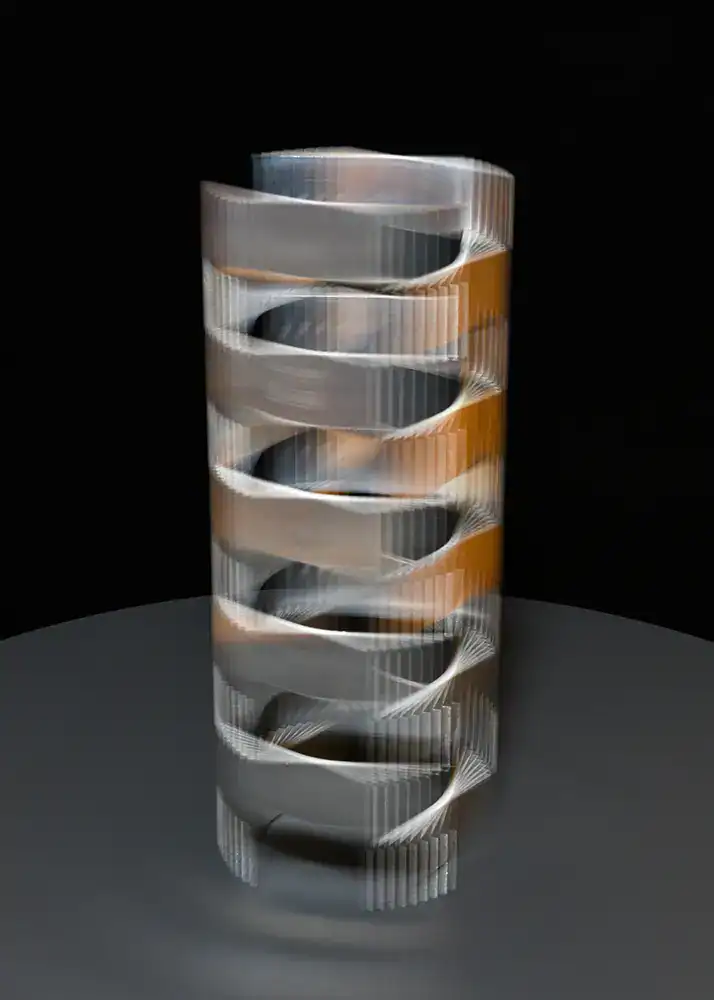
Yes, the work is constantly evolving. I was making videos of the sculpture on the turntable, some as documentation resulting in a 24-hour sequence, which is very slow, but I love recording on the turntable. The works change in that space. Alternatively playing with photography and allowing movement of the Square Maquettes sculptures, I spin the work on a turntable at different speeds, stop and start it, and shift the mechanism to different angles. These are open-shutter shots, many different variations. For me, they discuss time slowing it down, speeding it up, and capturing it.
In the longer video piece Hexagon Origins, the video starts with a formless static representing pure consciousness, shifting toward hexagon forms and solidifying, only to dissolve into negative space (which itself solidifies as objects), and finally emerging from matter splitting apart, then returning to static, a consciousness-like state. The accompanying music was from a newly released album by JARR, two composers from the UK who collaborate. I found them on Instagram, and one of the songs, Open Water (Blue) fit perfectly in the rhythm and pacing.
So interesting to see the work as a moving object – it makes the work alive. What’s the best advice you were ever given? Can you share advice for an artist starting out, and how do you define a successful show?
I don’t know if it was positive advice so much as “anti-advice”. My parents were very fearful people who played by the rules and liked the security that conformity offered. The more they conformed and told me I shouldn’t do something, the more I wanted to do it. There’s a teacher named Rupert Spira who teaches non-duality, the idea that nothing is material, and everything is of the mind. For me, culture complicates that: people get deeper into these little holes with their own special language, their own references, their own way of being perceived. My work takes a much broader view and speaks on a simpler level. I’ve always resisted being put into boxes and categories. My advice: step back a little. Don’t worry, it will all reveal itself. Be patient. You must find your true self, your authenticity, and that’s hard coming out of culture. The other thing is ego. I’ve had to let go of a lot of that, and it’s still evolving in this phase of my work.
As for success, it’s a couple buying something small, or someone engaging with the work in a way that moves them. I want my work in the world because of those connections. I don’t need a stadium full of people. I’d rather have one person at a time encounter the work. The success is the connection, realizing you made an impact, even the tiniest, most momentary one. Many people think that because they’re not thinking in a conventional way, it’s not good enough. But we do have some control over how we move through the world. I want people to see my work in person and experience what they’re perceiving in the moment, without the noise of language or references to other things. The work should appeal to a five-year-old as well as to a thirty-year-old who never looks at art, something that triggers a reaction and starts a conversation.
I enjoyed the almost dismantling quality of Howe’s three-dimensional works: the viewer never really sees the whole self. We catch glimpses of ourselves in a mirrored surface. The work disarms viewers even as it entices them into the space. There’s a great sense of connection and disconnection in the work, with pieces held together by just a thin, almost imaginary line, or a line that’s perceived, because there’s a gap or even a pin holding everything together. Sometimes you only see the negative spaces on the wall or the shadows falling on the floor crossing our own shadow. Looking through all of them, you find connection in the moment. •
To learn more visit sethhowe.com, or email seth@studiohowe.com. Follow on Instagram @sethhowe_art