Featured Artist
Alexis England
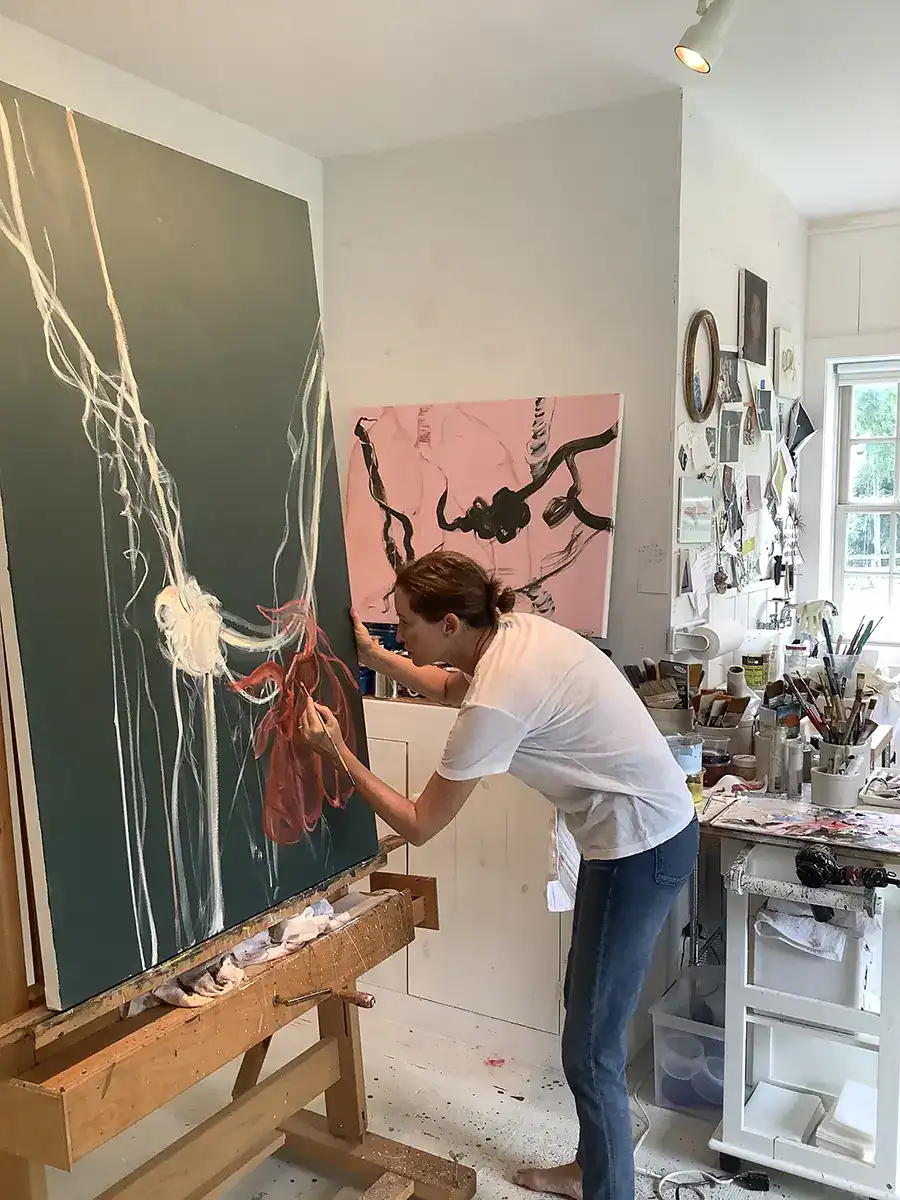
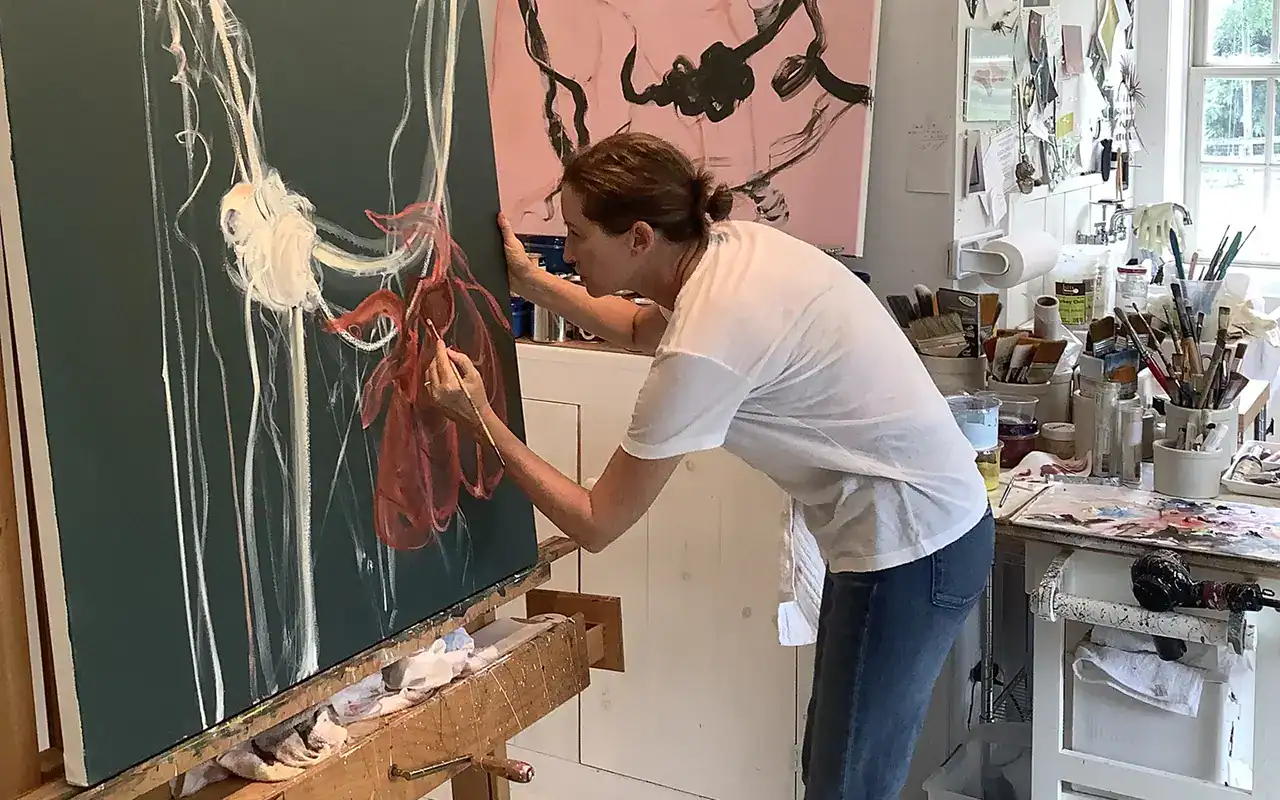
Alexis England’s studio is a place of beautiful contradictions. While curious goats peer in from the cold Millerton winter outside, England manages two different creative worlds within the same four walls. To your right, an immaculate setup for her celebrated animal portraits, detailed, pinpointed, and traditional. To your left, the room opens into large-scale abstraction, where the brushwork is broad, sweeping, and rhythmic. It is a space where precision meets expression, and where every mark tells a story. I caught up with her to talk about her practice.
What was it about this area that prompted the move?
I used to visit a friend up here, and eventually, I just knew I had to be here, too. Luckily, my husband Scott felt the same way. We found this house and never looked back; in fact, we bought the house before we even looked for an apartment. We were living in New York at that time. I had originally moved back there from Los Angeles, where I spent a long chapter of my life in the music business, but I was ultimately unhappy there. For me, the lack of seasons on the West Coast felt soulless; I realized that experiencing the change in seasons is key to my happiness.
I grew up on the East Coast for the most part, at least when my parents weren’t dragging me all over the place. I was so excited to finally come back. It feels good to finally be planted.
I came for the beauty of the landscape. Our farm is currently home to donkeys, goats, turkeys, and dogs. My creative process happens in a converted steel garage that we’ve softened with wood to make it our own. It’s a space of shared purposes: part studio, part guest house, and part hay storage. Being surrounded by this life and these creatures keeps me centered.
I tend to be a bit messy when I work larger, so I created a dedicated “portrait corner.” It’s a tight, focused space where I can zone in. To borrow a term from my music career, the portraits are my “straight gig.” I like that balance. The rest of the studio, the bigger, more open space is reserved for what I call my personal work. It’s a strange term, but it’s the only one that fits.
Your early career was as a singer. Can you talk about that time and what prompted you to start
painting?
I studied both music and art in school. I was at a level where I could have excelled in either, but eventually, I had to make up my mind. I spent my late teens, 20s, and 30s focused entirely on music, singing in bars and navigating that industry. But even then, I always dabbled in art along the way. Music was incredibly important to me, and I had a rewarding career.
I had a good voice and a deep love for R&B and soul. At my core, I’m a soul singer. It was my total passion, and for years, I was singing full-time. Back then, I was playing in cover bands, which meant singing five hours a night in clubs, on and off, set after set. You finish feeling completely exhausted, you sleep until two in the afternoon, and then you do it all over again. I was a total night owl back then, and that lifestyle is so immersive that there’s really no room for anything else. I was contained in this small, vibrant microcosm of musicians and music business. It was a great experience, and I’m sure it informs my work today.
People often ask how it translates to my art, and while I’m not always sure of the exact link, I know that those years of intensity stayed with me. Eventually, I felt the pull to shift back to my other passion full-time. To bridge the gap, I took a few classes just to get a technical handle on oil paints; I went to the Art Students League, which was a wonderful place to find my footing. Now, the art has taken center stage again.
What artists have inspired you
on your journey?
To be honest, I didn’t start out with many outside influences. It was almost backwards: I established my own style before I really knew the art world. I was moving forward on instinct. Once I began to immerse myself, I started to seek out work that resonated with me, and I found artists I truly love.
My tastes are broad, everything from the abstraction of Gerhard Richter, Willem De Kooning, Cy Twombly, Nathan Olivera, and Franz Kline, to the raw power of Georg Baselitz. I delve into books and go to the Metropolitan Museum.
Ultimately, it’s all about whatever triggers a reaction; for me, that is almost always nature. Early on, I made a series focused on the figure. I had a friend float in a pond – even then, I was drawn to the idea of something “floating” on the page. It’s a theme that stuck. Since that early work, my focus has shifted entirely to animals, botanicals, and the natural world.
I’m not drawn to painting people; I don’t feel like I’m missing anything by leaving them out. You must be truly drawn to a subject to paint it. Nature is where my inspiration lives. You must paint for yourself, and this path has given my work a sense of purpose.
Your work feels musical, almost as if there is a hidden notation or a specific sound attached to the marks. Do you listen to music when you work?
Interesting. That same rhythm and soul carries over from my past life, just expressed through a different medium. My relationship with music has changed completely; it feels almost like a divorce or a death. It sounds heavy, but now I choose to work in total silence. I talk to myself a lot while I paint, it’s how I figure things out. I’ll spend five minutes discussing a specific move with myself, almost as if I’m teaching a third party. It’s my way of embedding an idea into the work.
I’ve found that if I physically write something down or speak it aloud while I’m doing it, the concept truly takes root in me. Can you talk about your portraiture practice?
Whenever possible, I love to meet the dogs I paint in person. When I can’t, the process becomes a bit of a treasure hunt. We’ve all been there, the perfect pose but the feet are cut off, or the dog is so far away that I can’t see the light in their eyes. I work closely with my clients to find that one ‘magic’ photo that captures the face perfectly. At the end of the day, they need to see their dog in the brushstrokes. It can be a tedious search, but once we find it, I’m off to the races. Most of my work comes through word of mouth, and I wouldn’t have it any other way; it keeps every commission personal.
To be honest, I’ve intentionally kept my two practices separate. While portraiture is a vital part of my business, my personal work is where my deepest motivations lie; it’s the work I consider my most ‘serious’ exploration. I’ve always been concerned that showing them together might confuse my identity as an artist or dilute the impact of the abstracts. For me, it’s about clarity; I want my personal work to stand on its own merits, especially as I look toward to formal representation. I’ve learned to balance my commissions with my more abstract series, often working on both simultaneously. While I can transition between them out of necessity, I prefer not to step away once I’m deep into a series. There is a specific momentum to that personal work, a ‘high’ that comes from knowing exactly where the next piece is going. I find that I have to protect that focus; getting distracted when I’m in the middle of a series is the hardest part of the job.
What motivates your art practice?
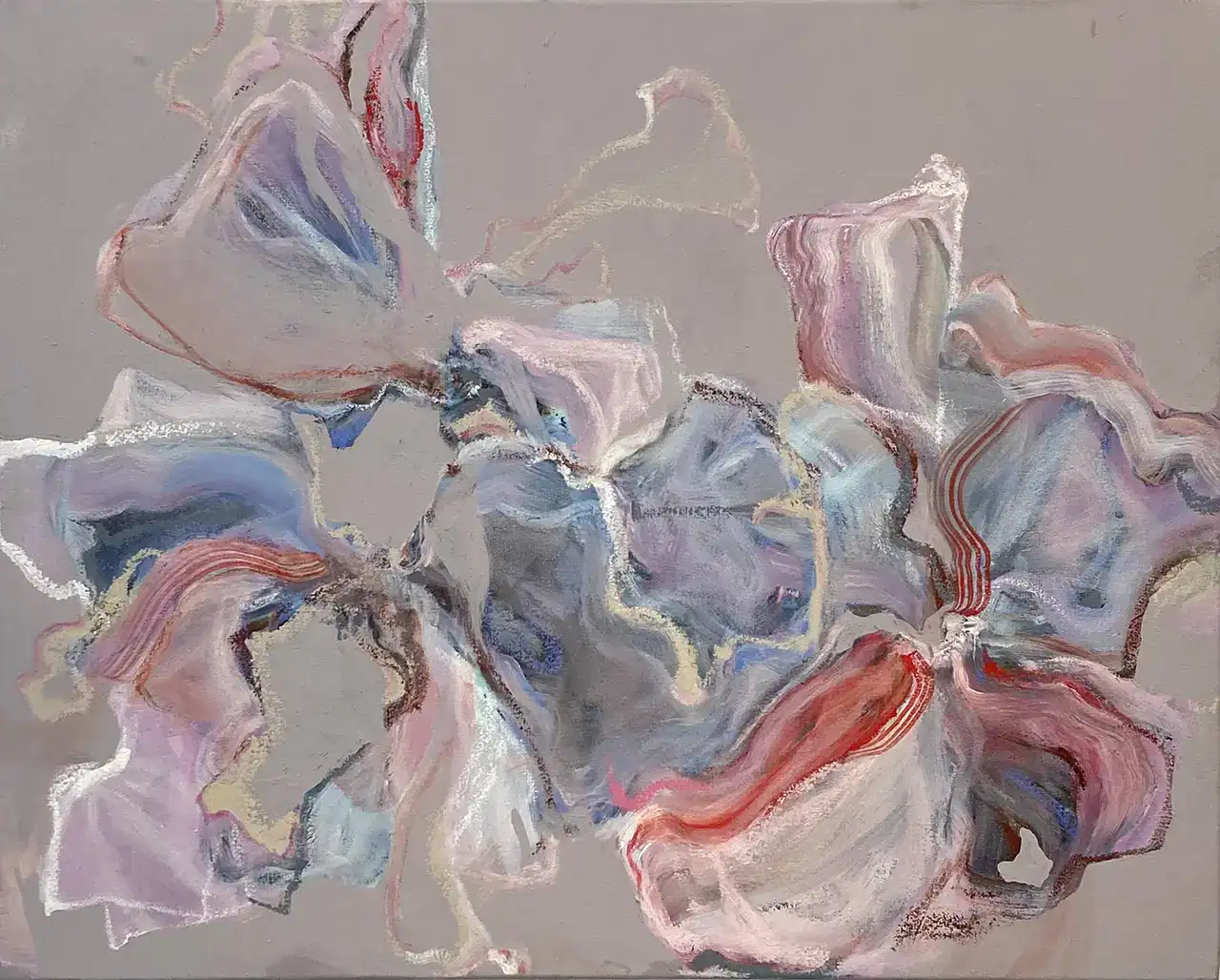
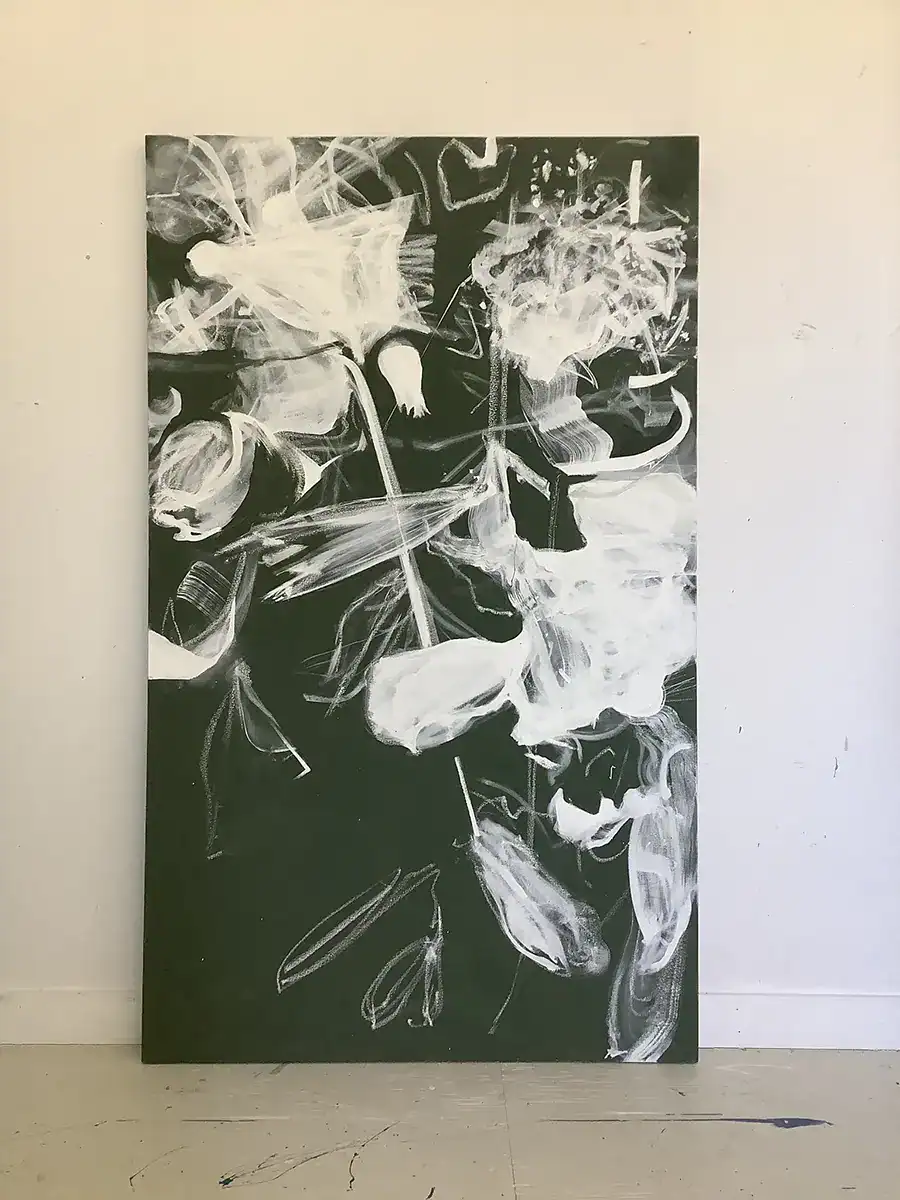
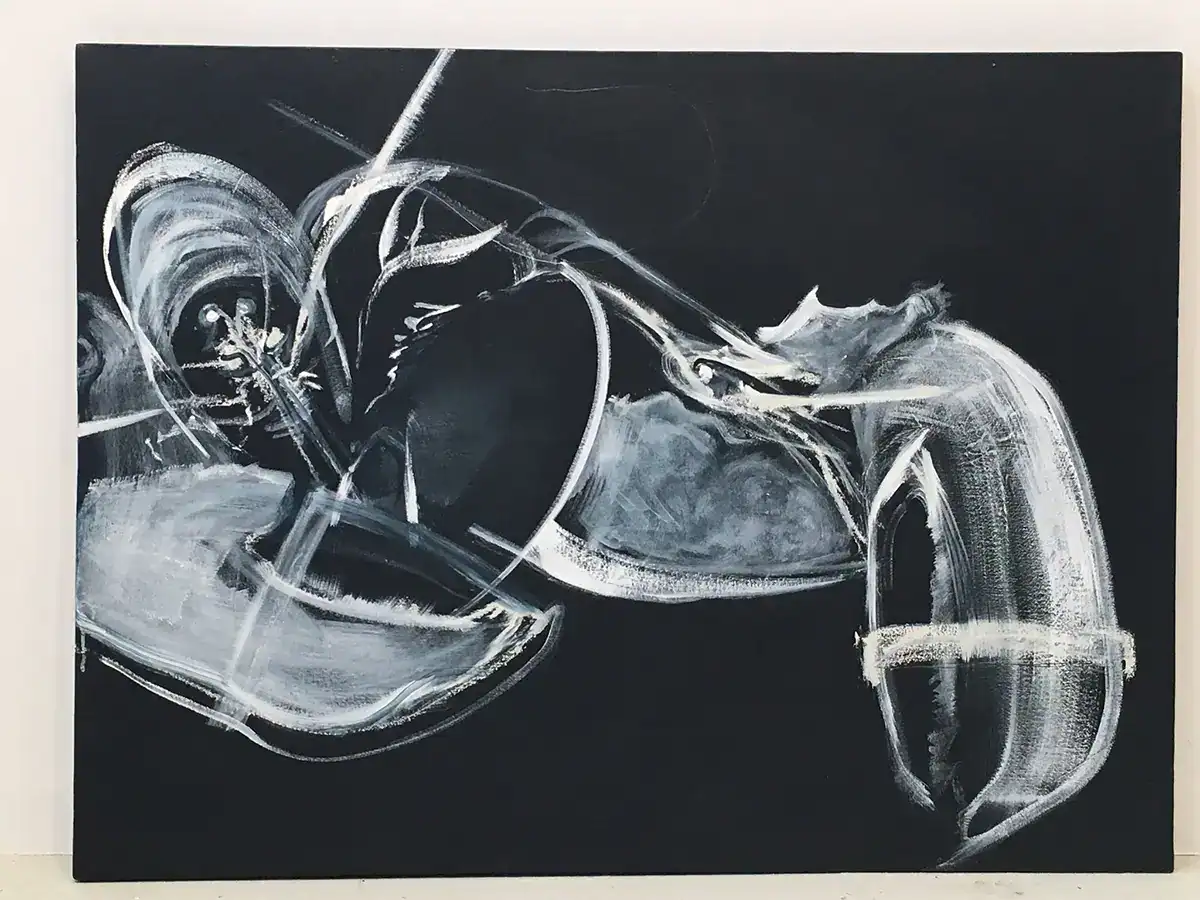
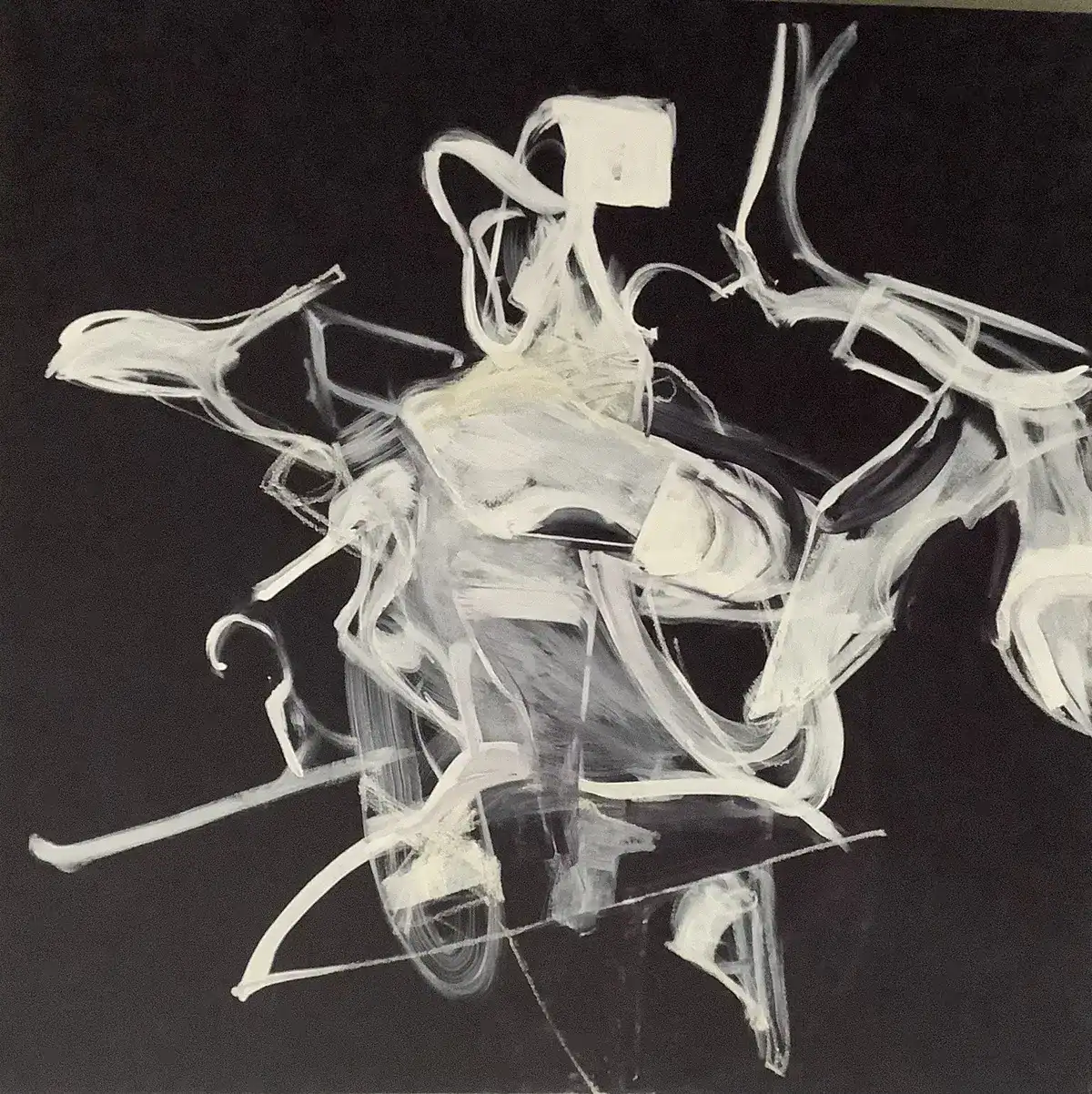
I work to get my emotions out physically. I strive to create beauty, but that beauty isn’t always a tangible thing that others can easily grasp. It’s hard to describe a process that is so visceral. The physicality of painting is essential to me; it’s the reason I’m drawn to working on a large scale. Big canvases allow an exuberance and a sense of movement that I just can’t replicate in smaller work. I need that space to get the energy out. The work begins with slapping paint down so instinctively that I often don’t remember the start; it’s a total flow state. But that wild beginning is always followed by an exacting second phase.
My process is a dialogue between instinct and precision. Technically, I love the tension of mixing mediums, working with house paint and oils together, sometimes incorporating other materials for more texture, a combination that is technically at odds. I love the experimental nature of forcing these two mediums to coexist. It’s a process-driven approach where the ‘rules’ of the materials are meant to be broken, though I keep those worlds separate for my portraiture, which is strictly oils.
I feel extraordinarily fortunate to do what I do every day, especially in these surroundings. To be able to do this for a living is a gift. I’m lucky, too, to have a husband who is also pursuing what he loves, we’re in a good place together.
I agree with you, it doesn’t matter what you choose, but let it be something that interests you, because you’re going to be doing a lot of it. If you’re truly gripped by your work, you’ll find yourself getting up at 4am for a photograph or staying up until 2am to finish a client’s piece. You do it because you truly care.
This work requires an immense amount of self-discipline, but when I’m truly into it, the feeling is incredible. It’s such a high when a series is chugging along, and I know exactly where the next piece is going. In those moments, I can’t wait to get back to the studio. I’ve always been quite insular and private, which makes talking about my art feel a bit uncomfortable. I’m not used to sharing the process. I’ve always worked solo, in a space that feels much like the music business, personal and quiet.
Does it help having the tightness of one practice and then going back, do you find one loosens the other up as well?
I must be very careful not to let my portraits get too tight, even though that work requires a certain level of precision. My practices speak to each other; the abstract work loosens me up. I love the balance between the two, moving from something very pinpointed and exacting to a piece that is massive and open. I couldn’t just do one or the other, because at the end of the day, I just love paint.
People often ask about my routine, but the truth is, I don’t have one. I work when the energy is there. When I’m in a groove, I’ll stay in the studio until I hit a wall, grab a quick bite, and go right back in. It’s various, it’s intense, and it’s unpredictable, but when you’re chasing a specific high in a series, you don’t stop until the work is done. When I’m finished, I just take a hiatus until I am ready for the next project.
What advice would you give someone wanting to be an artist today?
There’s a note on my board that I wrote to myself that simply says: ‘Shut up.’ It’s a vital reminder to block out the noise and the external voices that try to dictate the work. At the end of the day, you must paint for yourself, not for anyone else. You must love the act of creation enough to protect it from outside influence. When those voices go quiet, that’s when the real work begins.
Can you talk about your show last year at Troutbeck?
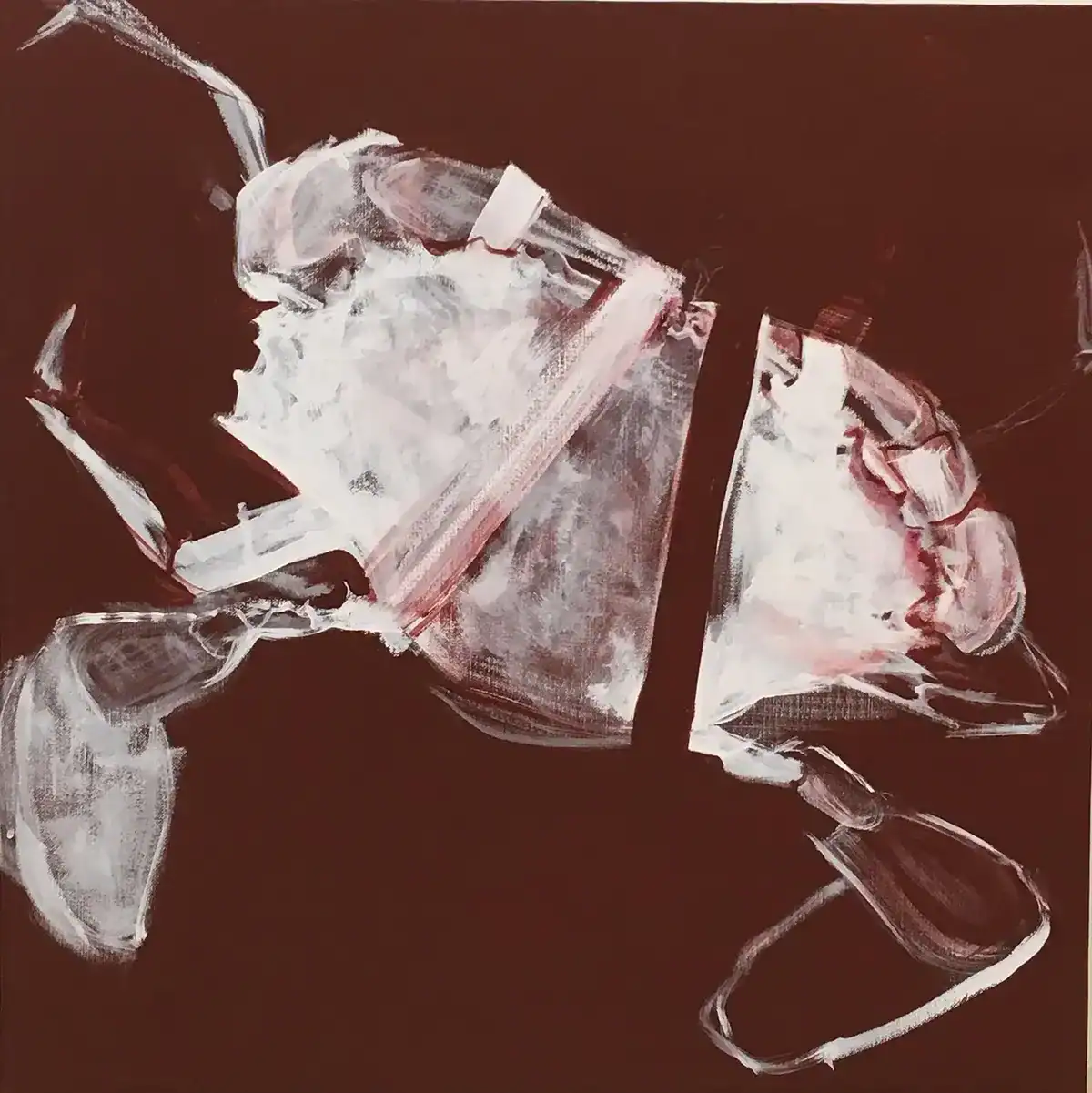
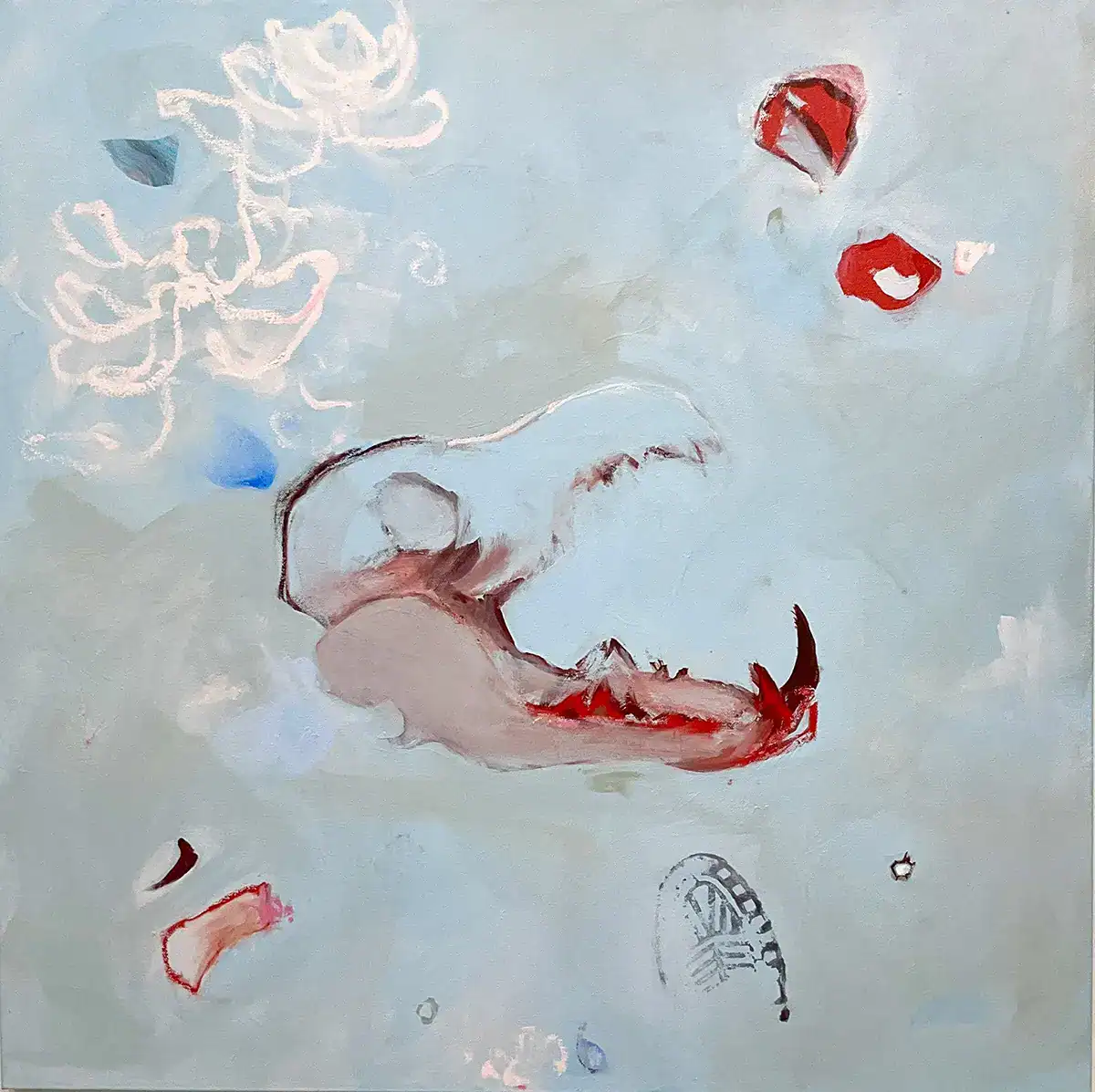
This series was about the tragedy of extinction, and it changed the way I see space. I found myself working with fragments, excavating the surface by constantly putting down and removing paint. You can’t see every layer in the final piece, but I know they’re there. It’s a process of covering and uncovering, a search for what remains when the rest has been stripped away.
The world can be mean, especially in its treatment of nature. I wanted to capture that by using a soft, ‘pretty’ palette as a juxtaposition against the reality of extinction. Placing a skull against a pale pink creates a friction that I find essential. This work isn’t about my usual sweeping movements; it’s about shards and remnants. It’s about the fractures left behind. These pieces are the shards of a natural world we are losing, and the process of painting them is my way of documenting that disappearance.
Sometimes the most important part of a huge painting is a tiny, single mark of red tucked in a corner. I love playing with that scale, the massive brushstroke versus the ‘micro-gesture’. Most people might not notice the tiny details, but they are the reason the piece works. The magic is in the things you feel without knowing why.
Is there a piece of work in the world if you could beg, borrow, and steal it that you’d love to own?
If I could live with one piece of art, it would have to be something that acts as a grounding wire, a work that centers me every time I look at it. It could be a Cy Twombly drawing. There is something about his graphite marks on paint. It’s not about decoding the work, I just love them. Or the raw energy of De Kooning or even a small Gerhard Richter. I’m drawn to work that reminds me to trust the act of making.
Children paint with a wonderful naivety. Then, school happens, and we’re taught that an apple must look like an apple, and everything must be a copy of reality. We can lose that early freedom of abstraction.
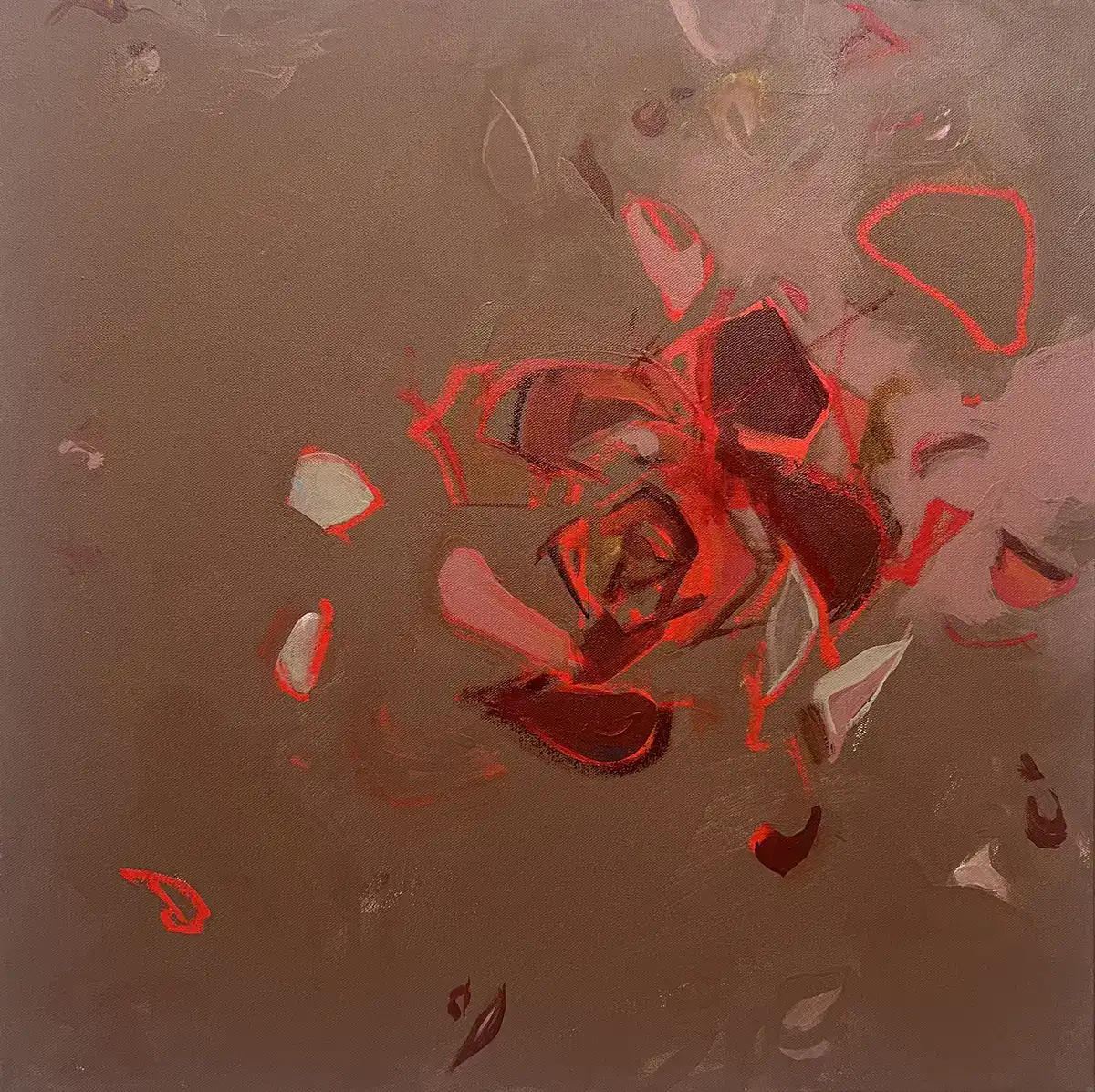
Originality can come from how you look at the things no one else wants. I love going to the florist for the ‘garbage’, the flowers that have already fallen apart. I throw them on the studio floor and look for the shapes in the wreckage. I did the same with shoes and hangers when I felt overwhelmed by the excess in my life. The excitement is in the whole journey: from the ‘shit’ on the ground to the finished canvas. There is so much strength in the broken and the passing.
It is a joy to see an artist who can have the intensity of two disciplines, her larger pieces filled with gestures that move across the surface, where the viewer leans in to inspect each mark. Meanwhile across from this large work sits a dear four-legged friend, coming to life with minute brushstrokes, who is staring intensely at England as she focuses on the flow of her paint. •
To see more of Alexis England’s work or to commission her for a portrait please visit her website and her Instagram, each tells a different story. Email Alexis at alexisenglandart@gmail.com. Visit her website at alexisenglandportraits.com or her gallery at geraldblandinc.com.. Find her on Instagram at @englandportraits and @alexisenglandart.