Local History
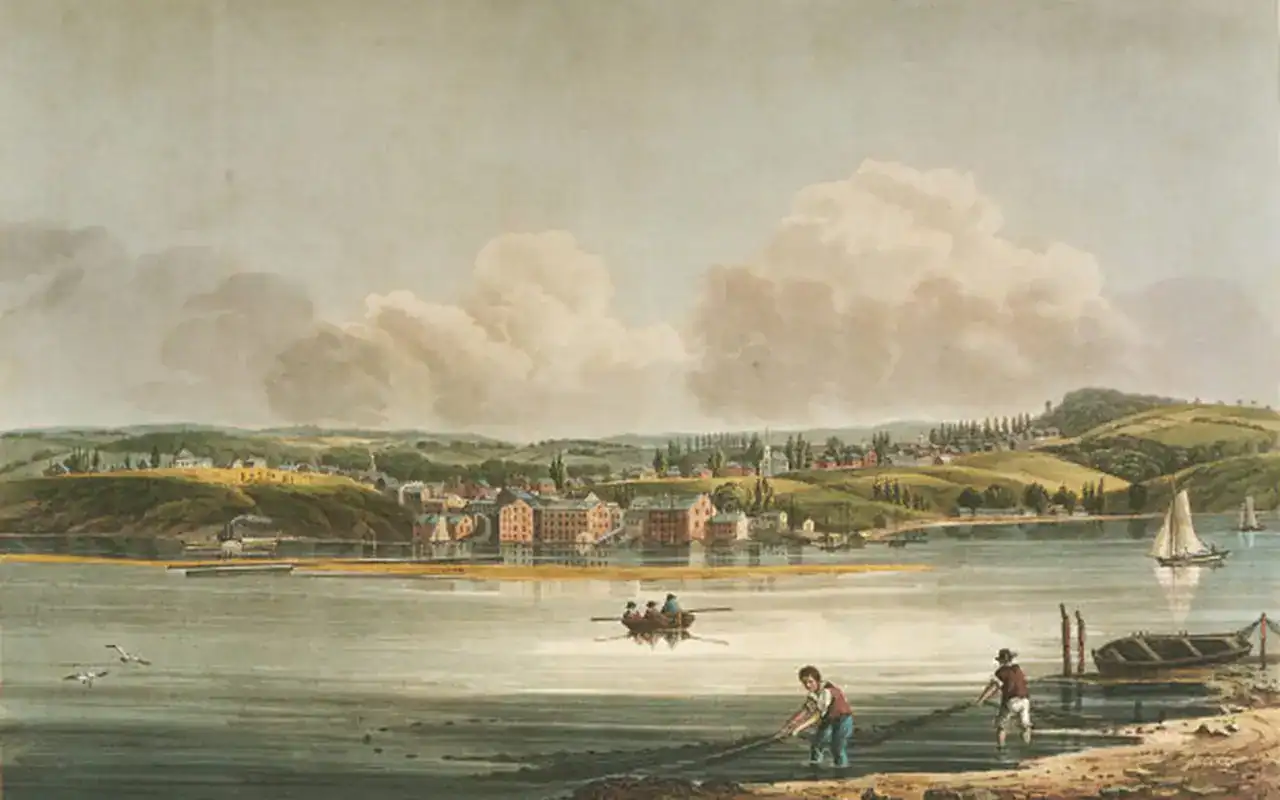
Hudson, New York
Perhaps as much as any one particular group, you might say the British were responsible for the ultimate creation of what we now know as the city of Hudson, NY. In those days, what’s now known as Hudson was then called Claverack Landing, settled in 1662 by the Dutch.
A little perspective here. For 11,000 years, Native Americans lived in what’s now known as Hudson and Columbia County. The white man, on the other hand, has lived here around 400 years. Let’s think about that for a second. Where we now flit about in our shiny jalopies, fiddle with our smartphones, and watch our television programs delivered via satellite or Internet, Native Americans lived, worked, and played.
The Quakers and their “safer and more sheltered location”
In 1700s, New England seafarers and owners of whaling ships were convinced that King George would not be content to let the American colonies go, and the British would be back to recapture what they’d lost. In all, about 30 persons, most of them Quakers and “all of whom were or had been engaged in commercial pursuits, the whale fishery, or other branch of marine navigation (and all possessors of considerable pecuniary means, while several were persons of large wealth), having suffered very severely in their business by reason of the ravages of British cruisers during the war, had formed an association with its goal of establishing a commercial settlement or town at some safer and more sheltered location.”
Heading up this party was Thomas Jenkins, Esq., of Providence, easily the wealthiest member of the association, who was said to be a man of “excellent business capacity, fine attainments, and great dignity and polish of manner.” Of the original 29 founding fathers of Hudson, née Claverack Landing, 14 hailed from Nantucket and the remainder from New England.
After passing through Long Island Sound and the East River, the group headed up the Hudson River, stopping along the way to examine a possible site in Poughkeepsie but eventually declining that location. Subsequently, they proceeded up river until they came to what was then known as Claverack Landing. By this time, Claverack Landing had begun to flourish – more than 100 sloops were known to operate along the river at the time.
Purchasing the land from the Dutch
The association “bought the land on the bluff and along the river from Dutch families whose ancestors had purchased it from the Mohicans generations before, and they set about to create there a seaport far from the sea.”
Prior to their arrival, according to The History of Columbia County, 1878, orchards thrived “upon the lands along the old country road, and the farms were well tilled, as was usually the case among people of Dutch birth or extraction. Besides bestowing the necessary care upon their lands and cattle, some of the inhabitants here found time to engage in fishing, particularly during the herring season, taking large numbers of these fish, for which they found ready sale in New York.”
The conveyance of property commenced on July 19, 1783, when Peter Hogeboom, Jr., conveyed his store and wharf property by deed to Thomas Jenkins for the consideration of 2,600 pounds.
The original signees to the articles of agreement subscribed by the proprietors (as they called themselves) of Claverack Landing were Stephen Paddock, Thomas Jenkins, Joseph Barnard, Reuben Macy, Benjamin Folger, Cotton Gelston, Seth Jenkins, John Alsop, William Wall, Charles Jenkins, Hezekiah Dayton, Ezra Reed, David Lawrence, Gideon Gardner, Titus Morgan, John Thursten, Reuben Folger, and Nathanial Greene.
A growing city and whaling
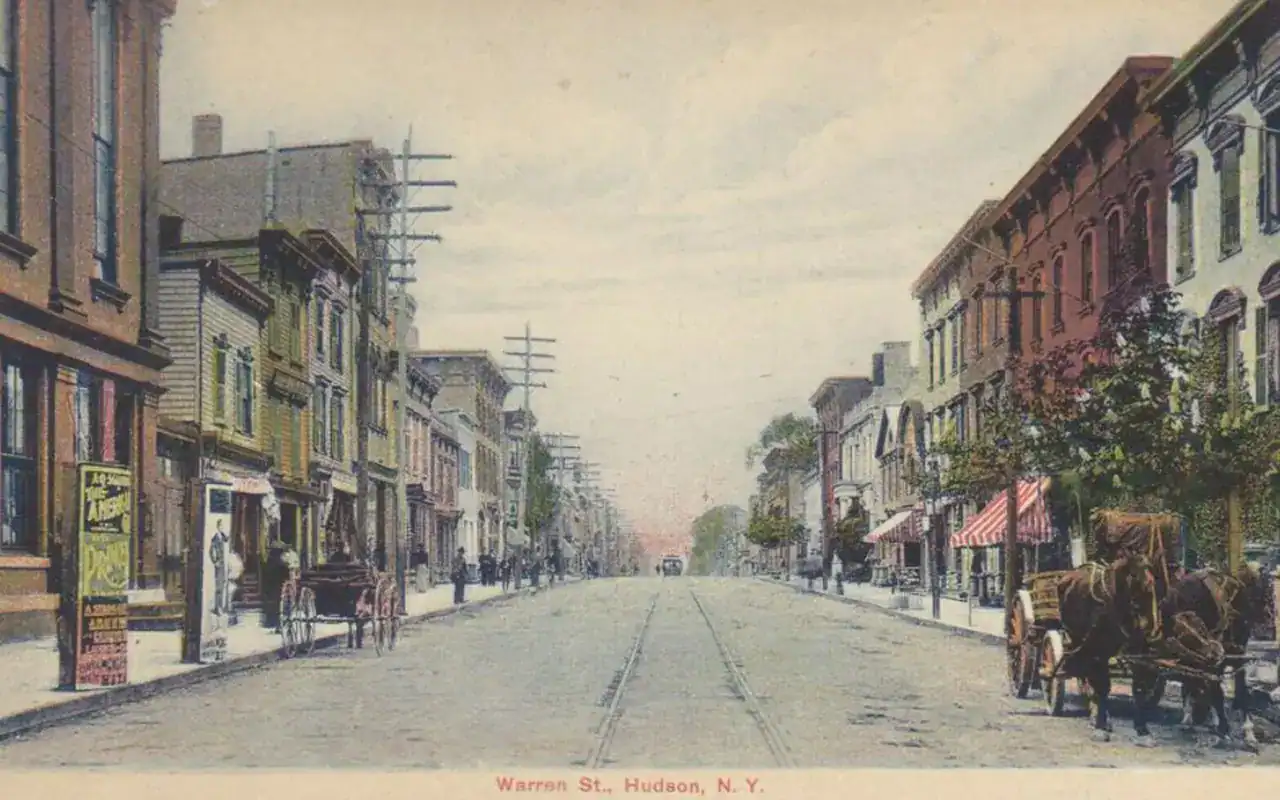
Two years had not passed before Hudson had grown into New York State’s third largest city, from which it sent out whalers while adding carpenters, caulkers, riggers, smiths, sailmakers, and merchants peddling footwear, medicine, and liquor. In addition to transporting whaling catches, boats fetched home hides, smoked or pickled river herring, beef, and pork. A jail complete with whipping post and stocks was erected on Warren Street, the main means of passage then as now, and, in 1818, an almshouse was built. That building would later become Dr. White’s Lunatic Asylum, and later still, the Hudson Female Academy, a private residence, and an orphanage, even later to morph into a library.
“Similar to the Nantucket whaling industry,” notes the Washington State University History Graduate Student Association, “Hudson whalers operated as floating factories with the sole purpose of killing as many whales as possible. Hudson whalers were not all Quakers, but they were all incentivized by either sustaining their families or the prospect of starting a family and buying a small farm.”
“However, unlike Nantucket, the Hudson whaling industry’s prosperity only lasted a short time. (Hudson lost its designation as a Port of Entry in 1815). Resentment toward the city’s comparatively high taxes, which subsidized the whaling industry and provided for the maintenance of city roads, lights, and the construction of municipal buildings, fostered resentment from farmers who in 1830 established the town of Greenport [costing Hudson the loss of more than 12,000 acres]. As a result, the whaling industry lost revenue, forcing many whalers to leave.”
But Hudson, holding the distinction of being the first city in the United States to be incorporated after the 13 colonies became the United States, and named county seat in 1805, was just getting up its head of steam on its way to what we can now, from this vantage point, characterize as a full and colorful past.
Gambling, the FBI and
Secret Service
There was a time in the mid-20 century when gambling became such a prominent part of the Hudson landscape as to be considered an inalterable feature. As noted in The Chatham Courier at the time: “Current [extensive] investigations have not stopped gambling in the county. It has merely revised the system of betting.” Shortly thereafter, the FBI and Secret Service were called into the investigation.
Reported the Chatham Courier at the time: “The fur will fly VERY SOON in Hudson where gambling, it is reported, has reached an all-time high! A floating crap game, one of the largest in the country, which has been operating seven days a week, has attracted some of the crummiest hoodlums in this area and several carloads of goons from New York City are visiting the cities horse-rooms daily.”
The huge floating crap game carried on seven nights a week, with a seemingly endless array of out-of-town racketeers and hoodlums who arrived by night and “must pass through something that looks like a Hollywood stage setting. There are three well-guarded doors, lights, more barred doors and finally a portal where a goon peeps out from a tiny slot, a la the old speakeasy days.”
This, in a city where word has it that when legendary gangster Legs Diamond stopped for a haircut on Warren Street during the 1930s, the barber would pull the shades while Diamond’s “security guards” would stand outside on the sidewalk, tommy guns secure in violin cases.
Temperance
A century earlier, with the founding of Hudson well in the rear view mirror, temperance had been the name of the game. By 1842, upcoming temperance meetings were not only scheduled for Hudson, but also set for Mellenville, Federal Stores, New Britain, Chatham Center, and North Chatham.
Under the 1847 Columbia Washingtonian headline, “Drinking Ardent Spirits,” the paper states, “There was a time, and it was not long ago, when fashion and public sentiment did not frown on the drinking of spirits. Now, thank Heaven, there is no man, no matter how great his talents or wealth, or how high the station he occupies, who can make vice respectable. There was a time, too, when the crime of rum selling was winked at and yes, licensed. A rum seller is a rum seller, a pest in the community, a libel on humanity. Shun him, nor enter his vile charnel house.”
And the movement blossomed. By 1870, The New York Times made note of the Grand Division of Eastern New York – Quarterly Session at Hudson, NY, at which “56 delegates were introduced and duly initiated” and the Grand Scribe read his report, which included eight new divisions since the last meeting, bringing the total to 441 divisions. Male members now totaled 16,356, with female members at 6,981.
Diamond Street and prostitution
It wouldn’t do to dip a toe in Hudson’s history without visiting its red light era, which the Times did in 1994 when author Bruce Edward Hall released “Diamond Street.” Diamond Street, coincidentally, had by then been renamed Columbia Street.
“Prostitution flourished in Hudson, along with gambling and bootlegging, because generations of local police officers and public officials either averted their eyes or were corrupt,” observed the Times. “’Hudson was a schizophrenic city then,’ Hall said. ‘It was a virtual shopping center of vice while at the same time respectable citizens held their church suppers, lived and worked, and ignored the vice around them.’”
Herbert Weintraub, a retired merchant, told the Times, “When my sister went off to the University of Michigan, my father told her to say she was from Albany, not Hudson, because of the city’s reputation.” The operator of a paint store on Warren Street, Weintraub, who was born and raised in Hudson, said he had “fond memories of old Hudson and the red-light district. ‘It was a marvelous cottage industry,’ Mr. Weintraub said. ‘The girls were customers as well as prostitutes. Hudson was prosperous in those days.’”
In 1950, a raid of the brothels and the arrest of many madams by state troopers, who did not notify local police, ended organized prostitution in the city.
Little could the Jenkins’ boys and the “proprietors” know that what they had spawned was an ever-vibrant city, constantly reinventing itself, its populace carrying forward the adventuresome spirit it had summoned more than two centuries ago. •
Sources: The Chatham Courier, The History of Columbia County, 1878, and The New York Times.