Featured Artist
LARGER THAN LIFE – RUTH AIZUSS MIGDAL
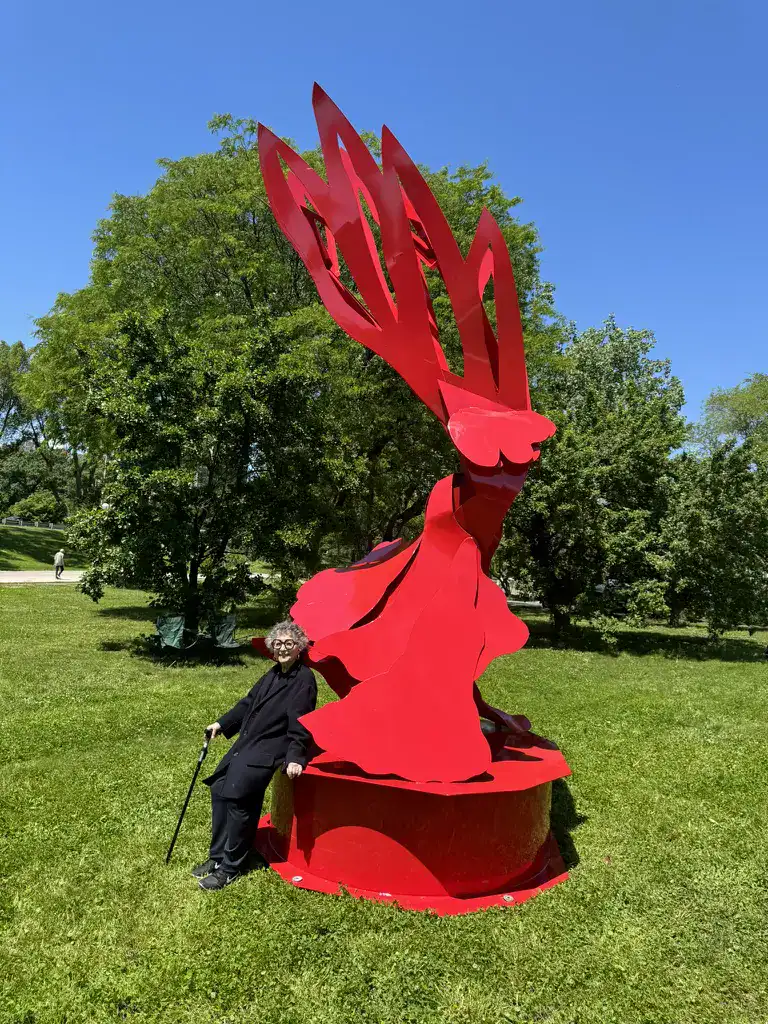
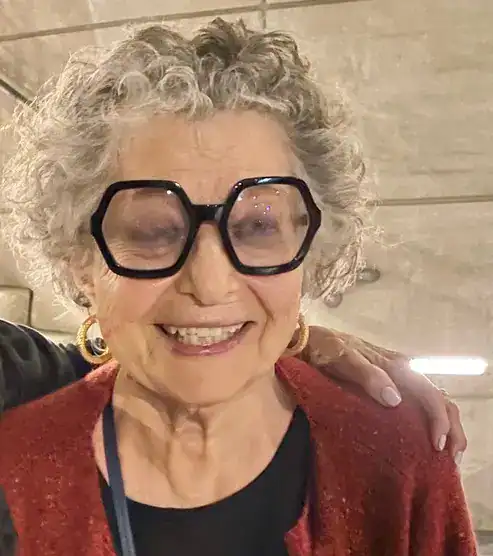 A vital energy exudes from Ruth Aizuss Migdal, a sense of joy and perseverance strides through our conversation. She has been creating work her whole life, with the seed of painting planted early. For more than 50 years, Migdal has been making sculptures and, since 2009, has increasingly focused on large-scale public works across the United States. These vibrant abstract sculptures, some rooted in female forms or tree forms, tower over the viewer, asserting independence, resilience, and joie de vivre, while unmistakably carrying Migdal’s own force of presence. Her studio is filled with ongoing projects; shelves are layered with bronze and steel-patinated female forms, constructed and deconstructed, reflecting the body in movement. Some angular, whilst others appear sensuous, many are realized as monumental works. I had the great pleasure of speaking with Migdal about her industrious journey, equally devoted to both teaching and her own art practice.
What first sparked your entry into the world of painting and sculpture? What motivates your practice?
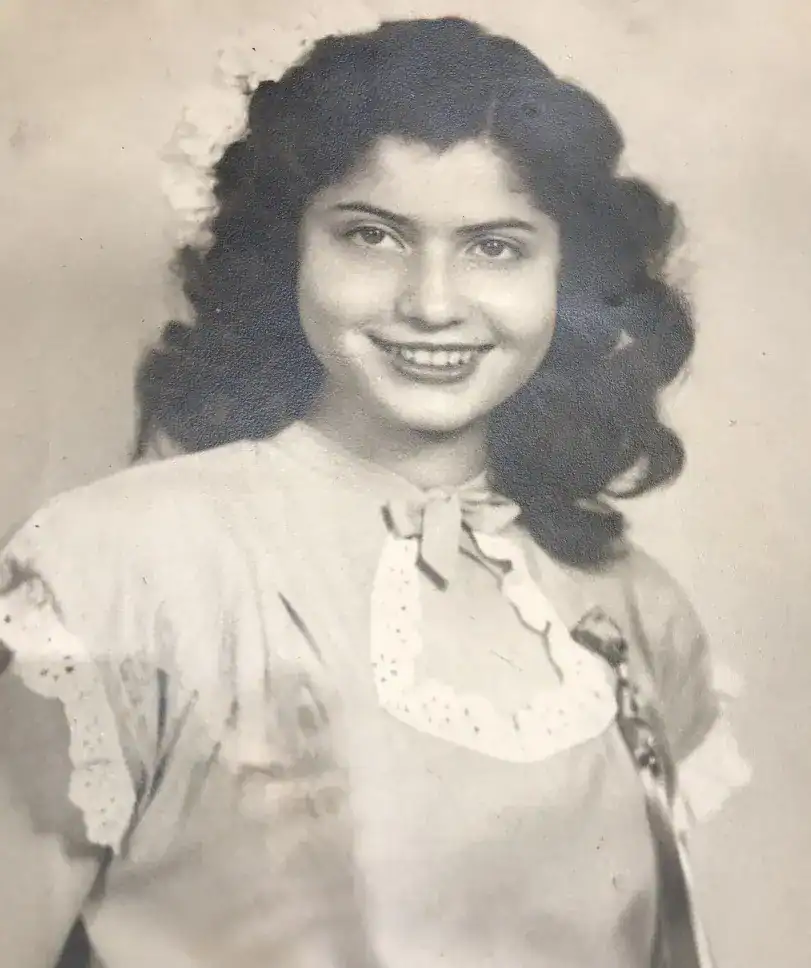
First, let me tell you: I’m now 93. My parents were poor Jewish immigrants who settled in Chicago’s West Side. My father’s family came to the United States in 1906 from Russia and Poland. My mother arrived after the First World War, but her parents never made it. They were murdered in 1942, and their entire town was wiped out. It was a very difficult history to grow up with.
I was born a twin, weighing just a few pounds, in the days before incubators, so we stayed in the hospital for two weeks. In those days, mothers stayed in the hospital for weeks after giving birth, not days like today. My mother took care of my brother while the nurses took great care of me. That amazing ministration saved my life, and we both thrived. Interestingly, my twin has no interest in art at all; the artistic gene stayed with me, luckily.
In first grade, our teacher drew something on the board and asked us to copy it. Mine looked exactly like hers, while everyone else’s were little doodles, so I was declared “the artist.” I was given as much paper as I needed, a rare privilege, since paper was expensive. These were rough, small sheets, and carefully rationed, but I treasured being able to draw. I loved school; I was inquisitive, eager to learn, and felt supported there.
So, I feel I became an artist the moment I chose to be one, at the age of eleven. The Women’s Board of the Art Institute of Chicago sent invitations to public school students for lecture classes, and my teacher gave me one. When I walked in, I saw this large painting on the wall, and a man was discussing the program in detail. In that moment, I knew that was what I wanted to do. After the lecture, we were asked to draw an image in the manner of what we had just seen. If your drawing was selected, you were invited to attend Saturday classes at the Art Institute, where we drew clothed models on a stage. Thankfully, I was selected, and whilst there, I discovered another program for children, which had two sessions a day, from nine to twelve and from one to four, which cost $25, which was a fortune to me at the time. However, I didn’t have the money, but my older brother gave me the $25 so I could attend. It was thrilling.
Amazing to have that inspiration so young. You went on to art school and began painting seriously. Can you talk about that transition?
Even in Saturday school, I was always drawing. I began painting seriously, earning my BFA from The School of the Art Institute of Chicago, where I received a partial scholarship. In those days, tuition was divided into quarters at $100 each session. Educational life was cheaper then; my husband went to the University of Chicago, and it cost $200 a quarter. Even without much money, it was possible to live and work. I completed an MFA from the University of Illinois in Champaign, both in painting and printmaking. More recently, in 2019 I received an Honorary Doctorate of Humane Letters from the University of Illinois, Chicago. I continued to focus on painting for a long time; architects loved my large abstract paintings. Interestingly, people used to tell me they felt like sculptures.
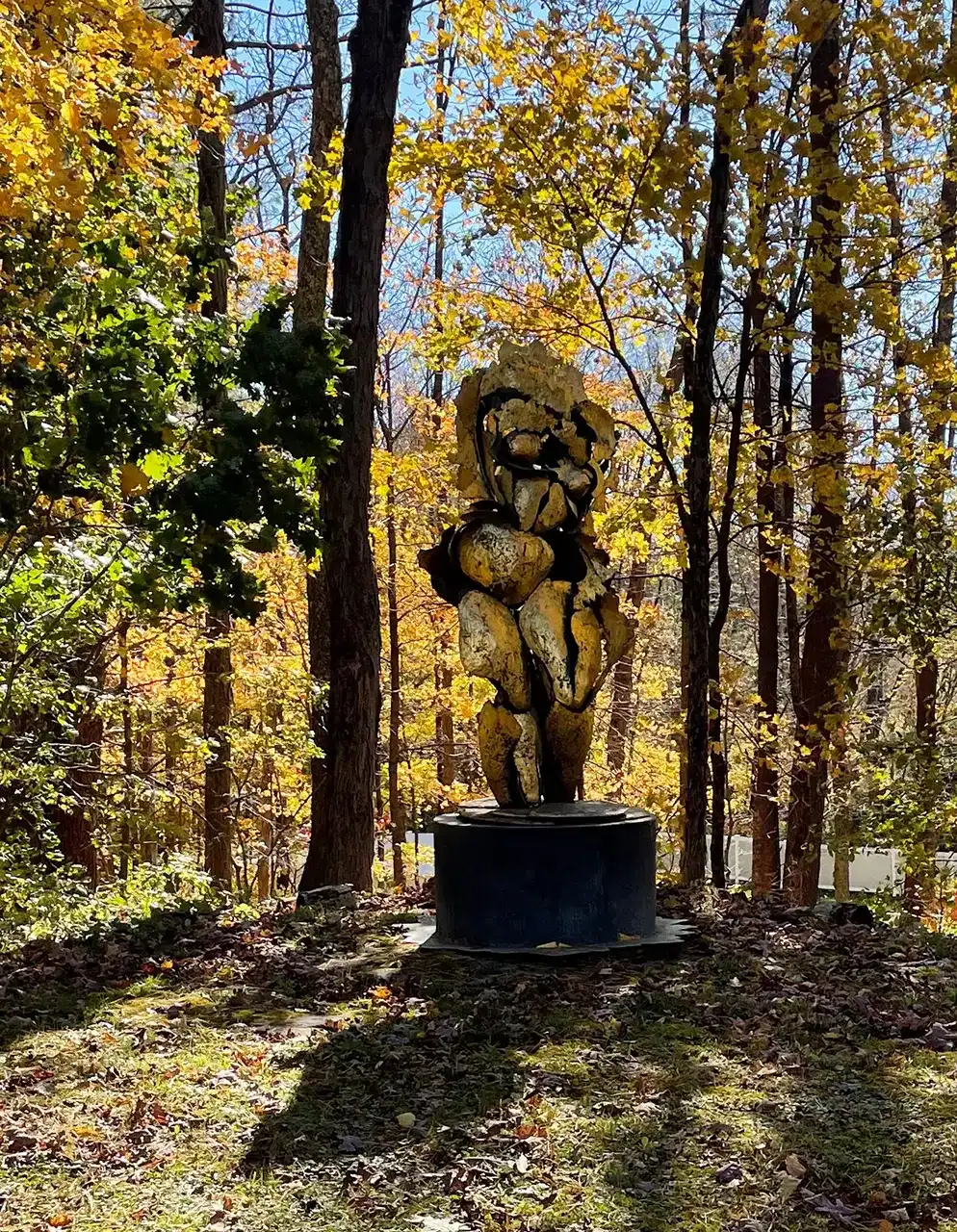
However, the work began to feel repetitive, and I felt it was time to move on. There are painters still working who I think should have done what I did – stop. We must continually evolve as artists, keeping our work and minds open. So, I did. In 1971, I began working in clay; in essence, I became a self-taught sculptor. Of course, many mistakes were made, but with a strong artistic background, I could learn anything with perseverance. Clay figures became my focus for twenty years. In 1990, I joined a study group at the International Sculpture Conference in Washington, DC, where I learned to make molds and waxes and finally had the work cast in bronze. UPS shipped all these bronzes back to Chicago. I did not look back and never returned to clay; I have stayed with bronze for both its permanence and flexibility.
Wanting to work on a larger scale, I approached Orsolini Welding and Fabricating Co., across the street. I showed him an eight-inch clay maquette, asking, “This is eight inches. Can you make it eight feet?” And they did. When I saw it at that scale, I was hooked. There began my Diva Series, works often 12 feet in height, way beyond my physical ability. Now, I make a variety of maquettes in steel before realizing the final, larger pieces, often as a series, which are fabricated in steel, painted with red epoxy, and assembled for installation. The larger bronze works, cast using the lost-wax method, are also reassembled and welded in place. I leave these pieces unwaxed so the patina will grow over time, allowing the work to continually evolve.
In addition to your practice, you’ve had a long teaching career. What can you share about your approach to teaching?
I grew up in a family that favored boys. My mother had wanted me to become a secretary so I could support my brother and the family. However, I rebelled and made sure I never learned to type, just in case. So, I supported myself through teaching, never expecting to make any money as an artist; none of us did. If you wanted to be an artist, you had to find a way, so I chose work that didn’t interfere with being creative. Most women artists don’t have children; however, I wanted them, so I adopted my children. I had no illusions about becoming famous. I raised my kids, I taught at school during the day and at night, when they were asleep, I painted in the basement.
I had the privilege of teaching for over 30 years at both Malcolm X College and Harold Washington College. I feel art engages a different part of the brain; it is not the part damaged by bad schooling; it draws on your natural intelligence. Art teaches you to look, and learning how to look makes you more curious.
My students were wonderful. I also taught on Saturdays, with graduate students from other colleges working alongside me in clay. I often wrote recommendation letters, telling admissions committees, you really should take this person – you’d be missing something important if you didn’t. And they would get in; it was joyful to see them succeed. It is important to follow your dream, but make sure you have a way to support yourself that doesn’t interfere with it. Artists have always known this.
On your journey, were there particular sculptors or artists who motivated you to dig deeper?
I admire many artists and have spent an enormous amount of time at the Chicago Art Institute. From the moment I decided that I was going to be an artist, I was constantly making notes on the works I loved, just looking and looking. I was especially drawn to the dark, early Italian Renaissance. When I encountered a piece that moved me, I would copy it, get it out of my system, and then move on. I loved the figure, especially the large bronze figures. I still do. When I finally saw Rodin’s original works in Paris, I understood how extraordinary they are; his best works are in Paris. But Camille Claudel, his muse and lover, was also magnificent, yet she struggled with familial disapproval of being an artist; being a woman artist was very hard, particularly then.
Early on, I studied Toulouse-Lautrec, particularly his use of angles and composition. I am very conscious of composition. I translated those angular relationships into sculpture. And I’m still learning, always trying to understand a better way to create.
What inspired your focus on the female form?
I have always had a fighting spirit, especially as a girl in my family with brothers. When I was five years old, I came home from kindergarten, and my older brother said to me, I’m smarter than you. This made me furious. I vowed to show people how smart I could be throughout grammar school and high school.
My work is a protest about how women are treated. My earlier paintings and wood sculptures were more abstract, but in the early 1970s I became more immersed in the female figure, working in clay through to the 1990s when I switched to bronze. I made the larger steel sculptures red as I felt that would truly register with the viewer. You cannot ignore them; they are bold and defiant. Men don’t always want to look at women who are not beautiful, but they will look at the color red; red demands attention. These sculptures are my protest. Look at what’s happening to women’s rights; the situation is worse than ever. Some people keep diaries. I look at my work and remember exactly what was happening in the world when I made each piece.
Is red the only color you use in these public works?
Yes. Public steel works are red and finished with epoxy. It’s expensive. This isn’t ordinary paint; it’s engineered so the sun won’t destroy it. I’ve learned that if you don’t use the best materials, you’ll only have to make everything again.
All my money goes into the making process. It’s worth it, but I must sell enough to cover the costs. I’ve always had to be careful. My parents never gave me a penny; they didn’t have one to give. During school, I worked constantly, with night jobs alongside a five-year art program. I was always running from place to place.
How does the placement of your public work usually happen? What is your most recent work that we can see?
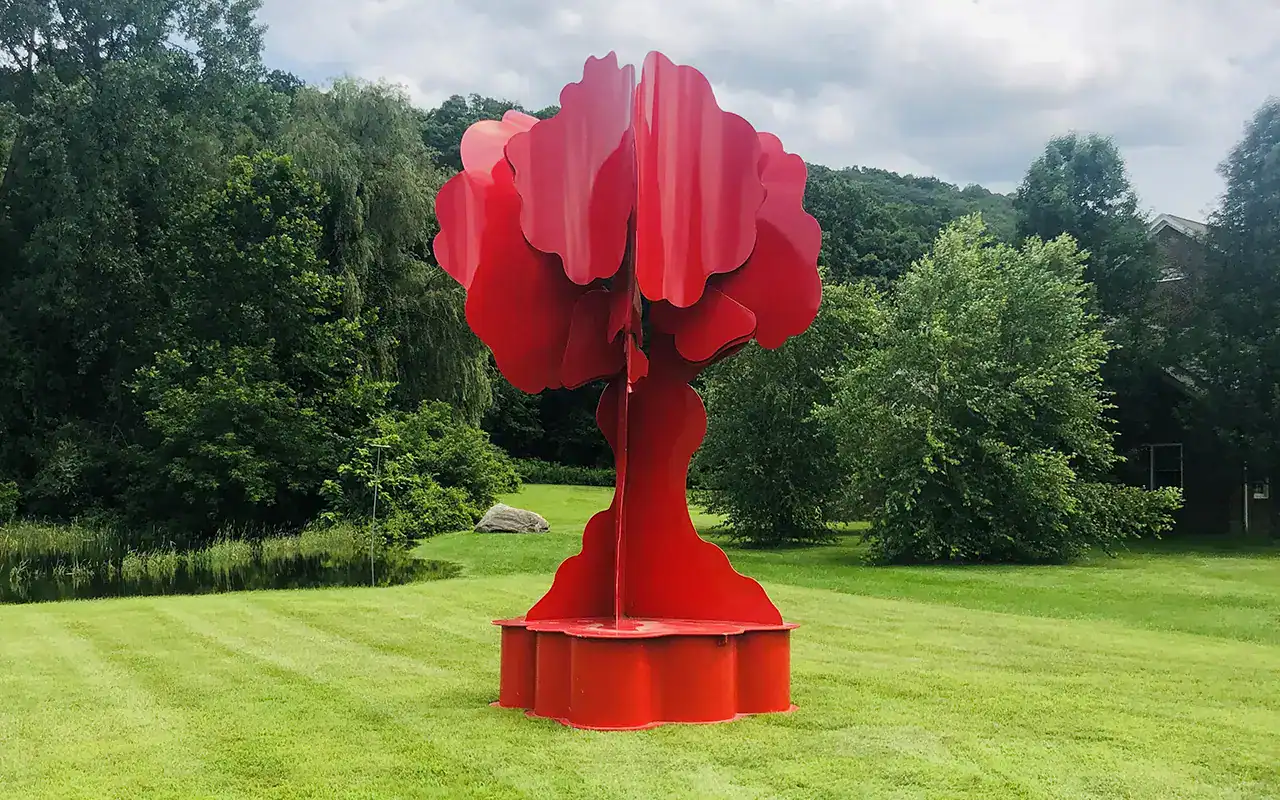
There is often a call for work where you submit images, a maquette, and information, and if you’re selected, the larger piece is installed for a set period, often one year or two. My most recent piece, Red Tree Rising 2025, is situated in the AIDS Garden, Lincoln Park, Chicago. Trees are another common thread throughout my work; they are like women, with roots deep in the ground and branches reaching upward, powerful and beautiful. Another tree-focused sculpture, Red Dancing Cloud Tree, 2019, came to Kent, CT, with the Morrison Gallery who represent my work.
Before making anything large, I always build multiple scale maquettes, which I also sell. I recently finished a new maquette after completing the Lincoln Park piece, but I don’t have the funding right now to realize it at full scale.
Sometimes, when the time for a public work ends, if I don’t have another placement for the sculpture, it will remain on loan, so the sculptures can stay in place for the public. I don’t have a large storage space, so this is a way to keep the work and message alive in the world. Everyone can enjoy it. I just love working; I do what I love. One thing I always told my students is this: time is not money; time is quality. Use it well.
Migdal continues to work weekly in her studio and is deeply devoted to her practice, reminding us that passion and curiosity carry vitality throughout our lives. Her impressive sculptures gaze across the landscape, resonating both the strength and joy of being a woman.
One can see Migdal’s pieces in Kent through the Morrison Gallery; Celebrate and Red Dancing Cloud Tree sit majestically within the landscape, both in stainless steel adorned in bold red, holding forth throughout the seasons.
Daphne Gallery in Bantam also currently has Radiate, an eight-foot bronze on a three-foot bronze base. The female form is both voluptuous and deconstructed, with a sensational gold patina. •
You can see more of Ruth Aizuss Migdal’s work: Instagram: @ruthaizussmigdal, website: ruthssculpture.com, or you can email: ruthsculptor@gmail.com. For further info you can visit morrisongallery.com or daphneartgallery.com.