
Featured Artist
Looking Inside
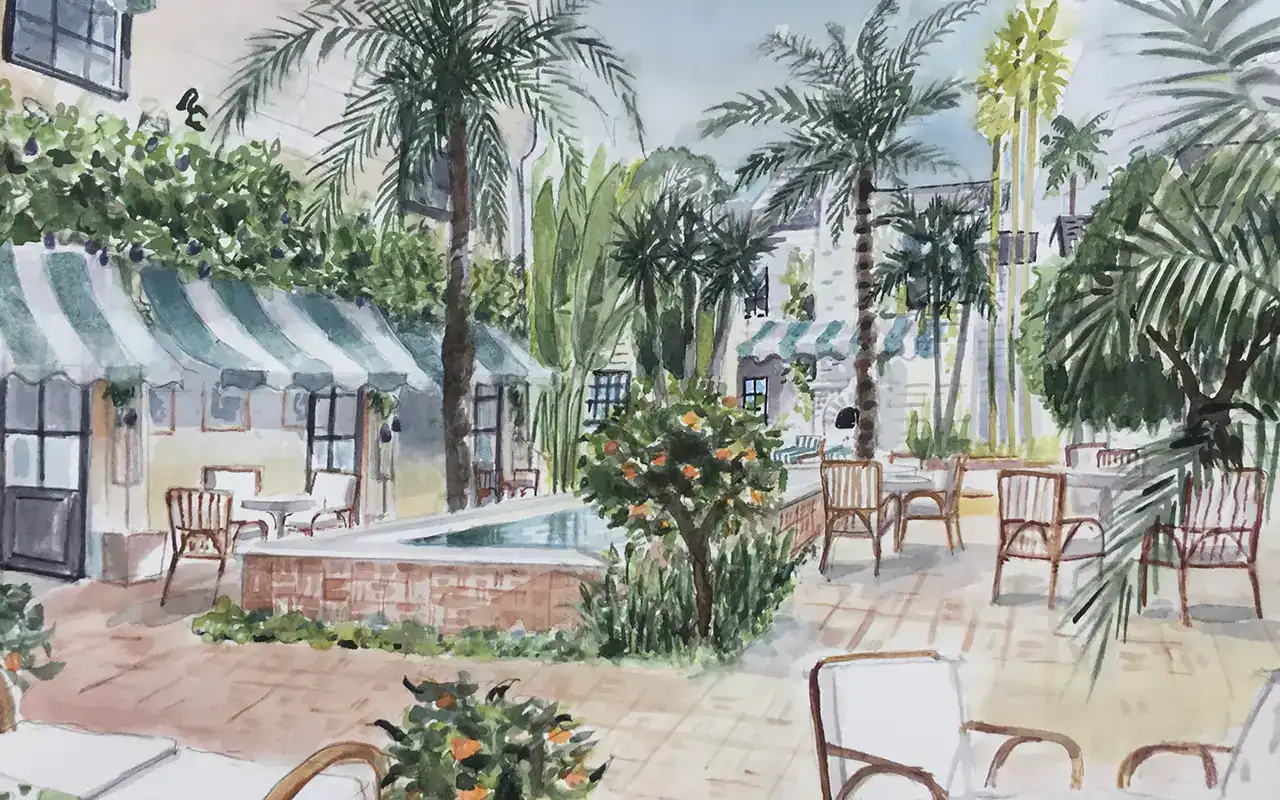
When we walk into a room, we encounter a cornucopia of objects, textures, colors, and feelings. Some rooms are havens; others are places of work. To borrow a phrase from Gaston Bachelard, many rooms possess a poetic space. Mita Bland not only captures that essence and the spirit of a place, but she is also able to create new spaces that have not yet been built, giving the viewer the sense that the space has always existed. Her watercolor renderings, filled with light, energy, and the simple joy of a moment, weave together intricate patterns of fabric and furniture, taking us anywhere from an 18th-century interior to a space yet to be constructed. Each place carries the feeling of a home.
What prompted you to start painting?
It runs in the family. My sister Daisy is an artist, my father was an artist, and my aunt was also a wonderful inspiration to me – she was so free and gestural in her own work. I grew up in Italy in an old villa on a farm. I often wondered how cozy life must be in the smaller houses, with the animals living below and generating heat that rose upstairs into the small rooms where everyone gathered with no formality at all. I dreamed about that, so I started drawing houses, imagining what I would put in them: where the bedroom was, where the kitchen was, where the bed was, and so forth. A simple farm life was my whole panorama growing up in the country. Finally, I realized what I’m doing now is exactly what I was doing at seven years old, and here I am at seventy, still doing it, still passionate.
I think it’s a fascinating question to ask children: what are they drawn to at seven or eight years old? Watch the child and see what they gravitate toward. They will often come back to it.
I started mostly in watercolor. I love that watercolor moves all over the place. It’s easy to transport, and when my own children were small, it was easy to work with in whatever moments I had. There’s a spontaneity to it – it puddles, it spreads, it dries, and you must coax it back into place. You cannot control watercolor, and that’s exactly why I love it. The unpredictability, the difficulty, that’s where the magic is.
Growing up in Italy, with that ancient history of place, must have had a huge influence on you. How coming to America feel?
I went to Wheaton College, near Boston, and I had a very good art teacher. It was also the first time I had been back in America since I was four years old. My aunt lived outside of Cambridge, and we visited museums, which felt like a different kind of art from what I was raised with, where the whole way of life involved art. In Italy, everything is touched by art: paintings in every church, frescoes on walls, and sculptures everywhere. It’s interesting; you don’t realize it until you travel somewhere that isn’t similar.
Growing up in Tuscany in the country, we were isolated in one way, yet you absorbed all the experiences of the community. Going to church, for instance, was always extraordinary. You would fast for three hours beforehand, and then there was the whole, mysterious ritual of the Mass: the priest at the altar with his back to us, everything in Latin. That fed my imagination enormously. I was always wondering what it was all about, the vestments changing color with the seasons, the light in the churches. Having not eaten for four hours, I must have been lightheaded.
And then there was drawing. I always wanted to draw, but we were sent outside to play. So, at night I would sit at my desk and draw the stories I had in my head. I found one of those old albums the other day; it was so sweet and naïve, just storybooks I’d made up myself. Later, when my children were small, we made storybooks together: stories of Christmas, stories about them. I think that kind of thing is so important. Imagination and creativity matter deeply. With all the talk of AI, I believe in the end it’s creativity and imagination that will carry us through.
After Wheaton, I studied watercolor at the National Academy of Design for about three years. Then a friend asked if I could do a drawing of a house interior. I remember driving up thinking, I’ve never done a watercolor of an interior, but I’ll try. So, I drove to Litchfield and sat in this beautiful room where the light was coming in on a slant. I thought, wow, this is so much more interesting than painting dead flowers in a tin can. That was the moment; I knew this was what I wanted to do. From there, I started borrowing friends’ apartments to work out perspective, light, and objects in a room.
These feel like still lifes of a place, still objects in a room, a narrative within each room.
There’s a narrative in the geometry; the stability of straight lines is reassuring. You have the structure of the place, and the architectural elements are always different. I’ve been making these renderings for 42 years, since my eldest daughter was born. It all spread by word of mouth, and I’ve been receiving commissions ever since, often for Brunschwig & Fils, a wallpaper company, but also private commissions for homes, interiors, and exteriors.
For the most part, I have a great deal of freedom. Brunschwig, for instance, will send me a mood board and say, we want a dining room, here are the fabrics and the furniture that’s going in there. So, I create a room for them using their objects, send it to them, they approve the sketch, and then I paint it. It’s a muscle, and it’s your muscle. What strikes me most is the light pouring into a room, bringing life to the space.
Would you say that light motivates your practice?
Yes, the light is essential to me, as well as the challenge of the space. I explained it to my brother the other day: creating art is like standing at the top of a cliff. It looks exhilarating, what you’re about to jump into, and then midway through you think, oh my God, what am I doing? This is so hard. I struggle through it; then I put it down, take a walk, try to resolve the problem in my head, come back, work on it, and I always work through it. The problems get resolved, but it’s hard sometimes.
My work tends to be commission-based; however, if something strikes me, whether it’s in the street, in the subway, or in a space, the minute I get home, I must sketch what I remember. It could be the expression on a person’s face, the light on a building, or even something small: I could be walking down the street and suddenly notice a bunch of nails with a red rubber band stretched across them. I think, wow, look at those colors, the silver and the red, they’re amazing.
Have you taught watercolor? What is your approach to teaching?
I’ve done a few workshops in New York, and I run painting workshops in Italy that last six days. Very often, I’ll hire another teacher so that I can work in the background, organizing meals, transportation, and all the things needed to keep everything flowing. But I frequently find myself teaching on the side as well, and it comes quite naturally to explain something that opens students’ whole vision of what’s happening around them. I aim to help my students become more aware, to look more closely at their immediate surroundings. It becomes a muscle. You must open yourself to this kind of experience; look at art, both old and new; and find inspiration from the greats.
Finally, I was in an exhibition last year, “The Persistence of Hand Drawing: Interior Rendering Today,” at the NY School of Interior Design. The subject was hand drawing versus AI, where eight of us held a panel discussion on the stage. What became very clear is that despite the help of CAD renderings, everyone on the panel agreed the hand-drawn image was more immediate and spoke more clearly of the immediacy of inspiration. When you use your hands rather than pushing buttons, you can feel your way around a room, which is essential in the creative process.
What was the best piece of advice anyone ever gave you about your practice?
Good question. Keep your lines free. Reeve Schley, my teacher at the National Academy, where he also served as president, was a great influence. I had just begun studying watercolor with him, and I threw myself into painting the still life he had set up. Months later, I was struggling and said, “I’m not good at this. I think I’m going to give up.” He went to a drawer, pulled out that very first still life I’d done, and said, “This is what you did in your first class.” He gave me perspective even after I’d left school and was beginning to do my renderings. He gave me confidence. He was the kind of person who just makes you believe you can. He often said, “You can, and you will.”
Amazing to receive that confidence. What prompted you to move here from New York?
I grew up in Tuscany, among those rolling hills. When I came to this area of Millbrook I couldn’t believe how similar this was. Without the hilltop villages, of course, but you do have the rolling hills and the open landscape. I love to walk and climb. Gerry and I have been coming here for 30 years. We brought our children up here, and they love coming back.
Your practice covers a variety of subjects, from commission work to your own pieces. How do you manage the balance between the two?
I call it an interior rendering practice, but really, it’s more of a portrait of rooms. The work ranges quite a bit: some of it is making rooms for people whose projects are going to be built. These images show their plans to investors or present a project that’s under construction. With commissions, once a painting is finished, I’ve checked everything, and it’s been proofed, I can’t come back and change it. For the most part, I have a great deal of freedom. Brunschwig, for instance, will send me a mood board and say, we want a dining room, here are the fabrics and the furniture that’s going in. So, I create a room for them using their objects, send it over, they approve the sketch, and then I paint it.
The current project I’ve just been asked to do is 12 illustrations for the Cipriani Maritime Building, downtown at the waterfront: 10 public rooms, an elevation of a building, and a map with key points, each about 20” by 20”. I paint the commissions, then hand them over so the client can scan them and use them however they need. I always photograph my work as I go and send images to the client so they can see exactly what they’re getting. I stay in very close contact throughout the process.
I make sure commissions are ready on time; that’s the discipline of a deadline. If I have a commission due in the middle of May, I know I’ll be working six days a week for the next few weeks to get it done. I find the energy of 10 o’clock in the morning is productive. And then again in the evening, sometimes; I love it, especially if I’m alone. I’ll paint from six o’clock until late, when finally, I’m able to paint on my own, which is always a different kind of challenge. When you’re given complete freedom, it’s actually very hard. So, I’ll take a big canvas, some acrylic paint, and just let it go, and something comes out. You start with an idea, and then something speaks to you, and you take a completely different route. Something emerges that you hadn’t anticipated. That’s the real essence of creativity; half of it comes from your head, but some of it just responds.
That happens with watercolor too, because of the nature of the medium, but it also happens with drawing. You start with a mark and something else appears in the mark, you develop it, and it becomes an animal, a person, a clown, whatever. And then you connect that to something else in your head. And you’re free.
You make it sound so easy, but learning to be free takes time and practice. What artists have inspired you?
I love the work of Van Day Truex, Mark Hampton, John Hulse, Walter Gay, and an Italian called Luciano Guarnieri. He may not be widely known, but his work is extraordinary. I would go to see the Elizabeth Peyton exhibition in a heartbeat; I’m fascinated by her portraiture. There’s something so candid and so naïve at the same time, so compelling and memorable. I once saw a Vuillard exhibition that I adored. When you think about the moment Vuillard was painting, photography had just been invented. I find such structure in the way he sees space, pattern, and figures all flattened together.
If you could borrow or steal a piece of work from anywhere in the world, what would it be?
That’s a hard question. There’s a painting by Pierre Soulages that made me cry; it might be hanging in the Pompidou. But we go through moments when a painting really means something to you, and then you move on to another, and that becomes your world for a while, while other artists just stay with you. And then, of course, the Renaissance: Botticelli, Raphael, and Leonardo. His drawings, I could live with any of them! •
Bland’s enthusiasm for drawing is infectious. She describes the lines of a room and the shadow of light pouring through a church window. Each piece narrates a story, and it can feel like a pause in a film, time stands still as you wait for a character to walk into the room. Even in the works she has created where the walls are still part of the imagination, that sense of place feels fully formed. Bland has also illustrated books for Sister Parish Design (2009), Veere Grenney’s’ A Point of View (Rizzoli), and David Netto (Vendome), and her upcoming book for Cathy Kincaid (Rizzoli) is due out in fall 2026.
You can see more of her work on Instagram @mitacbland and her website mitacorsinibland.com. Email her at mitacorsinibland@gmail.com.


