Featured Artist
Looking Into the Trees: Ari Kardasis
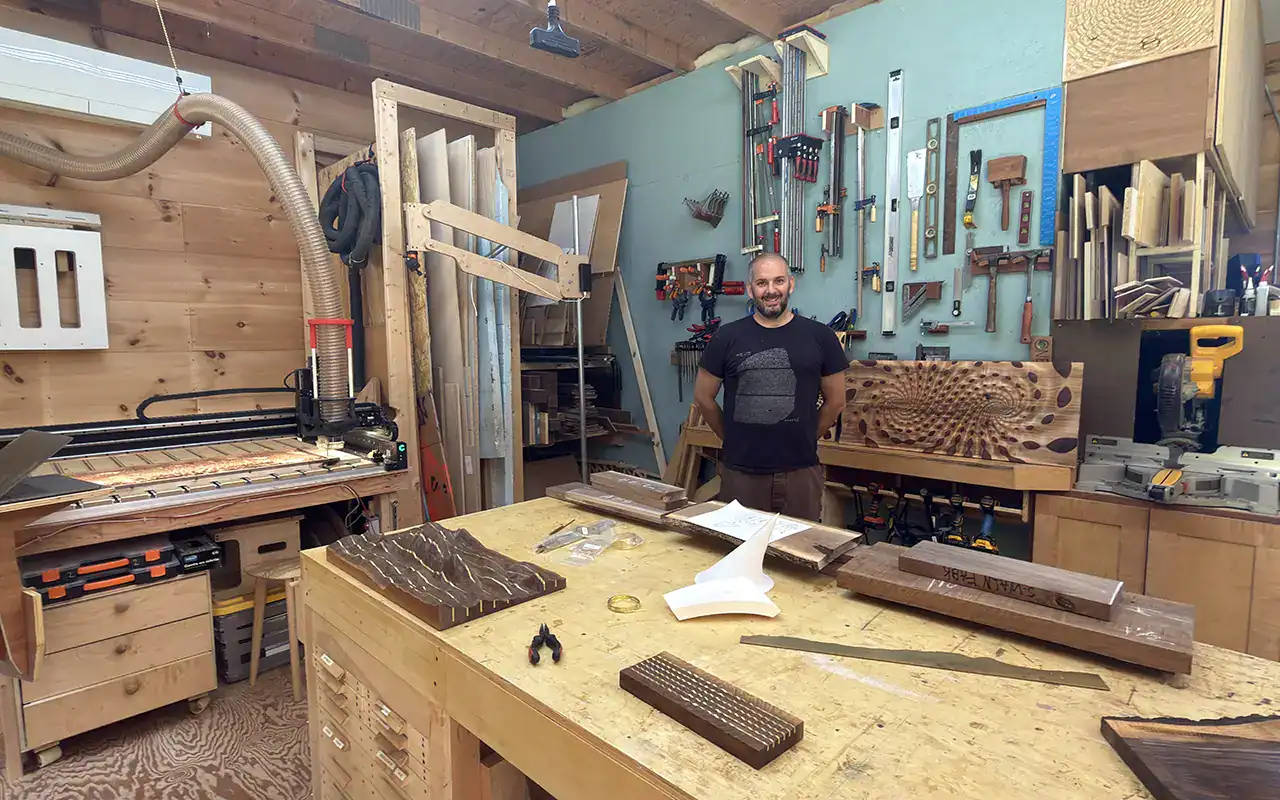
I met Ari Kardasis at his studio near Pine Plains, NY. Outside of his space stands a mature red Japanese maple with its gnarled trunk twisting upward toward a burgundy canopy of deeply etched leaves. This tree seems a fitting neighbor to his practice of working with wood and metal, forming both practical furniture pieces and wall hangings shaped through his lifelong passion for mathematics and by a drive to turn the abstract into tangible objects.
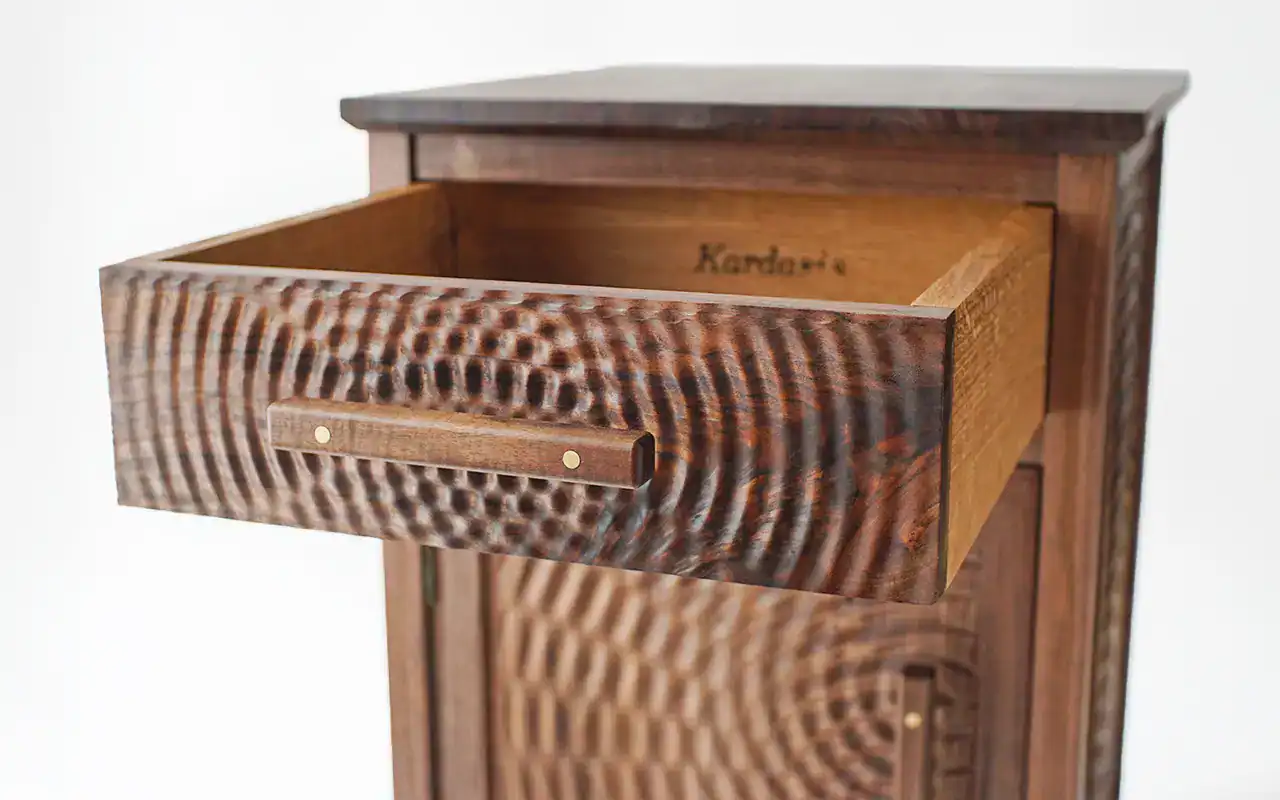
Some works depict an essence of a place, others lean towards water; each creation is exquisitely made using the natural grain of wood, bringing both light and texture to each piece. Raw cut lengths of wood lean patiently awaiting their turn in their second life to be turned into a piece of art. He selects each by hand for its hue, knots, and history.
What were your earliest memories of making?
I have a strong memory from high school of getting my hands on some mathematical software called Mathematica long before 3D printing was really a thing. This gave me this realization that I could turn abstract math formulas into physical objects. The concept that a formula could become a thing you could hold was both beautiful and significant to me, opening a whole new way of making.
Fascinating that it started with mathematics. Where did you study?
Initially I headed to architecture school at MIT, in a department that was more focused on design and computation. It felt collaborative, open ended, and interdisciplinary. My master’s was about what was behind architecture, for making and building smaller objects versus buildings. It was a kind of transition from a rigorous math background toward a creative discipline.
Architecture is amazing, and I’m so grateful I did it. Through that training, the pedagogy, the design process, and the self-reflection it demanded, I built a foundation I didn’t fully understand at the time. I only came to see how it would shape my practice much later.
It’s fascinating how our journeys take these obscure paths before they find the right one. What motivates your creative practice now?
For me, it’s about taking these kinds of conceptual ideas from math and science and bringing them forth into the world, in ways that expose their beauty to a wider audience. When I look at a math textbook, that’s my world, I love numbers, but many people find them alienating. So, I want to translate that language, to expose the beauty of mathematical thinking in a form more people can appreciate and connect with. A lot of people in STEM want a real connection to aesthetics, to be able to appreciate and learn from beauty the way they do from data. There’s so much within the sciences that people are hungry to connect with.
I see a real crossover with artists and painters drawing on the sciences too. What pulled you to this area?
I was based in Brooklyn and bought the Pine Plains house in 2015 as a weekend space. Gradually we moved up with our young family until we were here full time by 2019. It made sense for us to raise our children out of the city. At the time I was focusing on startup companies remotely, which made the move here easier. Obviously, having the space here enabled me to move into this work full time. And being able to draw on local, felled trees turned out to be significant – incorporating a sense of place became a real part of my process.
Do you have a favorite wood that you like to use?
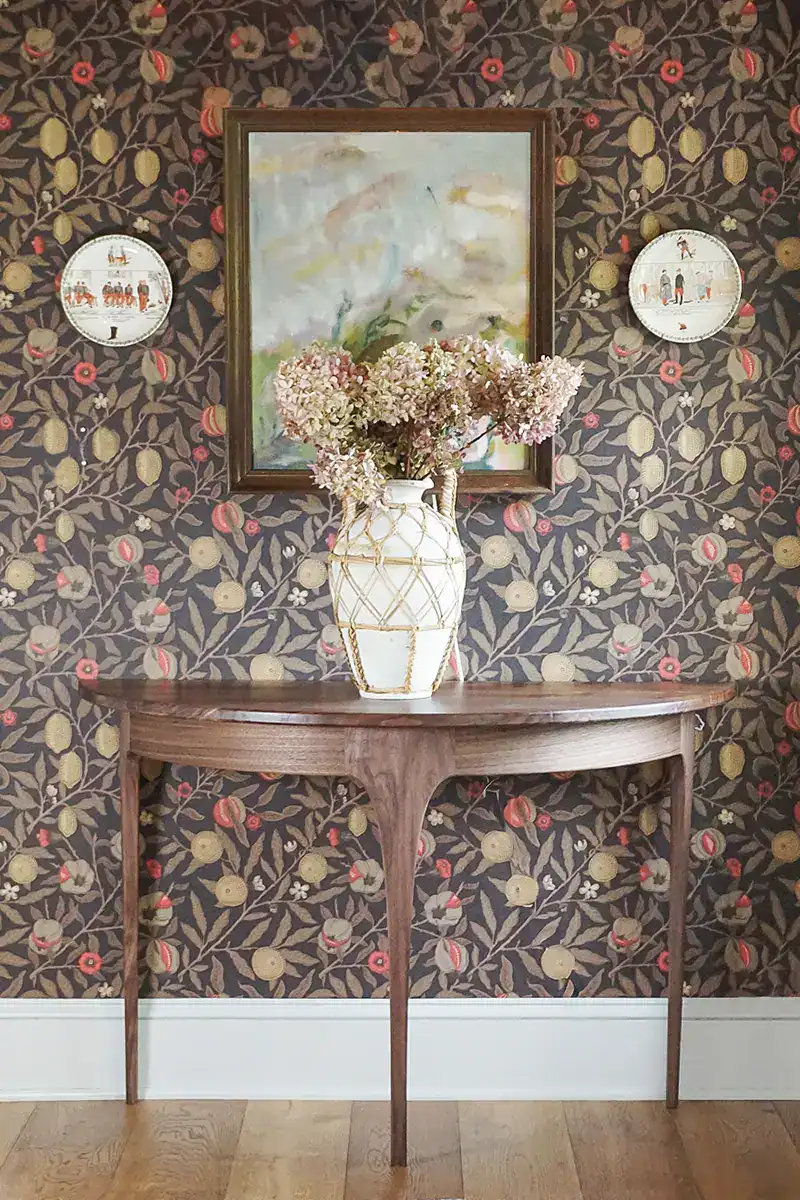
I like to let wood sit and mature for a few years before I use it. Black walnut is my go-to tree with an intensity of coloration I keep coming back to. Maple is also another favorite, and of course ash is common right now due to tree loss from the emerald ash borer beetle. We had to pull five or six ash trees from our property because they were affected by the borer.
Looking at these current black walnut projects, the variation in hue is remarkable to me. Every tree is genuinely unique. Sometimes I’ll laminate two different woods together before cutting, to build gradations of color once the piece is cut and sanded. I step the cutting down gradually until I’m happy with how the gradient reads. I’ve come to really appreciate the imperfections in the wood that make it much more complex to work with, but the magic is in the imperfection. Every piece of wood carries the story of where it grew. Shade, light, water – all of it plays into the tone. Some walnut is dark, whereas other pieces can be quite pale. That’s beyond my control, and it’s part of the process I enjoy most.
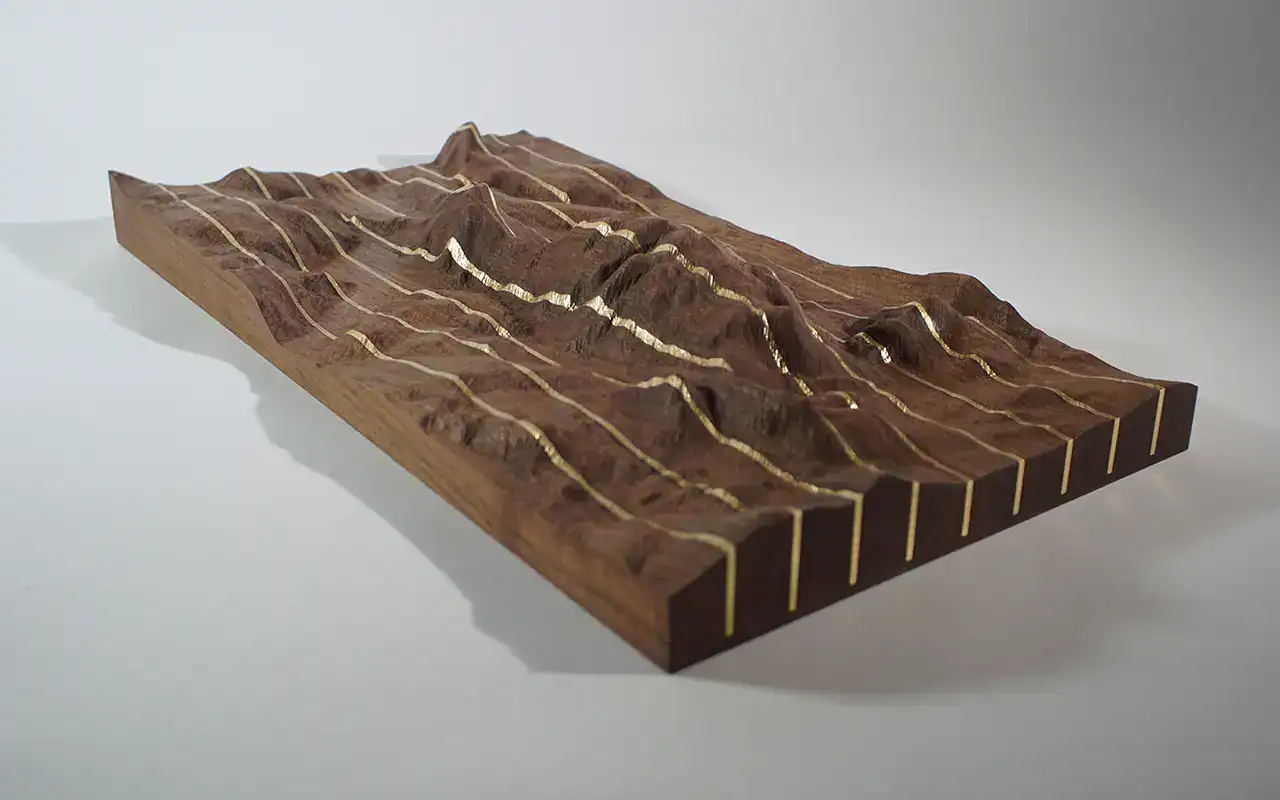
Surface feels integral to your work, it evokes sand, dunes, or water. Some of your surfaces feel like a beach after the tide has pulled back, leaving wave patterns. These lines through the wood feel abstracted as well, yet they’re all created by weather, season, and light, akin to drawings in that sense.
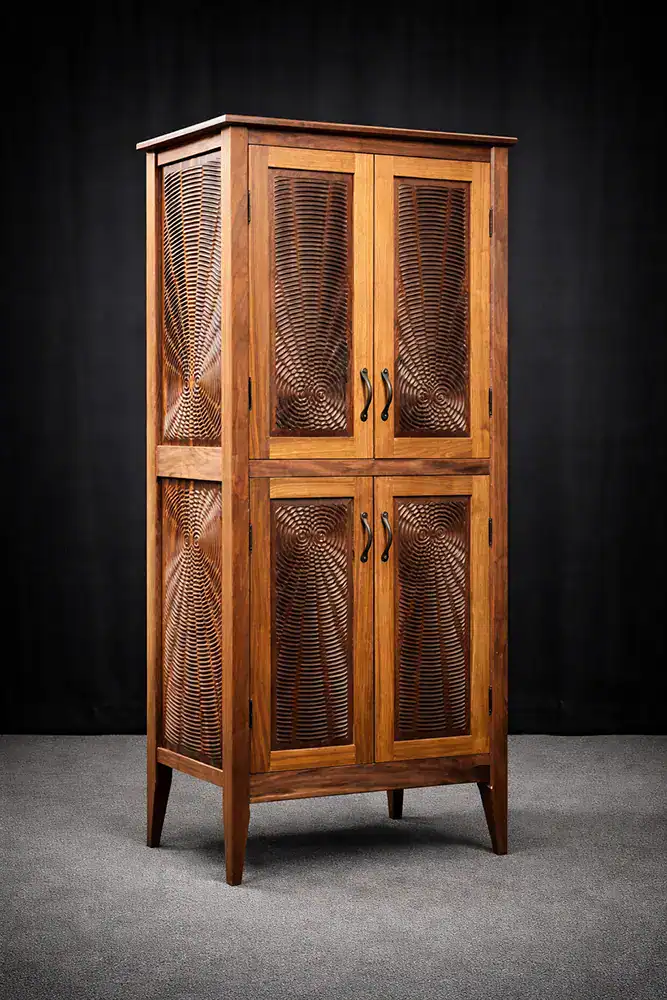
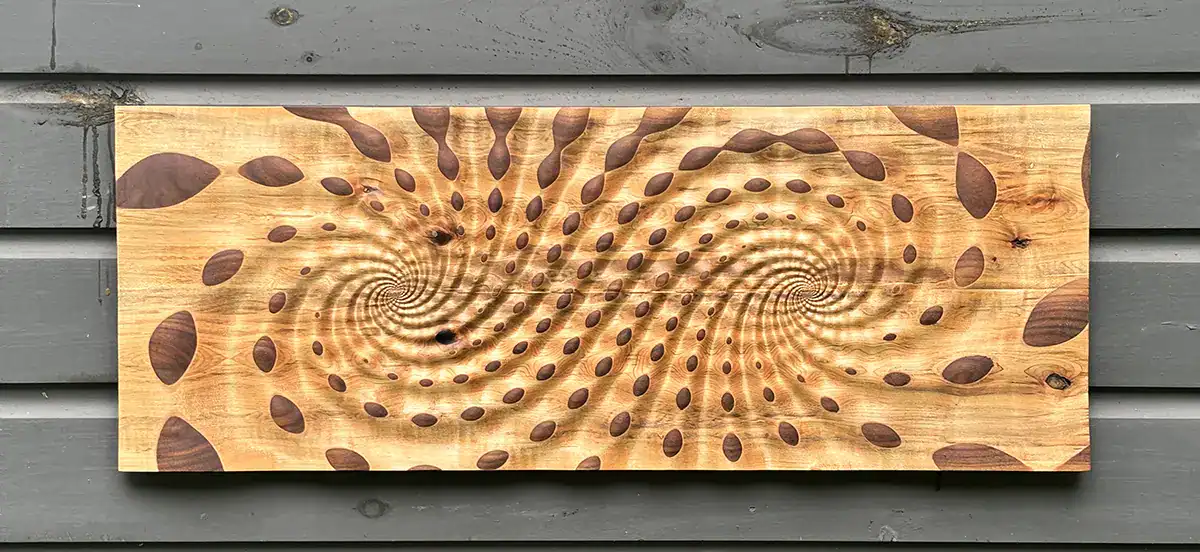
Yes, the wave patterns are inspired by liquid, from both water and sea, which I integrate into the surface. The spirals are also from an ancient source, akin to ammonite in stone. My inspiration moves between abstract calculation and the physical world, and I don’t feel a contradiction there – as I’m cutting into the wood, the patterns emerging are really an extension of an abstracted idea. With the wall hangings, the wave-cut patterns open the grain in a way you wouldn’t normally see, and they let the light in differently. Those are lightly oiled. The furniture has a flatter surface and is finished more traditionally, with a French polish, so you get that burnished quality where the light really sits on the surface.
You mentioned Georgia O’Keeffe as a spark in your work. Who else inspires you?
There’s a canon of mathematicians, as well as artists, who have led me to this work. The 18th century Swiss mathematician and physicist, Leonhard Euler, who was a widely considered one of the most prolific mathematicians in history, and John Conway and Roger Penrose are embedded with me. Finally I would add Henri Poincaré, a French mathematician, physicist, and philosopher of science.
Yes, I think there are many artists who do work with math and data, like Sol LeWitt in his wall drawings and British artist Bridget Riley for her vibrant optical patterned paintings. There’s an algorithmic, systems-based thread running through that work, where the result isn’t explicit but it’s clearly mathematical underneath and still deeply personal.
In the early days I felt I was not an artist; therefore, I needed to make furniture because it’s practical. It is labeled as craft, but it is also art. I now realize when you look at the wall carvings, they are art, as ancient as early carvings.
Yes, it’s interesting, the influence that math has had on your work. It’s not a common thread, maybe more within the architectural world. Math plays a part for my work. Many artists work with numbers and sequences. It’s quite common, especially the grid, as interpreted by the likes of Piet Mondrian, Sol LeWitt, and Frank Stella. You made a collaboration with Emily Weiner. Can you share that?
Yes, I made various panels for Emily to paint on, the frames and panels cohesively fit together. I keep coming back to the spiral. It’s older than people. Ammonites turn up buried in stone from centuries ago, and that shape has stayed constant in my work across different pieces, coming from something deeper than any single reference.
Do you have a collaboration or a dream project that you really want to do that you have not yet realized?
I would love to make a work on a larger scale, for example using spaces you work with or interact with would be fantastic – a large installation where the space envelopes the viewer.
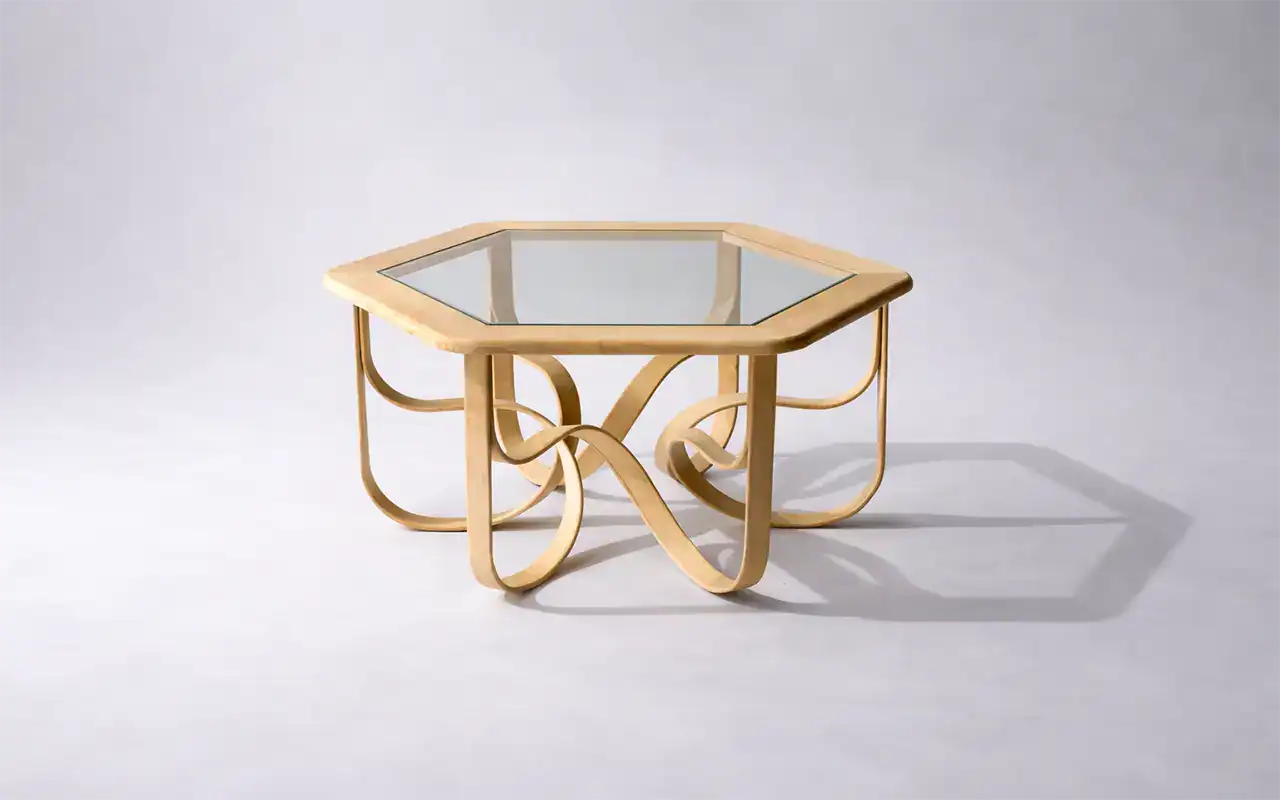
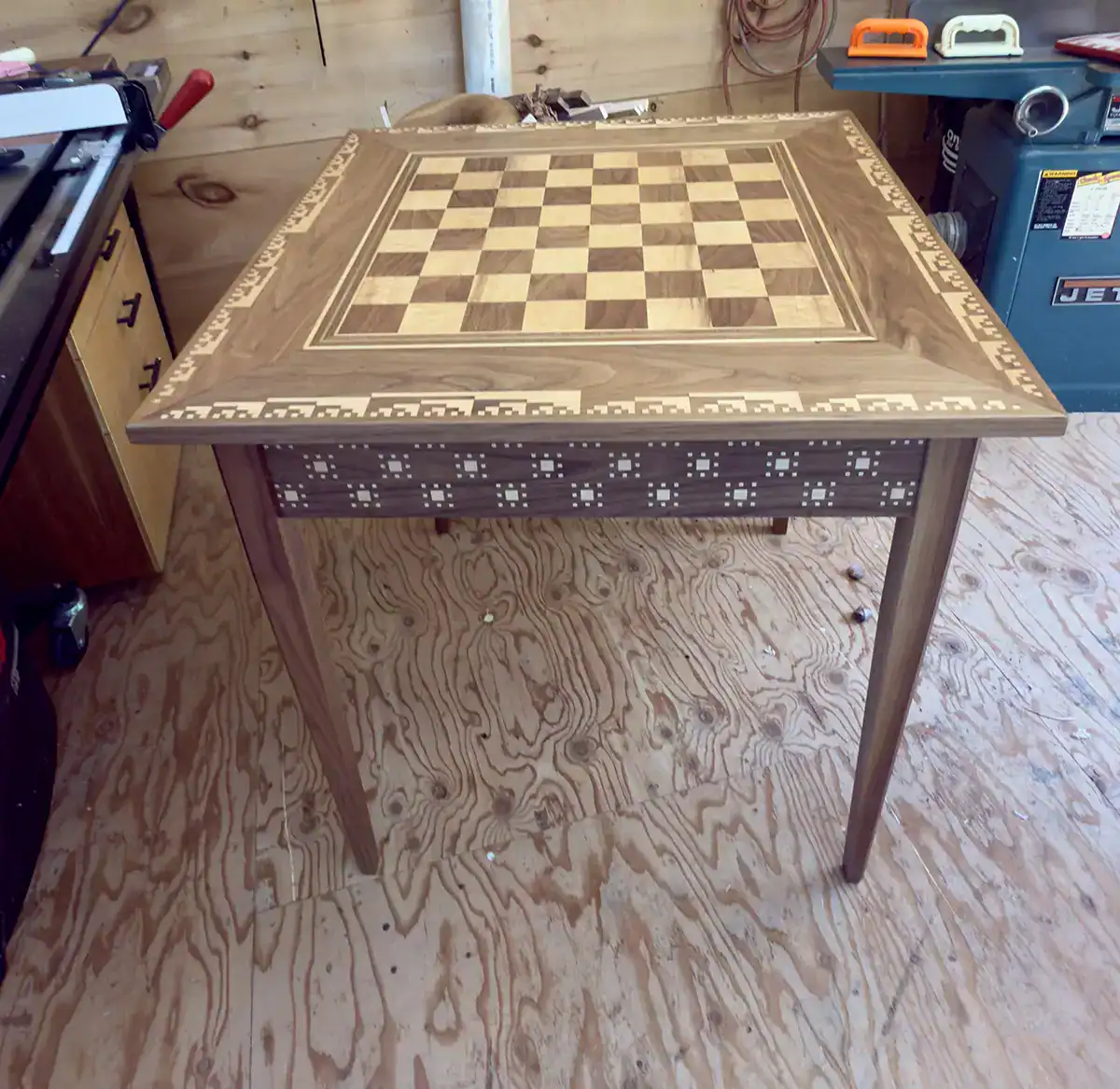
A recent furniture project is this games table made with a lighter black walnut and maple wood as the wood varies so much from tree to tree. I must consider this when choosing the wood. I need to integrate both color and grain patterns, density of line, and how they play with their neighbors. Marquetry comes into play for furniture pieces, integrating brass for finer lines as well. Here the maple is a wonderful grain, but you cannot reproduce each piece, as they are unique. Some trees grow by water, others in arid places. Each environment affects the tone and density of the wood. No two are alike.
Working with materials that are out of my control, with the wood as my collaborator, is interesting. I don’t decide how a piece finishes; the wood does, and that allows the magic to appear in the final stages. I have a 3D printer where I can conceptualize a piece there in the abstract, but with wood, the knots and color decide the final piece. Taking my abstract ideas into the physical world, the materials each decide the piece. Imperfection matters here; the places where you see knots and twists are much harder to work. You must pay for that beauty with effort, but you cannot replicate these knots. On the other hand, some maples are easy to work with, clear grain smooth, but they are not as interesting.
Have you ever taught? What advice would you give to a younger person starting out in a creative world?
I’ve done workshops, art projects, and talks in different places at MIT and Princeton. I’ve also taught high schoolers math, which I enjoyed.
There’s a moment when students realize math is genuinely hard, that it isn’t formulaic and can’t just be regurgitated. I enjoy that moment, the chance to help kids appreciate a subject even if they never excel at it, just to give them a real sense of its complexity.
As for advice: it’s about the blank page we are faced with at times. The creative block. So, make ten shitty things. If you don’t know what you want, if you’re convinced it won’t be good, or if you don’t know where to start, just make something terrible. Make it as bad as you can, then do it again. By the second or third attempt, you’re usually over the hump. The inertia of the creative act is powerful. The only way through it is to just make the work. Thomas Edison said that “genius is one percent inspiration and ninety nine percent perspiration.”
Finally, don’t let your ego hold you back, you do not have to be an Artist with a capital A to make things. Whatever you want to make, make it, whether it’s a mathematically inspired sculpture or something that makes no sense on paper. It doesn’t have to belong to a category. Listen to your gut, and don’t build work from inside a box, build it from what you’re passionate about. When I found Mathematica in high school, I just loved it, full stop. It still took years of sticking my neck out and getting it chopped off more than once before any of this worked.
Yes, you must go after inspiration with a club it seems. Is your work mostly commission based?
Almost all my work is commissioned. I also make many pieces I want to see in the world, usually furniture or objects, leaning more towards these wall hangings. I make furniture that is useful, but it also feels like art. Some would say it is craft, and it started as that centuries ago, but even that work was inspired by place or nature.
The studio will undergo a reboot as I am installing a much larger CNC machine. I’m curious to see how large some of these pieces can go once it’s in.
Kardasis draws his inspiration from the poetry of mathematics and from ancient, newly unearthed shells – cutting through them to reveal the intricate patterning hidden inside, then drawing that same patterning out of the wood grain. Two forms from nature, joined by a mathematical concept, let the purity of wood, line, and place collaborate – bringing a tree’s second life into the home, after decades of standing tall outside it. •
To see more of Kardasis’s work, dig a little deeper: Instagram: @arkadasis. Website: arikardasis.com. Email: ari@arikardasis.com.