
There are lines from songs … whisps of clever lyrics … that seem to rumble around in memory for years, only to be called forward at a moment’s notice. During a screening of “Pressure,” the classic lines from Simon and Garfunkel’s 1970 hit “The Only Living Boy in New York” shook off the cobwebs and took center stage. “I can gather all the news I need from the weather report.”
It would take a while to categorize all of the feature films, books, dramatic television series and documentaries that have been fashioned around the gross inhumanity of the Second World War. Whether it’s Quint’s “Jaws” monologue about the horrors of the shark attack on the USS Indianapolis torpedoed in the Pacific or Gary Oldman’s award-winning portrayal of Churchill rallying the English in “Darkest Hour,” the film legacy of the war continues. Bombing. Savage shark attacks. Flame throwers blasted into caves. Devastating air battles. Weather.
Weather?
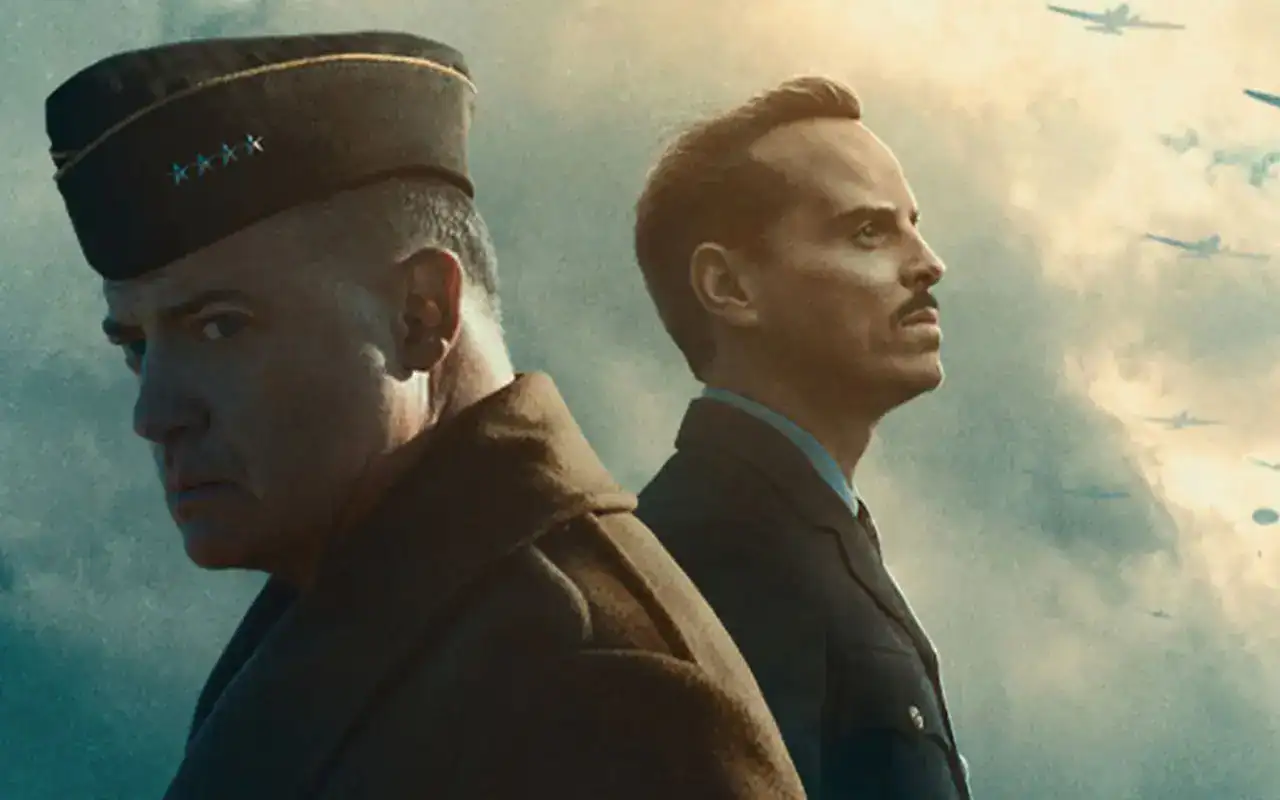
Anthony Maras, who directed and shares screenwriting credit with playwright David Haig has brilliantly opened a new, fresh chapter in the seemingly endless re-examination of the war. Although there is some colorized footage of the actual “D-Day” invasion when wave after wave of allied troops stormed the beaches of Normandy, the vast majority of the film is played out at Southwick House, the English country estate that served as Eisenhower’s headquarters leading up to the invasion – code named “Operation Overlord.” At the heart of the drama is the conflict between James Stagg (Andrew Scott), the Scottish meteorologist charged with predicting the weather for the invasion, his American counterpart, the arrogant, acerbic Irving Krick (Chris Messina) and General Dwight David Eisenhower (Brendan Fraser).
Without over-simplification, the projected invasion of the French beaches is the pivotal point of the war in Europe. Nazi Germany had overwhelmed country after country, sent millions to gas chamber filled concentration camps and threatened Russia in the east and Britain in the west. Eisenhower had commanded the successful efforts in North Africa, thanks, in part, to the metrological predictions of Krick, who based his forecasts on vast charts of historical data. Northern Europe was an entirely different matter, and under the direction of Dr. Stagg, predicting the winds, the wave heights, the cloud formations and the tides required a different discipline. High seas would make landing impossible. Too much cloud cover would make air support and parachute drops the same. And, there was a storm coming. Stagg was sure of it. Krick was convinced that clear skies were on tap.
The conflict between the principals is palpable, which makes the film so much more engaging. Damien Lewis excels as Field Marshal Montgomery who derides Stagg in favor of storming the beaches on the originally determined “D-Day,” June 5th. Kay Sommersby (Kerry Condon) extends her role as Eisenhower’s aid to attempt creating a bridge with Stagg, who in true Scottish form, keeps his emotions in check, even as his wife lies in labor at a bombed hospital, far beyond his reach.
As history reminds us, the 24 hour weather delay to June 6th made all the difference.
“Pressure” is about just that. Brilliant actors engaged in tightly scripted verbal conflict depicting the event that made the difference – that changed the course of history. What’s not to like?
While it might be perfectly acceptable to await the ultimate arrival of “Pressure” on a streaming service, seeing in on the expanse of a large screen allows us to see the texture, the character of the time and place and to be invited to truly experience … the pressure.