
Real Estate
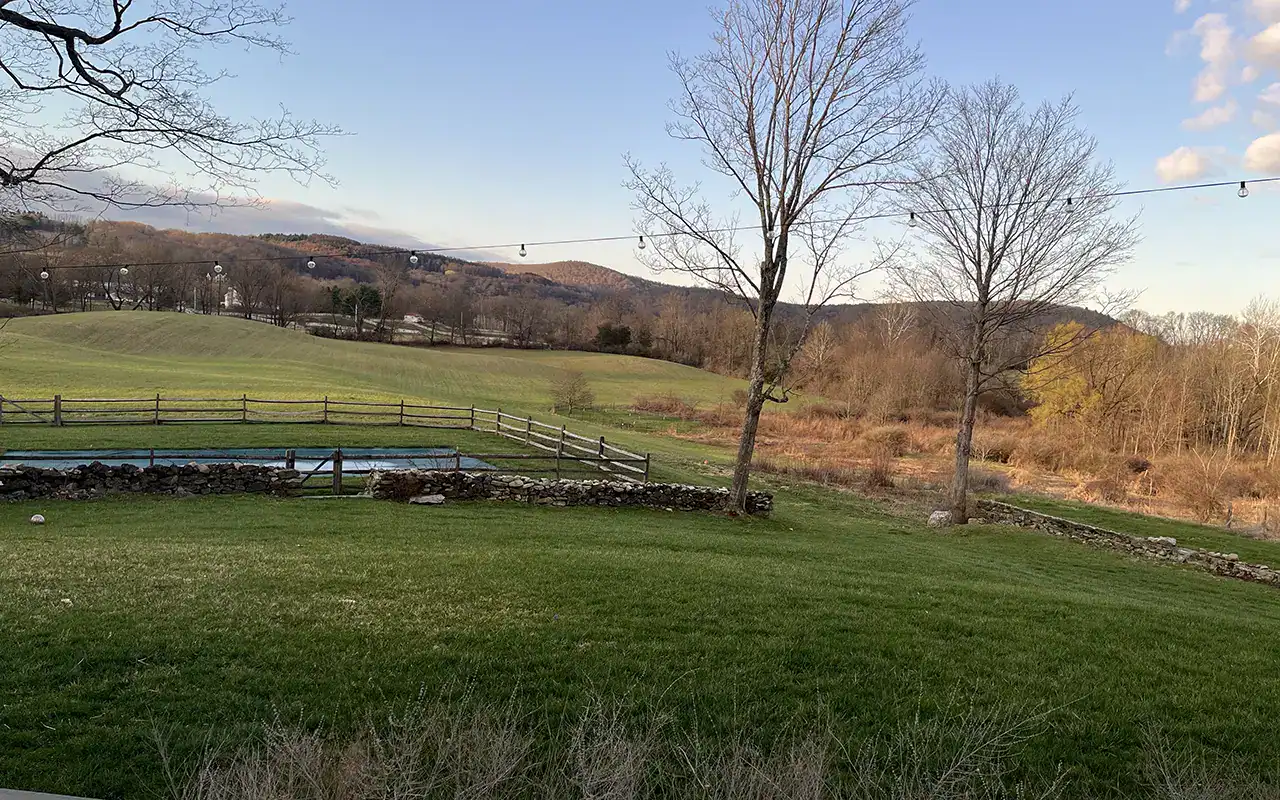
THE NEW GREEN PASTURES – AGRICULTURAL REAL ESTATE IN AMERICA AND THE TRI-STATE COUNTRYSIDE
Across the United States, agricultural land values have climbed to record highs, driven by forces that have little to do with corn prices, milk yields, or farming. And in the rural fields of Dutchess and Columbia Counties in New York, the Litchfield Hills in Connecticut, and the Berkshires in Massachusetts, the change is even greater.
Farm prices are increasing nationally
Ten years ago, a farm was a way of life for the family that owned the land. Today, it is also an asset class. According to the United States Department of Agrigulture National Agricultural Statistics Service, the combined value of all land and buildings on farms averaged $4,350 per acre in 2025, up 4.3% from 2024. This follows a 5% increase the year before, marking the fifth consecutive year of gains. To put that in perspective, in 2016, the national average stood at approximately $3,010 per acre – a gain of roughly 45% over nine years.
The last decade can be divided into two periods. From 2014 through 2020, values were relatively flat as the market was catching up after the commodity boom years of 2011–2013. Then came 2021 when commodity prices surged while COVID and remote work untethered buyers from office jobs in cities. Low interest rates made borrowing cheap. Suddenly, farmland, once the quiet cornerstone of the rural economy, became an investment, and dot.com millionaires and creatives moved to the country. Cropland values climbed fastest, reaching $5,830 per acre nationally in 2025, while pastureland values rose to $1,920 per acre.
The gains, however, are far from uniform. Farm real estate in the corn belt of Iowa, Illinois, and Indiana has remained among the nation’s most productive and commands values nearly twice the national average.
Iowa cropland, for instance, has long traded above $10,000 per acre in its most fertile counties. Mountain and Pacific states show dramatic extremes. Arid rangelands pull the averages down, but California’s vineyards and irrigated specialty crop land push prices to extraordinary heights; Pacific region cropland reached $9,830 per acre in 2025. Federal disaster assistance and ad-hoc subsidy programs have also provided a price floor in agricultural states, sustaining values even as commodity prices softened in 2024 and 2025.
The Northeast has been the most surprising, specifically New York, Connecticut, and Massachusetts, where farm real estate now commands some of the highest per-acre prices in the nation. The USDA reported that state-wide, Massachusetts recorded the highest average farm real estate values in the country in 2025, at $14,900 per acre. Connecticut came in close behind at $14,400 per acre. These are not Midwestern row-crop counties. These are small states where the definition of a “farm” increasingly includes horse barns, hay fields, or a heritage-breed livestock operation with a renovated farmhouse and a swimming pool. The forces driving national farmland prices upward include strong interest by institutional investors, including Warren Buffet, who notice that farmland has outperformed the S&P 500 over the long term on a risk-adjusted basis. In 2020, a new type of buyer, the urban immigrant, arrived on the scene seeking a pastoral life within two hours of a major city.
In the Oblong Valley and the Litchfield Hills, farms are becoming estates
Drive north from New York City along Route 22 in New York or Route 7 in Connecticut beyond the creeping exurban sprawl where farms offer pumpkin picking in October, fields are dotted with hay bales, and cows graze. The corridor of Dutchess and Columbia counties, Litchfield County, and Berkshire County, is still a patchwork of historic farmland that is two hours north of New York City and has become one of the most competitive rural land markets in the United States. As recently as 2010, much of this land traded quietly among farmers, conservationists, and weekend-home buyers. But the pandemic transformed what had been a steady creep of New York City weekenders into a full-scale land rush.
Dutchess County
Dutchess and Columbia Counties are the western border of this corridor for buyers driving north on the Taconic or traveling on the Metro-North train line to Wassaic. In 2016, a working 100-acre farm in Dutchess County might have traded for $800,000 to $1.2 million, perhaps $8,000 to $12,000 per acre. Today, the median price per acre for rural land listings in Dutchess County hovers around $17,000 to $20,000 per acre, with prime open parcels with views routinely asking and achieving $25,000 to $35,000 per acre or more.
Despite these high average results, prices and activity can vary enormously, year to year, and town to town. There is no average farm in size or price. An example is the Town of Washington, aka Millbrook, where over 2,000 acres of land classified as agricultural has been sold since 2018. Price per acre has varied from $35,312 in 2018 to $10,980 in 2024 with an eight-year average of $21,347.<
In the Town of Amenia, farmland reached a high in 2022 of $30,884 an acre with an average of $17,436 for the period. “We need to refocus on our land,” according to Mark Doyle of Amenia, “particularly because of the threat of subdivision and development on the Culver/Keane Stud land that is so famously part of the identity of Amenia,”
Listing prices for farm properties on the market keep rising. For example, 228 acres of vacant agricultural land on Skunks Misery Road in the Town of North East is asking $15,721 an acre, higher than the town’s $13,097 average over the last seven years.
Buyers in Dutchess County are not primarily farmers. They are entrepreneurs who may want to grow heirloom vegetables, keep horses, or build private estates. They are investors who see land as inflation protection. And increasingly, they are buyers from neighboring Westchester and Putnam counties, priced out of those already-expensive markets and moving north.
Columbia County
North of Dutchess County, Columbia County has undergone one of the Hudson Valley’s most dramatic reinventions. The city of Hudson, which was a depressed river town as recently as the 1990s, is now lined with design shops, farm-to-table restaurants, and art galleries, and its allure has pushed rural land prices across the county to new levels.
In 2016, large farm parcels in Columbia County with a 200-acre mix of open land, woods, and an old farmstead in a town like Ancram, Gallatin, or Hillsdale could be had for $5,000 to $8,000 per acre. Today, similar properties are trading at $10,000 to $18,000 per acre, and exceptional parcels with long views are well beyond that. One of the highest-priced properties in the four-county area is 2,150-acre Mill Farm in Ancramdale, currently listed for $80,000,000 or $37,192 an acre, which includes historic homes, cottages, and barn structures. (See Main Street’s November 2025 article.)
The county’s southern tier, bordering Dutchess, draws buyers from New York City, and its eastern fringe pulls buyers from Boston, Berkshire County, and the Litchfield Hills.
Conservation easements, which restrict development in exchange for tax benefits and appeal to conservation-minded buyers, have played an outsized role in Columbia County, especially in Ancram and Gallatin. The Columbia Land Conservancy has protected thousands of agricultural acres from development. Preserving farmland has driven higher prices for unprotected land like Mill Farm as the supply of developable or unrestricted farmland shrinks further with every easement. These conservation easements make farming possible according to Doyle. “There are different points of view for sure, but the key is that the productive resource is being preserved, and at the point that there is sufficient demand for the productive use of that land, farmers will most likely be able to lease it.”
Litchfield County
Litchfield County is Connecticut’s largest county by area and the least densely populated. It’s a rural landscape of rolling hills, horse farms, and historic hamlets, which has attracted wealthy second-home buyers for decades. The pandemic accelerated what was already a strong trend.
The USDA reported that Connecticut farm real estate values averaged $14,400 per acre statewide in 2025, among the highest in the nation. Within Litchfield County, the median price per acre for rural land listings runs around $26,000 to $40,000 for farmland specifically.
Between 2017 and 2022 alone, the USDA found that the average estimated market value of Litchfield County farm land and buildings rose 28%. Since 2022, further appreciation has continued. A 118-acre parcel in Salisbury with a four-acre pond and long ridgeline views recently listed at over $2 million. In the towns of Sharon, Salisbury, Kent, Cornwall, and Washington in the heart of the Litchfield Hills, this is not unusual, while land prices in more remote towns like Norfolk and Colebrook are much lower.
“I was fortunate to purchase my land before the crazy COVID inflation hit,” said Kelley Babbin, a third-generation farmer and owner and operator of Howling Flats Farm in North Canaan, CT, speaking to The Lakeville Journal. “These prices make it unattainable to purchase additional pasture or hay ground.”
Farming itself is under severe pressure as a consequence. “Connecticut is a densely populated state, and farmland is in high demand from both farmers and non-farmers,” the state’s Department of Agriculture has noted. Farmers who want to grow their operations find themselves competing against buyers for whom land is a lifestyle purchase, not a production input.
Berkshire County
The westernmost county in Massachusetts, Berkshire County is simultaneously one of New England’s great cultural destinations (summer theater, Mass MoCA, the Clark Art Institute) and a working rural landscape of hayfields, small dairy operations, and forests. In 2016, farmland here could be found for $6,000 to $10,000 per acre in most towns, with exceptional scenic parcels reaching higher. Today, the price of farm-specific property in Berkshire County averages closer to $15,000 to $25,000 per acre, one of the highest prices in the country for working agricultural properties according to the USDA.
The county’s tourism economy, which draws hundreds of thousands of visitors for summer music, dance, and theater, has directly inflated land prices. Buyers purchasing a farm with a restored barn and a meadow are not merely buying farmland; they are buying proximity to Tanglewood, to hiking trails, and to the sophisticated small-town life of Lenox or Stockbridge.
What comes next
Taken together, these four counties represent a microcosm of broader forces transforming American farm real estate. Nationally, analysts project modest continued growth of under 3% in 2026 as interest rates remain elevated and commodity prices soften.
In the Northeast corridor, supply constraints and persistent urban migration pressure suggest that prices will remain firm, even if the extraordinary acceleration of 2021–2023 is behind us.
For the working farmer, the picture is uncertain. The land they steward has never been worth more. But for the next generation hoping to buy in, the arithmetic is brutal – $20,000 per acre means a 100-acre farm costs $2 million before a tractor is purchased, a barn roof is replaced, or a seed planted. The question that will define farm real estate in this corner of the country over the next decade is not whether the land will be valuable, but who will be allowed to call it home.
Christine Bates is a registered real-estate agent in New York and Connecticut with William Pitt Sotheby’s. She has written about real estate and business since Main Street Magazine’s first issue in 2013.