
Real Estate
Two Railroad Villages: Millbrook and Millerton Today
First, an important explanation about villages. An incorporated village is a municipality within a town with its own government including a mayor and elected board. Villages collect taxes and have their own zoning regulations, administrative staff, and highway departments that function independently from the surrounding town. In New York unincorporated centers of population are designated as hamlets. Irondale in the Town of North East and Mabbetsville in the Town of Washington are both examples of hamlets. Dutchess County only has eight villages; most are along the Hudson River.
Founding days
The only two villages in Northeastern Dutchess County, Millbrook and Millerton, became incorporated villages for very different reasons. Surrounded by farms and iron mining, Millerton became a major rail hub in 1851 when three train lines, the New York & Harlem, Dutchess & Columbia, and Poughkeepsie & Eastern, converged in the center of town. Three hotels were built, retail shops lined Main Street, and Victorian homes appeared on the side streets. In 1875 Millerton officially became a village and by 1900 its population had reached 802, almost as many as today’s 883 residents.
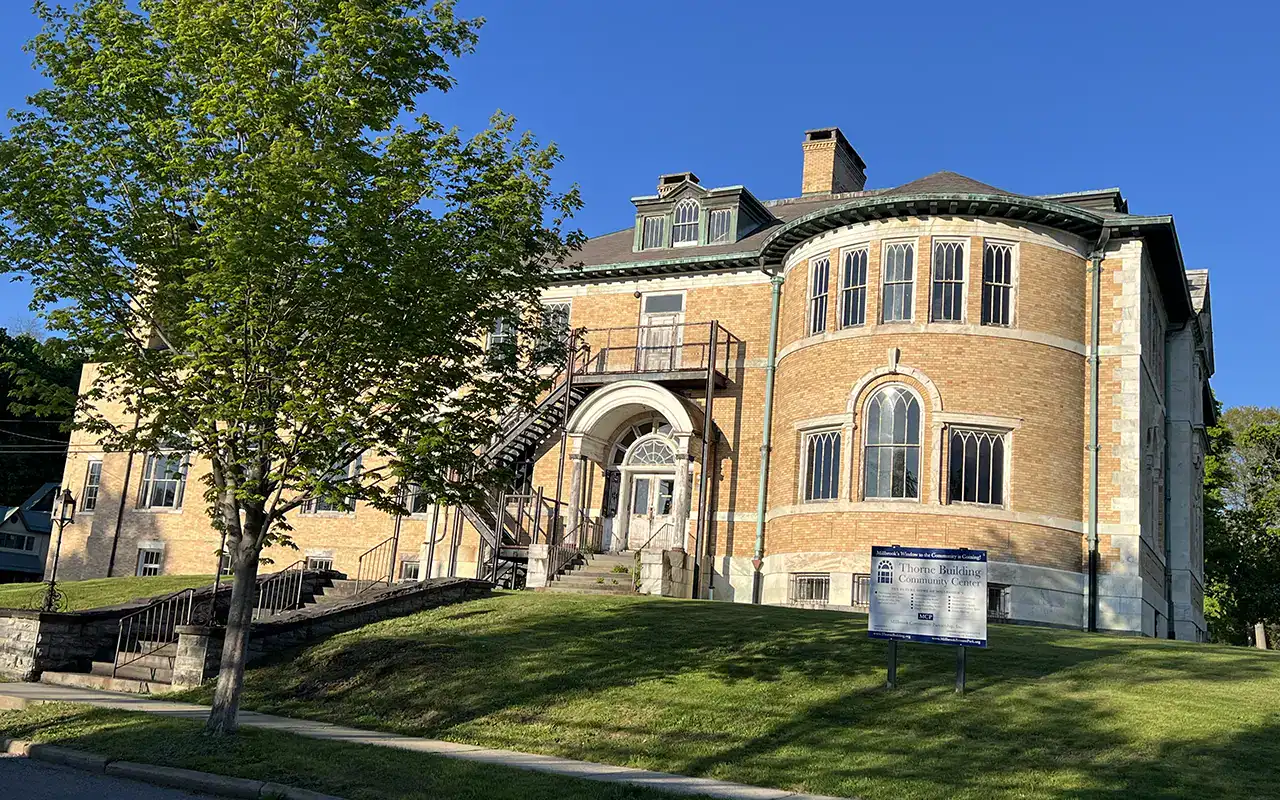
In contrast, Millbrook became more densely populated with the arrival of a single railroad line in 1869. Historically the area that is now the Village of Millbrook in the Town of Washington was bordered by huge estates of wealthy New Yorkers. It was the last village created in Dutchess County and only became incorporated in 1895 because the philanthropic Thorne family wished to officially donate the elegant school they built for the community. The distinction between entrepreneurial, commercial, scrappy Millerton and refined Millbrook continues today, a century and a half later.
Millbrook’s median household income has declined to $74,000
Demographic comparisons of the two villages today are surprising. Despite the perception of affluence, Millbrook’s median income of $74,000 is currently less that Millerton’s of $85,000. While Millbrook’s median income was significantly higher in 2017, Millerton has experienced upward growth while Millbrook has declined based on US Census Bureau data and recent projections. Millbrook is also significantly older than Millerton with a median age of 58 years compared with 36 years in Millerton. The number of families living in poverty is slightly higher in Millbrook, but both villages are above the Dutchess County average of 8.4%.
Millerton today
The liveliness of Millerton today, especially on weekends, can be attributed to the appeal of the Harlem Valley Rail Trail that runs through the village; The Moviehouse with first run studio films, independent and foreign films, and live digital broadcasts; Oblong Books; restaurants; and the Harney & Sons tea parlor.
Ed Stillman, a full-time village resident, attributes the commercial bustle and changing retail scene to “the factors that established the village almost 175 years ago – being at the literal crossroads of its surrounding communities. The evolution of those neighboring Connecticut towns is reflected in Millerton’s Main Street. Meanwhile, Millbrook feels more tucked away, which has its charm, but might make for a less dynamic village.”
Clearly the Millerton retail scene has gone upscale with new stores replacing the old standards. Dutchess Trading with its Farrow & Ball paints replaced Terni’s, and Westerlind, a purveyor of high-end European sportswear and gourmet food, reimagined Saperstein’s, Millerton’s former iconic landmark. Eddie Collins Field, Millerton’s village park, is undergoing a major makeover and the return of a public swimming pool. Funds are in place to build a sewer system in the center of the village. A lot has been happening. “Millerton has a way of reinventing itself to stay vibrant and relevant for its local community and visitors alike,” according to Debbie Middlebrook, a former village mayor, “which makes it an incredibly special place.”
Millerton home prices continue to rise
Millerton’s single-family home prices have traditionally been lower than those of Millbrook. Even in 2020 at the beginning of COVID, a buyer could find a village house for under $300,000. Sales first rose above the $300,000 threshold in 2023 and by 2025 reached $420,000 with limited supply and increased demand from remote workers who wanted a walkable, village life.
“I myself am shocked,” commented the village tax assessor Katherine Johnson. “Prices are unprecedented, nothing is for sale, and everything is listed at very high prices.” Houses on desirable Barton and Simmons Street have sold for over $500,000, an all-time record for the village. In 2025, only six houses were sold in the village and only two through April of this year. New home construction is limited by zoning requirements and the small 0.6 square miles of the village. They aren’t making any more building lots.
Millbrook today
Millbrook is a very different scene but also on the edge of change. The nonprofit Millbrook Community Partnership Inc. under the leadership of Oakley Thorne has created an expansive 32-acre gateway to the village replacing the derelict Bennett College, once a luxury hotel and then a school for young women. Plans are also underway to develop the long vacant, elegant former school in the center of the village, the reason for its creation, into a community center.
“Millbrook wears its wealth well,” according to Leila Hawken, who covers the Town of Washington and Village of Millbrook for The Millerton News. “The sense of community spirit is real in Millbrook.” Unlike in Millerton, generational wealth and commitment to community supports the village life.
Millbrook home prices rising
Millbrook, which has a 64% larger population and land area, typically has double the single-family home sales of Millerton. The composition of properties sold in the two villages is very different, with condos accounting for 25% to 30% of sales in any given year in Millbrook, lowering the reported median price point.
In Millbrook, sales of higher-end homes began to rise steeply in 2020, and by 2025 6 of the 13 homes sold closed over $500,000. The first $1,000,000+ home sold was 89 Maple Avenue in 2020 for $1,295,000. In 2025, two $1,000,000 sales were recorded and the overall median price reached $475,000. By May 2026, only three homes were listed for sale, including the renovated 42 Merritt Avenue for $1,295,000 and 3311 Franklin Avenue for $1,375,000 on 0.21 acres.
Both villages are changing while maintaining the distinct identities shaped by their histories. Millbrook continues to embody privilege anchored by impressive stone churches, a large library, parks, and the Millbrook Golf and Tennis, an exclusive 69-acre club. One longtime resident said he hasn’t seen any real change in the last 20 years, “It’s still old fashioned.”
If Millbrook is uptown, Millerton with its younger, more diverse population is a downtown village that is increasingly attracting creatives as residents and seeing increased demand for homes along its quiet, historic streets. •
Christine Bates is a registered real-estate agent in New York and Connecticut with William Pitt Sotheby’s. She has written about real estate and business since Main Street Magazine’s first issue in 2013.