Featured Artist
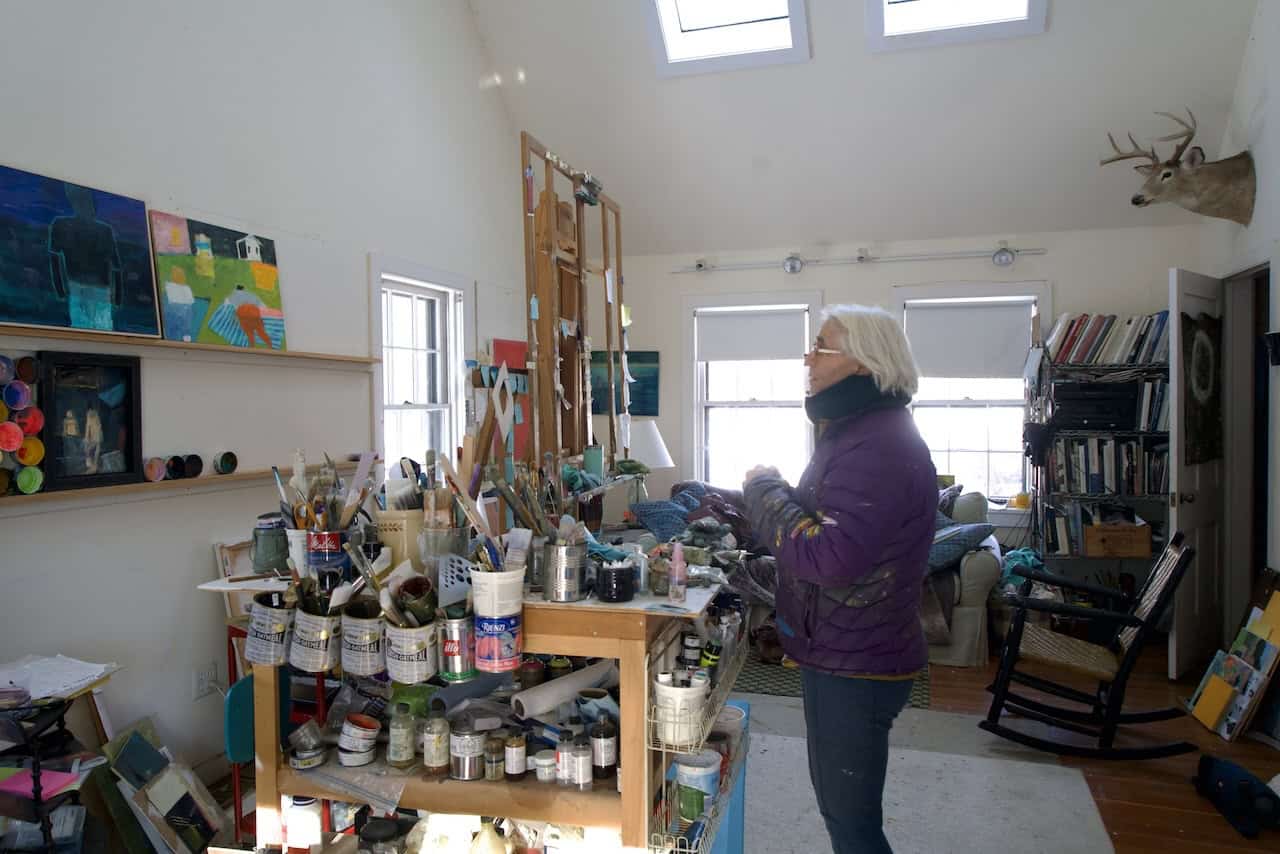
Watching — Susan Rand
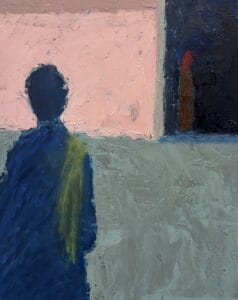
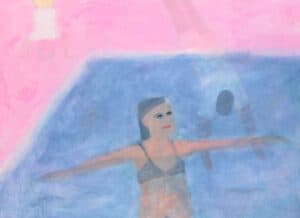
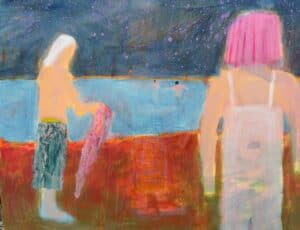
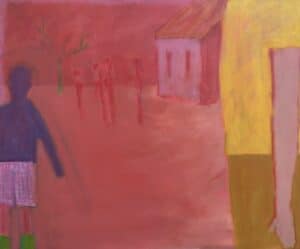
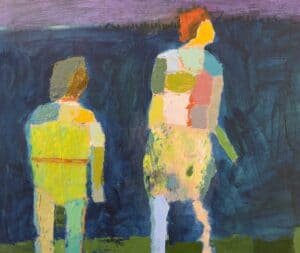
Figurative painter Susan Rand works within a visual language of quiet observation and pause. Her figures, often viewed from behind, invite the viewer to inhabit their vantage point and look outward through their eyes. A subtle hesitancy runs through the work, as though we momentarily step into another’s shoes. Her canvases glow with vibrant color, and a sense of joy radiates from the figures larking about in the water. At other moments, a gentle pensiveness emerges as we watch those who themselves are watching, creating a layered sense of curiosity that draws us into the unfolding narrative. We caught up for a studio visit after a snowstorm as we begin to settle into the winter season. Rand had just hung her latest show at Sweet Williams in Salisbury, CT.
So, what pulled you into painting?
Well, I’ve always been creative, but my visual journey really began with photography. In high school, I landed a January-term job shooting for a local newspaper, which was such a fun introduction to working behind the camera. Later, I studied fine art photography at Goddard College, where I really learned to push myself visually.
Was there a mentor or teacher who inspired you?
My group was very tight-knit, the critiques were strong, and my teachers pushed us in all the right ways. It was the cohesive group that inspired me. I slowly began drifting toward painting. I started shooting SX-70 Polaroid film and manipulating the images, scratching into them, then coloring over them with oil pastels. They felt like paintings, even though at the time, I knew little about drawing or color, just that I had an instinct for it.
Eventually, I was commissioned to create three paintings for a house that was under construction. However, when on site, I took one wrong step, fell backwards 12 feet, and severely injured my right arm. The healing was a slow process as my wrist needed to be rebuilt. I also worked in real estate because, as you know, it’s nearly impossible to live solely off your art; I’ve been involved in real estate for over 30 years. But I always painted alongside it. I needed painting for my sanity; so many artists have a ‘real job’ to support the work that feeds their soul.
When I was in the hospital, they gave me morphine, which I couldn’t stand, but through the fog I kept hearing this voice shouting in my head: Quit your job and go paint. Quit your job and go paint. After surgery and discharge, I couldn’t drive, and my arm was terribly painful. But eventually I started studying painting with Joan Griswold in Great Barrington. She ran an open studio every Friday afternoon. It was a wonderful group. I was determined to learn how to paint, but I quickly realized that painting is something you never finish learning.
I’m really interested in the narrative of what pulls you to make work, what art means to you, and what motivates your practice?
I often feel a strong emotion when I make art. I think that’s important, because the emotions that surface aren’t always pleasant. We’ve all had experiences that shape us, and those experiences, especially the difficult ones and the process of working through them, feed the work. The discipline of the practice is a huge motivator too: the daily act of showing up, picking up the brush, and being in the studio, even if all you do is read books. I thrive on the sense of purpose that comes from making work.
Many artists work in creative fields without fully realizing why they are drawn to them. People who have gone through something emotionally difficult often find a way to express it through their work, without ever having to talk about it directly. When I look at all the great artists, so many of the truly compelling ones have had arduous journeys. What the artist experiences isn’t always visible to the viewer, who doesn’t have the same emotional attachment to the narrative. But the energy of the emotion is in the making, and that does come through.
Yes, emotion is an essential component of my work. Sometimes I look at a piece and think, Wow, that’s dark. I’ll show it to a friend in the studio and say, “Don’t you think this is dark?” And they’ll say, “No, what are you talking about?” They don’t have the emotional attachment to it that I do. The energy of the emotion is in the making, even if viewers don’t consciously perceive it.
Do you photograph images and then work from those?
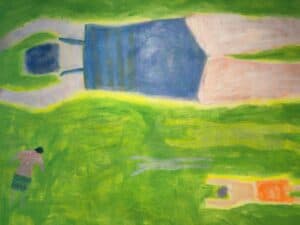
I spend time at the beach watching people’s interactions. I take so many pictures and often think, Ooh, I’d love to do a painting of that. For a while, I had a little pochade box I would bring to the beach. I don’t like to sit in the sun, and I get bored just lying there, so if we were going for a few hours, I’d bring my little box and paint landscapes right on the beach. I loved doing that. I was always so careful carrying everything back to the car.
Eventually, I decided to leave the paints at home. Instead, I started sketching quickly in pencil – loose figures, fleeting impressions – and later developed paintings from those sketches. That process is what ultimately led me into the swimmer series.
Yes, you had a show of the swimmer series at Standard Space. The motivation for that show came from those daily trips to the beach.
Exactly. When I started painting, I focused on getting the perspective and scale right, and I’m terrible at both; I’m not a good renderer. So, I finally decided to let go of that, forcing myself to loosen up, and now I’m much more forgiving of myself. We impose many constraints on our work. After my injury, when I had to write and paint with my other hand, I loved the freedom that gave me. My handwriting looked childlike, but the message felt adult. That looseness opened something up for me.
Yes, a different part of your brain is working when you’re doing that; it brings something else out. When I’m painting, I use both hands, and I switch the brush back and forth. Do you have a favorite time that you work?
I like to start my day off working because if I don’t, I might have a harder time getting into the studio later in the day. But that doesn’t always happen. There are times when I’ll come down and go for two hours, which can easily turn into five hours.

What brought you to this part of the world?
When I went to Goddard College, I met Curtis in the dark room as we both majored in photography. He grew up in this area. We became good friends. I used to visit Salisbury often, and I took summer jobs through college with him. The friendship morphed into marriage, and we are in our 50th year, living here in the house where Curtis grew up, and where we have raised our family.
What artists have inspired your journey?
Yes, so Milton Avery, Pierre Bonnard. I love Richard Diebenkorn, Peter Doig, Edward Hopper, Mark Rothko, and Katherine Bradford. I’m very inspired by her, and David Park is amazing. All these artists have excellent use of color and image making. It’s the color that often motivates me.
This fall, we went on a trip to Italy. We don’t travel much because we are both busy, and we have land here, which we love working on. However, knowing I wanted to sketch, I brought my iPad and drew with the Procreate app, which is terrific for travel. Curtis also had his own sketchbook and pencils. We had so much fun!
I’m currently working from those pieces. Using this platform feels like letting go completely. When you work with a more limited palette, you have less control over the colors. It’s such fun, a great tool. A good use of technology, though much digital production, including AI, consumes enormous energy. People often don’t realize that.
Yes, Hockney has created incredible bodies of work on the iPad. But we must be wary of over-reliance on digital tools. The world needs tangible things. NFTs, for example, remove that tangibility while consuming massive energy. Have you ever taught, and what advice would you give to an artist today?
I once helped run a printmaking studio in New Haven, before I had kids. I did many etchings and still have my etching press. My advice? That’s a tough one because who can afford to be an artist? No one’s ever been able to afford to be an artist; 80% of artists have other jobs. So, make sure you can support yourself, and don’t have high expectations for selling your work or making a living from it; you’ll get rejections. Rejections are all part of the game. Passion keeps you going.
Have you done residencies?
Yes, I’ve been to the Vermont studio center three times. I stayed at Tyrone Guthrie in Ireland, which was beautiful although the weather was wet and heavy. However, it was good to get away to focus on work. I had three kids, but a month away is a long time for me, and I get homesick. Isn’t that ridiculous? But now I feel like I don’t need a residency anywhere. I have this place; it is my private domain. Now you can do online workshops, which are great as well as in person. The NY Studio School was excellent, a grueling drawing program, but incredible.
Can you discuss the figures in your work?
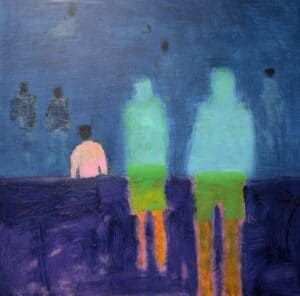
Well, they’re mysterious, and they are usually painted from the back, occasionally, from the front; the figure appears to be looking for or at something. One piece came from a photograph my daughter Lilly sent me; her son’s first day of camp. Here you arrive, and you don’t know any of those kids who are all together; you are outside the group, but must walk in. That sense of trepidation comes through the work. I had to figure out so much at a young age, and socially, I might have been shy, so that may come through.
You have recent work at Sweet Williams. Can you talk about that series and what inspired it?
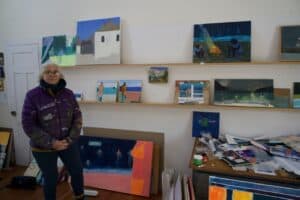
I installed 13 pieces of a body of figurative work I’ve been working on for the past few years. Most of the images were seeded by trips to the ocean and by observing daily interactions. Sweet Williams is an excellent local space, and with so many galleries closing, keeping it local feels important. In the current world, we’re in this place of flux; keep it local, keep it simple.
How was making work as a woman and a mother?
Actually, I used to photograph my children, and I ran a portrait photography business for a while. I knew I had limited time to work when they were little, so this was a good outlet for my creative life for a few years. Later, when they went to school, I returned to the studio to paint.
Historically, male artists received more recognition because they didn’t carry the domestic load. Women artists often put their careers on the back burner.
Yes, domesticity can kill creativity. There are more collaborative couples now, but the imbalance still exists.
I have other things that distract me from my art, which is healthy. We have land, as we live on an old dairy farm that my father-in-law ran. A couple of years ago, Curtis gave me my own tractor, so I could mow and manage the fields. There is a Zen to this task, the monotony, the light, the movement. The other day, I was mowing a huge phragmites patch and saw a massive bear rooting in the compost. I filmed it and watched it zoom across the field. It’s a whole different experience. Working with the land is essential to my practice.
Do drop by Sweet Williams for a delicious cake and a cuppa and take time to look closely at Rand’s work. You’ll see the brushwork, the palette-knife marks, and the layers of paint, each image capturing a moment suspended in time. Who, then, is doing the watching: the figures on the wall as they engage with one another or the artist herself? In these paintings, everyone is watching something. •
Susan Rand Show at Sweet Williams is donating 15% of sales to Corner Food Pantry, thecornerfoodpantry.org.
Sweet Williams is located at 17 Main St, Salisbury, CT. The show runs December 4 through February 27, 2026, visit sweet-williams.com. To see more of Susan Rand’s work please visit her website and gallery at susanrand.com. Follow her on Instagram, @susandrand. Email, susan@susanrand.com. Visit the Shamnoski Gallery at shamnoski.com.